
US and Venezuela Sign Deal to Reestablish Military Ties, Hegseth Announces
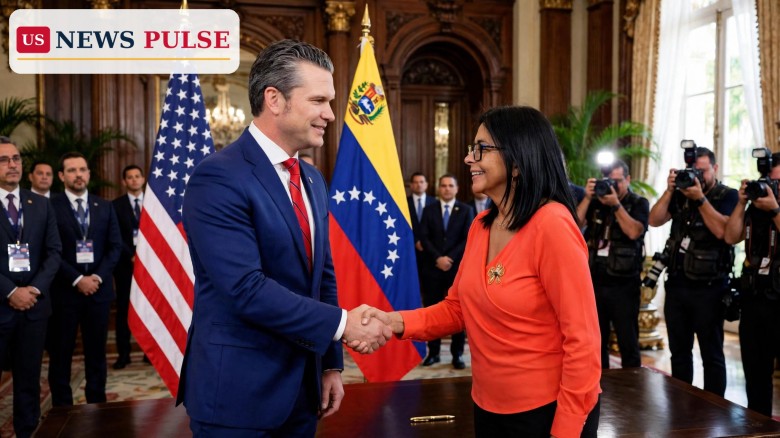
The United States and Venezuela have signed an agreement to reestablish military ties, Defence Secretary Pete Hegseth announced on Wednesday in Caracas, in the clearest sign yet that Washington's relationship with the interim government has moved from confrontation to formal partnership.
The deal covers training, intelligence sharing, strengthening Venezuela's military forces and border security, Hegseth said at the Miraflores presidential palace alongside interim President Delcy Rodriguez, in remarks broadcast by Venezuelan state television. It is the first signed US-Venezuela defence pact since American forces captured then-President Nicolas Maduro in January 2026.
Key Points
- The United States and Venezuela signed a deal on Wednesday, November 18, 2026, to reestablish military ties, covering training, intelligence sharing, stronger forces and border security.
- Defence Secretary Pete Hegseth announced the agreement in Caracas, alongside interim President Delcy Rodriguez, on Venezuelan state television.
- Hegseth called it a "reestablishment of our defense partnership" and said Venezuela has gone "from our most aggressive regional threat to a compliant security partner" since US forces captured Nicolas Maduro in January 2026.
- Rodriguez said the deal will strengthen training of the Bolivarian National Armed Force, improve its operational equipment and give access to new technologies to "face common threats".
- The Pentagon gave no further details; Hegseth was due in Colombia later on Wednesday, and the New York Times reported Washington is negotiating a status-of-forces agreement for US troops to stay long term.
What Happened
Hegseth's announcement came at the end of a visit the Pentagon had not publicly announced, the highest-level American visit to Venezuela since Maduro's ouster. Standing beside Rodriguez at the presidential palace, he said the two countries were restoring a defence relationship broken for years. "We spent some time talking about the long history of our countries, so in many ways we see this as a reestablishment of our defense partnership and the opportunity to work together between our two great militaries," he said.
Rodriguez hailed a "resumption of the technical-military relationship between both countries", saying US training would strengthen the Bolivarian National Armed Force, improve its equipment and open access to new technologies so the countries can "face common threats". Hegseth also praised "close cooperation" with Rodriguez, saying it had allowed officials "to stabilize Venezuela and rid it of narco-terrorists once and for all". No text of the agreement was released.
Background: From Maduro's Capture to a Defence Pact
The pact is the latest step in a rapid transformation. In January 2026, American forces raided Caracas at night, captured Maduro and flew him to New York to face drug-trafficking charges, which he denies. Rodriguez, a Maduro ally, took over as interim leader.
Since then, Washington has worked closely with her government, above all on energy. Trump said in August that Hegseth helped broker a sweeping deal for the United States to take control of some Venezuelan oil reserves, and the administration says it has returned more than $12 billion of Venezuelan oil revenue to the country. ExxonMobil signed a memorandum of understanding with the Venezuelan government and PDVSA, its first formal step back in nearly 20 years, and Trump has called Venezuela a US "new acquisition". General Francis Donovan, head of US Southern Command, has met interim authorities in Venezuela at least twice this year.
US Venezuela Military Deal: Training, Intelligence and Border Security
The four areas Hegseth named — training, intelligence sharing, strengthening military forces and border security — point to a partnership built around counter-narcotics and regional security rather than a large permanent US garrison, at least for now. Training is the most concrete element: Rodriguez framed the deal around the Bolivarian National Armed Force gaining instruction, better equipment and new technology, putting American advisers in direct contact with Venezuelan units. Intelligence sharing would extend cooperation around drug-smuggling routes in the Caribbean and the eastern Pacific, where American forces have been attacking boats the administration says are smuggling drugs. At least 240 people have been killed in the boat strikes since September 2025. The agreement's silence on numbers — no troop figures, no bases, no timeline — leaves the scale open.
Reactions and Quotes
Hegseth's language in Caracas was strikingly warm for a relationship that, less than a year ago, was defined by a military raid and a captured president. He said he looked forward to deepening the military partnership and working together to fight drug smuggling, framing the deal as a return to a long history rather than something entirely new.
The announcement also lands in the middle of an unsettled political picture inside Venezuela. Rodriguez's court-allowed term expired in July, but she continues to function as the country's head of state, and there is no date yet for the next presidential election. Opposition leader Maria Corina Machado recently returned to Venezuela from exile. Secretary of State Marco Rubio has said her "safe" return was the result of "reconciliation talks" supported by the United States. Many Venezuelans remain conflicted: while relieved that Maduro is no longer president, many believe the White House's decision to prioritise reviving Venezuela's oil industry over pro-democracy steps was the wrong approach.
Why It Matters
The deal matters because it formalises a relationship built so far case by case — an oil arrangement here, a Cabinet visit there, a quiet meeting with Southern Command — into a signed military partnership between the United States and a government Washington itself installed by force ten months ago. For the region, it signals that the Trump administration intends to keep Venezuela inside its security orbit rather than hand the country back to a purely civilian transition. A status-of-forces agreement, if it follows, would make the American military presence a long-term fact. Hegseth's unannounced visit to Caracas underscored how far and how fast that closeness has developed.
What Happens Next
Hegseth was due to visit Colombia later on Wednesday, a stop that will test how the region's governments react to a US-Venezuela defence pact that touches their own borders. The next milestone is the status-of-forces agreement the New York Times reported is under negotiation: if signed, it would confirm that the arrangement announced in Caracas is the start of a lasting American military footprint in Venezuela, not a one-off gesture.
Frequently Asked Questions
What did the US and Venezuela agree?
The two countries signed a deal to reestablish military ties, covering training, intelligence sharing, stronger forces and border security. Hegseth announced it in Caracas on Wednesday, November 18, 2026, alongside interim President Delcy Rodriguez.
What did Hegseth say about the deal?
Hegseth called it a "reestablishment of our defense partnership" and said Venezuela has gone "from our most aggressive regional threat to a compliant security partner" since US forces captured Nicolas Maduro in January 2026.
What did Rodriguez say?
Rodriguez called it a "resumption of the technical-military relationship" and said it would strengthen training of the Bolivarian National Armed Force, improve its operational equipment and give access to new technologies to "face common threats".
Will US troops stay in Venezuela long term?
Not settled. The New York Times reported Washington is negotiating a status-of-forces agreement that would let US troops remain in Venezuela long term, but the Pentagon has not confirmed it, and the deal gave no troop numbers or timeline.
© 2026 US News Pulse. All rights reserved.
 Print
 Save