
White House Seizes Reporters' Phones on Air Force One After China Departure
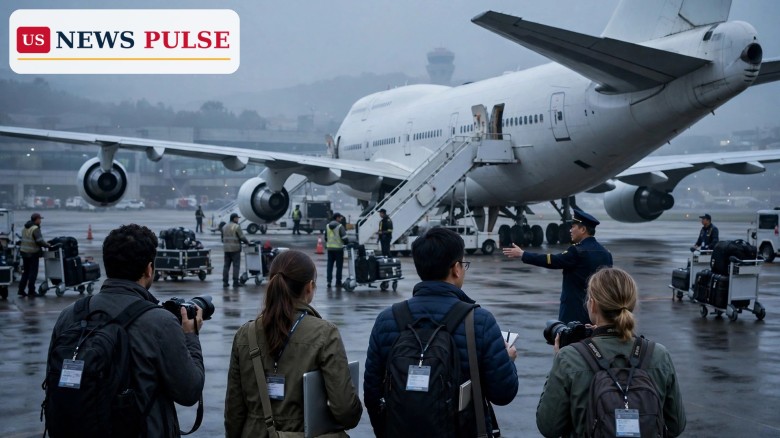
White House officials collected the mobile phones of journalists travelling with President Donald Trump aboard Air Force One shortly after the plane left Shenzhen, China, on Thursday, November 19, 2026, a rare security move that immediately set off speculation about where the aircraft was heading. The reporters' phones on Air Force One were taken without warning minutes after take-off, with no immediate explanation of the decision or of when the devices would be returned.
Key Points
- White House staff collected the mobile phones of the travelling press pool shortly after Air Force One departed Shenzhen, China, on Thursday, November 19, 2026.
- AFP White House correspondent Aurélia End wrote in a pool report at about 5:48 a.m. ET: "Our phones are being taken away for now for security reasons."
- Reporters were not told in advance and learned of the move only after taking their seats aboard the aircraft.
- NBC's Garrett Haake called the move "unusual"; Fox News correspondent Jacqui Heinrich noted phones were not collected when Trump left Beijing in May.
- Phones are normally taken only when the president visits a war zone, such as Iraq in 2018 and Afghanistan in 2019.
What Happened
Air Force One left Shenzhen at around 5:45 a.m. ET on Thursday, hours after the APEC leaders' meeting and the first-ever trilateral summit between Trump, Xi Jinping and Vladimir Putin. Within minutes, officials moved through the press cabin collecting the journalists' phones. End's pool note, filed at about 5:48 a.m. ET, was blunt: "Our phones are being taken away for now for security reasons."
The reporters had no advance warning. They learned of the collection only after taking their seats, with no word on who ordered it or when the phones would be handed back. The White House did not immediately respond to requests for comment.
The phone collection was not the only unusual step before departure. Staff also discarded Chinese-issued credentials, delegation pins and temporary phones near the aircraft stairs before boarding, reflecting surveillance concerns around presidential travel in China, and leaving the press without its usual tools just as the trip's biggest question — where Trump was going next — was unanswered.
Background: A Summit of Firsts in Shenzhen
Trump's Asia trip had already made history before the phones were taken. The APEC meeting in Shenzhen on November 18-19 ended with the first-ever trilateral summit between an American, a Chinese and a Russian president, and the three leaders issued a joint peace declaration, though the talks produced no breakthrough on Ukraine. Read our full report on Trump, Xi and Putin ending their first trilateral summit with a peace declaration.
Throughout the trip, Trump had repeatedly raised the possibility of meeting North Korean leader Kim Jong Un, although none had been announced when Air Force One left Shenzhen. That open question gave the seizure an extra charge: with the press cut off, speculation spread quickly that the aircraft might not be heading straight home.
It was not the first time Air Force One had been at the centre of a sensitive story. Earlier this year, Secretary of State Marco Rubio was reported to have briefed Trump on espionage concerns around Nvidia aboard the aircraft in May. Read more in Rubio briefed Trump on Huang spy concerns aboard Air Force One in May, source says.
Why Reporters' Phones on Air Force One Were Taken
The only explanation offered on board was security. End's pool note recorded the officials' phrase — "for security reasons" — and nothing more. In China, where foreign delegations assume their communications may be monitored, the precaution has an obvious logic: a phone carried through days of meetings in Shenzhen could be a surveillance risk.
But the timing made the move striking. The collection happened after take-off, not before boarding, and came without notice. Fox News correspondent Jacqui Heinrich, president of the White House Correspondents' Association, noted phones were not collected when Trump left Beijing in May — a comparison that undercut any suggestion this was standard practice for China trips.
Heinrich also raised questions about changes to flight restrictions over Alaska and whether Air Force One "may not be heading straight home". The White House has not confirmed the flight plan, and with the pool's phones in staff hands, independent confirmation of the route was, for a time, impossible.
Reactions and Quotes
Haake's one-word verdict — "unusual" — captured the mood in the press cabin, where correspondents recognised the break from routine. Phone collections are a known, if rare, feature of presidential travel, but they are associated with war-zone trips: reporters' phones were taken when Trump visited Iraq in 2018 and Afghanistan in 2019.
The White House Correspondents' Association, through Heinrich, would normally press the White House for an explanation of any restriction on the travelling press. As of the first reports, the White House had not answered questions about who ordered the seizure or how long it would last.
Why It Matters
The episode matters for two reasons. First, it touches on press freedom: the travelling pool exists so the public knows where the president is and what he is doing, and taking its phones removes that check at exactly the moment his movements are most in question. Second, it fed a genuine news mystery, with Trump having spent days publicly floating a meeting with Kim Jong Un.
There is also a security dimension that cuts the other way. If the White House feared the delegation's devices had been compromised in China, collecting them was a proportionate precaution. The question is why none of that was explained to the reporters affected.
What Happens Next
The first answers will come from the sky: where Air Force One lands, and when the pool's phones are returned, will settle whether the plane made an unscheduled stop. Flight-tracking data and the pool's reporting once devices are restored should confirm the route within hours of landing.
Trump is scheduled to hold a White House news conference at noon on Friday, where the phone seizure, the Shenzhen summit and the open question of a Kim Jong Un meeting are all likely to come up. Until then, the White House's silence leaves the episode unexplained. For the full story of the summit, see Trump, Xi and Putin open first-ever trilateral summit in Shenzhen, China.
Frequently Asked Questions
Why were reporters' phones taken on Air Force One?
White House officials said the phones were taken "for security reasons", according to the pool report by AFP correspondent Aurélia End. No further explanation has been given.
When did the phone seizure happen?
Shortly after Air Force One departed Shenzhen, China, on Thursday, November 19, 2026, at around 5:45 a.m. ET. End's pool note was filed at about 5:48 a.m. ET.
Is taking reporters' phones on Air Force One normal?
No. Phones are normally taken only for war-zone trips, such as Iraq in 2018 and Afghanistan in 2019. They were not collected when Trump left Beijing in May.
Has the White House explained the decision?
Not yet. The White House did not immediately respond to requests for comment, and it is unclear who ordered the seizure or when the phones will be returned.
© 2026 US News Pulse. All rights reserved.
 Print
 Save