

 | Today's Date:



Trump, Xi and Putin End First Trilateral Summit With Peace Declaration, No Breakthrough
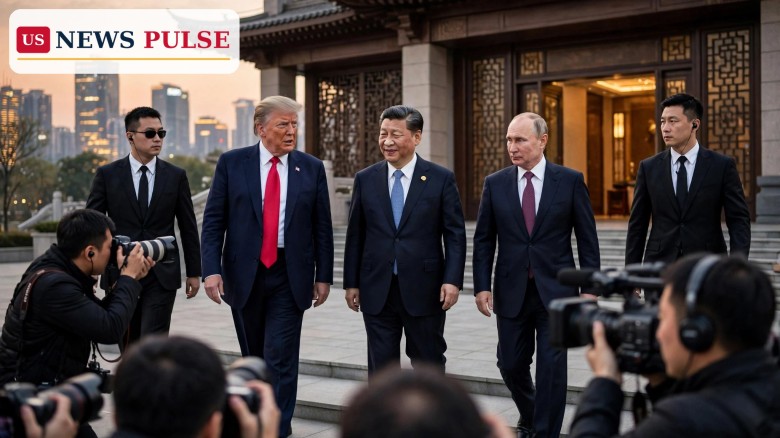
Donald Trump, Xi Jinping and Vladimir Putin closed the first-ever trilateral summit of the sitting leaders of the United States, China and Russia on Thursday, November 19, 2026, after about 90 minutes of closed-door talks in Shenzhen. The three leaders issued a joint statement they called a "peace declaration," pledging more talks on reducing nuclear risks, but no breakthrough on Ukraine, Iran or arms control.
The Kylin Villa meeting, held on the sidelines of the APEC summit, ended almost as quickly as it had begun. Trump left in his motorcade for Shenzhen airport, while the joint statement, the first communique ever issued by the three nuclear powers together, promised more dialogue but said little about the wars on the agenda.
Key Points
- Trump, Xi and Putin ended their first-ever trilateral meeting on Thursday, November 19, 2026, in Shenzhen, China, after about 90 minutes of closed-door talks at the Kylin Villa, CCTV reported.
- The leaders issued a joint statement, called a "peace declaration," pledging further talks on reducing nuclear risks and preventing proliferation, and committing to uphold strategic stability and international security.
- The talks produced no immediate breakthrough: the statement did not explicitly mention Ukraine, and it reported no settlement on Iran and no new arms-control treaty.
- In opening remarks, Xi said "a nuclear war cannot be won and must never be fought," Trump urged arms reduction, and Putin cited the three nations' joint responsibility for peace and security.
- Earlier, Trump held an hour-long bilateral with Xi, followed by a working lunch, and a 35- to 40-minute bilateral with Putin, his first talks with Putin since the Alaska summit. Ukraine dominated both, with no agreement announced.
What Happened
The three leaders sat down at the Kylin Villa for a session scheduled for about an hour that ran for roughly 90 minutes. Xi chaired the meeting, which opened with brief public remarks from each leader before the doors closed.
When the doors reopened, the outcome was modest but real: a joint statement pledging further talks on reducing nuclear risks and preventing nuclear proliferation. Kremlin aide Yuri Ushakov had said beforehand that intensive consultations on a draft joint statement were under way, and that if none emerged each leader would deliver their own assessment. The statement contained pledges to keep talking, not decisions. US News Pulse reported when the three leaders opened the summit earlier on Thursday.
Background: How the First Trilateral Came Together
The idea of a three-way meeting between the leaders of the United States, China and Russia has been discussed for years but never happened until now. The APEC summit in Shenzhen provided the occasion: all three leaders were already in the same city. US News Pulse reported when the trilateral meeting was confirmed.
The nuclear question gives the meeting its sharpest edge. The US-Russia New START treaty, the last agreement capping the arsenals of the two largest nuclear powers, expired in February 2026, leaving those arsenals uncapped for the first time in over half a century. China has been expanding its own arsenal and has never joined an arms-control treaty with the United States and Russia. Expectations were kept low: US officials had said a breakthrough was unlikely.
Trump Xi Putin Trilateral Summit Ends: What the Joint Statement Said
The joint statement was short, and its most important feature may be what it left out. On nuclear weapons, the three leaders pledged to talk further about reducing nuclear risks and preventing nuclear proliferation, committed to upholding strategic stability and international security.
On Iran, the statement mentioned plans to increase the production and supply of energy products disrupted by the Iran war. It reported no settlement, no ceasefire and no new diplomatic track. On Ukraine, the silence was complete: the statement did not explicitly mention the war at all, even though Ukraine had dominated Trump's bilateral with Putin earlier in the day. On trade and technology, the leaders' statement said nothing concrete; a separate APEC statement pledged data cooperation, with no concrete AI agreement.
Reactions
Trump framed the meeting as a responsibility that comes with nuclear power, saying the three largest nuclear powers "must safeguard world peace, stability" and must focus on arms reduction. He suggested he still believes a peace deal is possible, saying "things are happening," and before the talks began he embraced Putin and called him "my friend."
Xi framed the meeting as a matter of how great powers should deal with one another, saying healthy interaction between major countries is a must, and warning that "a nuclear war cannot be won and must never be fought." Putin kept his remarks short, saying the three nations have joint responsibility for peace and security, while committing Russia to nothing specific on Ukraine or Iran.
Why It Matters
The meeting matters first because it happened at all, and because it ended with a joint statement. The United States, China and Russia together hold the overwhelming majority of the world's nuclear weapons, and until Thursday their leaders had never met all three together. With New START expired, no treaty limits the nuclear competition between Washington and Moscow, and no framework includes Beijing.
It matters second because of what the statement did not do. The war in Ukraine has resisted every diplomatic effort so far, including Trump's Alaska summit with Putin, and the war with Iran has pulled the United States deeper into a conflict with no clear end. A meeting that ends without mentioning Ukraine shows how far the leaders are from agreement, even sitting in the same room.
What Happens Next
The immediate question is whether the pledged talks on nuclear risks actually happen. The statement promises further discussion, but it sets no date, no venue and no negotiators. Trump flew back to Washington immediately after the talks, and the APEC summit continues in Shenzhen without him. Neither war has a new diplomatic track coming out of Shenzhen.
Frequently Asked Questions
What happened at the Trump-Xi-Putin trilateral summit?
The first-ever meeting of the leaders of the United States, China and Russia ended in Shenzhen on Thursday, November 19, 2026, after about 90 minutes, with a joint "peace declaration" but no breakthrough on Ukraine or Iran.
What did the joint statement say?
The leaders pledged further talks on reducing nuclear risks and preventing proliferation, and committed to upholding strategic stability. The statement also mentioned energy-supply plans disrupted by the Iran war, but did not mention Ukraine.
Did the summit produce a deal on Ukraine or Iran?
No. The talks lasted 90 minutes and produced no immediate breakthroughs. Ukraine was not explicitly mentioned in the joint statement, and no settlement or ceasefire was announced for either war.
Where and when did the trilateral meeting take place?
At the Kylin Villa state guesthouse in Shenzhen, China, on Thursday, November 19, 2026, on the sidelines of the APEC summit, chaired by Xi Jinping. Trump left for the airport in his motorcade right after the talks.
What happened before the trilateral session?
Trump held a roughly hour-long bilateral with Xi, followed by a working lunch, and a 35- to 40-minute bilateral with Putin, his first talks with Putin since the Alaska summit. Ukraine dominated both meetings, with no agreement announced.

The US News Pulse newsroom covers breaking news across the United States and the world, working from wire services, official statements and on-the-record sources. Every story is reviewed against our editorial standards before publication. Corrections and tips: info@usnewspulse.com
About our newsroomLeave a Comment