
Four Back-to-Back Supermoons Begin With November's Beaver Moon on Nov. 24
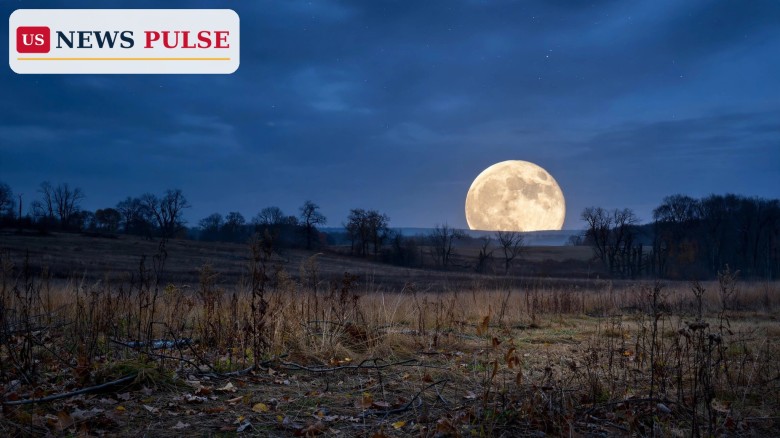
Four back-to-back supermoons will light up the night sky from late November 2026 through February 2027, starting with the full Beaver Moon on Tuesday, November 24, 2026. It reaches full phase at 9:53 a.m. EST, according to Space.com, making it the year's second supermoon and the first since January. The Cold Moon follows on December 23 — the closest full moon of 2026 — then the Wolf Moon on January 22, 2027, and the Snow Moon on February 20, 2027, according to NASA. Each one will be visible to the naked eye across the United States, weather permitting, with the best views near moonrise and moonset.
Key Points
- The full Beaver Moon reaches full phase at 9:53 a.m. EST on Tuesday, November 24, 2026 — the year's second supermoon and the first since January.
- The Cold Moon follows on December 23, peaking at 8:28 p.m. EST about 221,700 miles from Earth, the closest full moon of 2026.
- The Wolf Moon is full at 7:17 a.m. EST on January 22, 2027, and the Snow Moon closes the run at 6:23 p.m. EST on February 20, 2027.
- A supermoon is a full moon at or near perigee, the moon's closest point, and can appear up to 14 percent bigger and 30 percent brighter than a full moon at its farthest point.
- The Beaver Moon takes its name from the season when beaver traps were set before waterways froze, and when beavers reinforced their dams for winter, according to The Old Farmer's Almanac.
What Happened
The four-moon run was detailed on Sunday, November 22, 2026, drawing on data from NASA and Space.com. It is a run of four consecutive full moons that each fall close enough to perigee to count as supermoons. The opening act is the Beaver Moon, the first supermoon since January.
The Beaver Moon is full on the morning of Tuesday, November 24, at 9:53 a.m. EST. The Cold Moon peaks on the evening of Wednesday, December 23, at 8:28 p.m. EST, and at about 221,700 miles from Earth the closest full moon of the whole year. The Wolf Moon is full early on Friday, January 22, 2027, at 7:17 a.m. EST, and the Snow Moon closes the series on Saturday, February 20, 2027, at 6:23 p.m. EST.
Background: What Makes a Moon Super
A supermoon occurs when the moon is especially close to Earth while it is full. The moon's orbit is not a perfect circle, so its distance changes through the month. At perigee, its closest point, it sits noticeably nearer than at apogee, and a full moon near perigee looks bigger and brighter.
The term supermoon was coined in 1979 by astrologer Richard Nolle. It is the popular name for what astronomers call a perigean full moon — a full moon near or at the moon's closest point in its orbit — and NASA uses the same description.
Supermoons often arrive in runs: when the full moon lines up with perigee for several months in a row, each one qualifies. The effect is real but modest — up to 14 percent bigger and 30 percent brighter than a full moon at its farthest point — and easiest to notice when the moon is low.
How to Watch the Beaver Moon Supermoon
No special equipment is needed. The Beaver Moon supermoon will be visible to the naked eye from anywhere with a clear sky, and the best viewing will come near moonrise or moonset. That is when the moon illusion comes into play: the moon seems especially large near the horizon, framed by trees, hills or buildings.
NASA notes that the supermoon framed against colorful autumn landscapes can make for a particularly striking sight. Find a spot with a clear view to the east at moonrise or to the west at moonset, and give your eyes a few minutes to adjust to the dark. Binoculars will bring out the craters and dark plains known as maria, but they are optional.
Photographers should include something in the foreground — a tree line, a rooftop or a hill — because that is what makes the moon look huge in a picture. A tripod helps, and the moon is bright enough for a phone camera to catch it cleanly.
What NASA and the Almanac Say About the Supermoon
NASA describes a supermoon as a perigean full moon, and says the best views come near moonrise or moonset, when the moon illusion makes it appear especially large. The Old Farmer's Almanac explains the name: it refers to the season when beaver traps were set before waterways froze, and when beavers reinforced their dams and lodges for winter. The November full moon is also sometimes called the Frost Moon.
Why It Matters
A run of four supermoons in a row is a rare stretch of night-sky events that anyone can watch for free, with no ticket, no telescope and no travel. The December Cold Moon is the standout: the closest full moon of 2026, at about 221,700 miles from Earth, and the brightest of the four.
It is also a reminder of how much astronomy happens in plain sight: the moon is the one object everyone can watch together on the same night, and events like this turn a routine full moon into a shared moment.
What Happens Next
Next comes the Cold Moon on December 23, peaking at 8:28 p.m. EST as the closest full moon of 2026, then the Wolf Moon on January 22, 2027, and the Snow Moon on February 20, 2027.
Each moon will look full on the nights around its peak. Check the local forecast, pick a spot with a clear horizon, and look east at moonrise or west at moonset for the largest view. After February, the run ends, and the next supermoon will have to wait for the moon's orbit to line up with the full phase again.
Frequently Asked Questions
When is the Beaver Moon supermoon?
At 9:53 a.m. EST on Tuesday, November 24, 2026. It will look full on the nights of November 23 and 24.
How many supermoons are in this run?
Four: the Beaver Moon on November 24, 2026, the Cold Moon on December 23, 2026, the Wolf Moon on January 22, 2027, and the Snow Moon on February 20, 2027.
Which is the closest full moon of 2026?
The Cold Moon on December 23, 2026, which peaks at 8:28 p.m. EST about 221,700 miles from Earth.
Why is it called the Beaver Moon?
The Old Farmer's Almanac says it refers to the season when beaver traps were set before waterways froze, and when beavers reinforced their dams for winter.
What is a supermoon?
A supermoon is a full moon at or near perigee, the moon's closest point to Earth. It can appear up to 14 percent bigger and 30 percent brighter than a full moon at its farthest point.
Related coverage: BepiColombo Reaches Mercury Orbit After Eight-Year Journey, Claude AI Helped Prove the Riemann Hypothesis, Mathematician Claims and Wolbachia Mosquitoes Cut Dengue and Chikungunya by 69% in Brazil Study.
© 2026 US News Pulse. All rights reserved.
 Print
 Save