

 | Today's Date:





BepiColombo Reaches Mercury Orbit After Eight-Year Journey to the Innermost Planet
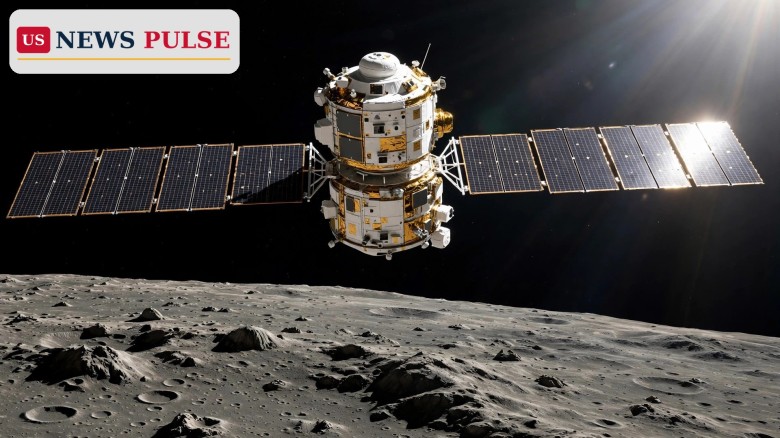
DARMSTADT, Germany. — BepiColombo entered orbit around Mercury on Saturday, Nov. 21, 2026, the European Space Agency announced, completing an eight-year journey since its launch on Oct. 20, 2018. It is only the second mission ever to orbit Mercury, after NASA's MESSENGER, and the first to circle the planet with two spacecraft at once.
Key Points
- BepiColombo entered orbit around Mercury on Sat Nov. 21, 2026, eight years after its launch on Oct. 20, 2018.
- Only the second mission ever to orbit Mercury, after NASA's MESSENGER (2011-2015), and the first with two spacecraft at once.
- Four thrusters fired to slow the spacecraft at Mercury's south pole, capturing it into an initial elliptical orbit of 590 by 11,640 kilometres.
- ESA's Mercury Planetary Orbiter and JAXA's Mio will separate on Dec. 9-10, 2026.
- Science operations begin in April 2027, with the science phase starting April 6, 2027; ESA holds a media briefing on the arrival on Fri Nov. 27.
What Happened
The decisive moment came as BepiColombo swept past Mercury's south pole. Four of the Mercury Planetary Orbiter's thrusters fired to slow the spacecraft stack enough for the planet's gravity to capture it, into an initial elliptical orbit stretching from 590 kilometres above the surface at its closest point to 11,640 kilometres at its farthest. ESA confirmed the arrival on Saturday, ending a voyage that began in October 2018.
The arrival was the payoff for months of careful preparation. In September, the mission's Mercury Transfer Module separated from the spacecraft stack, leaving the Mercury Planetary Orbiter to power the combined spacecraft on the final approach. On Sept. 24, the orbiter tested its axial thrusters for the first time in the new configuration, firing for 8 minutes and 42 seconds to deliver a precise push of 11.4 metres per second that kept BepiColombo on course. Days earlier, on Sept. 15, all of the orbiter's instruments had been switched on together for the first time since the separation, and the first checks showed them in good health.
Background and Context
BepiColombo is a joint mission led by the European Space Agency in close collaboration with the Japan Aerospace Exploration Agency, JAXA. It is named after Giuseppe "Bepi" Colombo, the Italian mathematician who worked out the gravity-assist technique that let earlier spacecraft reach Mercury. The mission travelled to the innermost planet using gravity-assist flybys past Earth, Venus and Mercury itself, shedding speed until it could fall into orbit around the Sun's closest and smallest planet.
Mercury is one of the least explored worlds in the Solar System, despite lying closest to the Sun. Only two NASA spacecraft have visited it: Mariner 10, which flew past three times in the 1970s, and MESSENGER, which orbited from 2011 to 2015. It is a world of extremes, with days hot enough to melt lead, yet water ice hides in polar craters that never see sunlight. It also has a magnetic field, which no other rocky planet besides Earth possesses.
BepiColombo Mercury Orbit: Two Orbiters, One Planet
What makes BepiColombo different is that two spacecraft will study Mercury at the same time, from two complementary vantage points. ESA's Mercury Planetary Orbiter will circle close to the surface, coming within 400 to 480 kilometres, to map the surface, probe the internal structure and trace the geological history. JAXA's Mercury Magnetospheric Orbiter, Mio, will swing much farther out, to about 11,000 kilometres, to study the magnetic field and how the solar wind interacts with it.
Working together, the pair can do science neither could do alone. When the Mercury Planetary Orbiter measures a change in the magnetic field close to the planet while Mio measures the solar wind far above it, scientists can tell whether the change came from inside Mercury or from space weather outside it. The orbiter's instruments are ready: its laser altimeter, BELA, fired its laser for the first time in space, emitting more than 700,000 pulses over 21.5 hours, while the MERTIS thermal spectrometer and the SIMBIO-SYS camera passed their first tests.
Reactions
ESA describes BepiColombo as "a world-class science mission led by the European Space Agency (ESA) in close collaboration with the Japan Aerospace Exploration Agency (JAXA)", . The mission control team at ESA's European Space Operations Centre in Darmstadt guided the spacecraft through the final approach, tracking it through deep-space antennas in Cebreros, Spain, and Malargüe, Argentina.
The arrival drew attention far beyond the control room. For scientists who have waited eight years since launch, the orbit insertion turns years of planning into a working observatory around a planet that has kept most of its secrets. ESA leads the surface and interior studies, while JAXA leads the magnetosphere work.
Why It Matters
Mercury is a puzzle that matters to the whole Solar System. It is far denser than it should be for its size, with an iron core that fills most of the planet, and scientists still argue over how it formed that way. One idea is that a giant impact stripped away much of its rocky outer layer early in its history; another is that the young Sun's heat vaporised the outer rock. BepiColombo's measurements should help settle the argument.
The mission also matters beyond our Solar System. Many rocky exoplanets orbit close to their suns, in conditions much like Mercury's, and Mercury is the only such world scientists can study up close. Its magnetic field, thin exosphere and polar water ice are clues to how small rocky worlds survive next to a star.
What Happens Next
The work is only beginning. The two orbiters will separate on Dec. 9-10, 2026, and the separation of Mio's sunshield and interface structure follows on Dec. 16. After that, the Mercury Planetary Orbiter will perform more engine burns to shrink its orbit toward its final science orbit by March 2027, and science operations begin in April 2027.
ESA will hold a media briefing on the arrival on Friday, Nov. 27. Once science begins, the mission is expected to operate for at least a year, mapping Mercury's surface and magnetic field from two places at once.
Frequently Asked Questions
When did BepiColombo arrive at Mercury?
BepiColombo entered orbit around Mercury on Saturday, Nov. 21, 2026, eight years after its launch on Oct. 20, 2018.
Is BepiColombo the first mission to orbit Mercury?
No. It is the second, after NASA's MESSENGER (2011-2015). BepiColombo is the first with two spacecraft at once.
What are the two BepiColombo spacecraft?
ESA's Mercury Planetary Orbiter, which studies the surface and interior from close in, and JAXA's Mio, which studies the magnetic field and solar wind from farther out.
When will BepiColombo start its science work?
The two orbiters separate on Dec. 9-10, 2026, the ESA orbiter reaches its final science orbit by March 2027, and science operations begin in April 2027.
Why is Mercury so hard to reach?
Mercury sits deep in the Sun's gravity well, so a spacecraft must shed a huge amount of speed to fall into orbit. BepiColombo used gravity-assist flybys past Earth, Venus and Mercury to slow down.
Related coverage: NASA Mars simulation crew emerges after 378 days inside Houston habitat and Antarctic ozone hole largest in a decade, NASA says, but recovery stays on track.

The US News Pulse newsroom covers breaking news across the United States and the world, working from wire services, official statements and on-the-record sources. Every story is reviewed against our editorial standards before publication. Corrections and tips: info@usnewspulse.com
About our newsroomLeave a Comment