
Chino Creek Flash Flood Kills Two in California Storm After Pair Swept Away
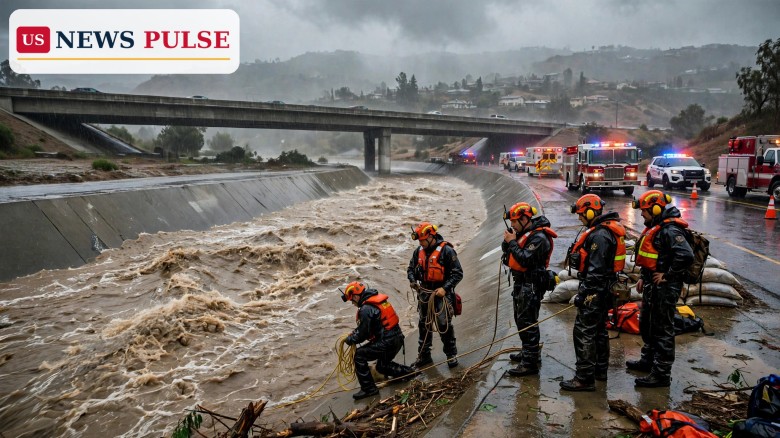
Two people are dead after being swept away by flash floodwaters in Chino Creek, California, during the season's first atmospheric river storm. The Chino Creek flash flood turned a flood-control channel into a deadly torrent in minutes, and a second body found on Friday showed the danger was greater than first thought.
A man was pulled alive from the water on Thursday morning. The woman with him could not reach the rescue line thrown to her and was carried downstream. When sheriff's search teams returned on Friday, they found her body — and a second man, never reported missing, also dead.
Key Points
- Two people were found dead in Chino Creek in Chino, California, after being swept away by flash floodwaters during the season's first atmospheric river storm.
- On Thursday, November 19, 2026, at about 10:39 a.m., a man and a woman were seen floating downstream in the San Antonio Wash, or Chino Creek, near Chino Avenue and State Highway 71.
- Chino Valley Fire swiftwater teams pulled the man out alive. The woman could not grab the rescue line and was swept downstream.
- On Friday afternoon, November 20, sheriff's dive and search teams found the missing woman dead — along with a second man, not previously reported missing, also dead in the creek.
- The San Bernardino County Coroner's Division is investigating both deaths; the storm dumped up to 5.54 inches of rain at Running Springs over two days.
What Happened
The first call for help came on Thursday morning, November 19, in heavy rain across the Inland Empire. At about 10:39 a.m., a man and a woman were seen floating downstream in the San Antonio Wash, the flood-control channel that runs through Chino as Chino Creek, near Chino Avenue and State Highway 71. The water was moving fast after hours of intense rain.
Chino Valley Fire swiftwater teams reached the scene quickly and worked from the banks. Rescuers pulled the man out and took him to hospital as a precaution. The woman could not grab the rescue line thrown to her, and the current carried her downstream, out of reach. The rescue turned into a search. On Friday, sheriff's dive and search teams found the missing woman deceased — and, in the same search, a second man, also dead, who had not been reported missing.
Background: The Season's First Atmospheric River
The deaths came during the season's first atmospheric river storm, a long plume of Pacific moisture that soaked Southern California over two days. The storm dumped up to 5.54 inches of rain at Running Springs, and rain fell at more than 2 inches per hour in parts of the Los Angeles area. Flood-control channels across the region filled quickly and ran dangerously fast.
California's flood-control washes look harmless in dry weather. They are wide concrete channels and sandy creek beds that sit empty for most of the year. When a major storm hits, water funnelled from streets and hillsides can arrive as a sudden wall, rising feet in minutes. The same storm brought flooding rain and heavy mountain snow across California, and the atmospheric river storm battered the state with flooding rain and feet of Sierra snow.
Chino Creek Flash Flood: The Rescue and the Search
The rescue showed both the speed of the Chino Valley Fire teams and the limits of what even trained rescuers can do in a flooded channel. Swiftwater crews work with ropes and throw bags, but a person in fast, debris-filled water has only seconds to grab a line. The woman in Chino Creek could not reach it, and the current took her beyond the point where rescuers could follow safely.
Sheriff's dive teams and search crews then worked the creek through Thursday and Friday. Finding the woman's body on Friday closed one part of the search but opened another: the second man had never been reported missing, and officials have not said who he was. The upstream Cucamonga Flood Control channel has claimed other lives in recent years, according to local reports. In the same storm, San Bernardino rescuers pulled a homeless man and woman from a wash on Thursday; that pair survived.
What Officials Said
Officials have released little detail so far. The San Bernardino County Coroner's Division is investigating the cause and manner of both deaths, and the victims had not been identified as of Friday. Officials said the pair may have been homeless. Local reporting noted the upstream Cucamonga channel has claimed other lives in recent years, and officials repeat every storm season that flood-control channels are not shelter.
Why It Matters
The Chino Creek deaths are a reminder that flash flooding is one of the deadliest weather hazards in the United States, killing most often in places that look safe. Flood-control washes move water, not people, and can fill in minutes when rain falls hard miles upstream. The deaths also point to a vulnerability that repeats every storm season: people without housing sometimes shelter in washes and underpasses, out of sight of warnings. Record flooding elsewhere this week, including the St. Johns River breaking a 73-year record in Florida, has shown the same pattern: water arriving faster and higher than people expect.
What Happens Next
The coroner's investigation is the immediate next step: officials will identify both victims, notify their families, and determine the official cause and manner of each death. Investigators will also try to establish when the second man entered the water and whether he was connected to the pair seen on Thursday. Residents are urged to stay out of flood-control channels and creek beds during and after storms, and never to drive or walk through flooded roads. With the atmospheric river season under way, more storms are expected in California.
Frequently Asked Questions
What happened in Chino Creek?
Two people were found dead in Chino Creek, Chino, California, after flash floodwaters swept them away in the season's first atmospheric river storm. A man and a woman were seen floating downstream on Thursday, November 19. The man was rescued alive; the woman was found dead on Friday, with a second man who had not been reported missing.
Who were the victims?
As of Friday, November 20, neither victim had been identified. Officials said the pair may have been homeless; the Coroner's Division is investigating both deaths.
How much rain fell in the storm?
Up to 5.54 inches at Running Springs in the San Bernardino Mountains over two days, with more than 2 inches per hour in parts of the Los Angeles area.
Why are flood-control channels so dangerous?
They carry storm water away quickly, so they can fill in minutes when heavy rain falls upstream. The water moves fast, carries debris and can rise feet in moments; the upstream Cucamonga channel has claimed other lives in recent years.
What should you do if you encounter floodwater?
Never walk or drive through flooded roads or channels — turn around and find another route. Six inches of fast-moving water can knock an adult down; a foot of water can float a car.
Related: two people died and hundreds were rescued in the Palm Bay, Florida flooding earlier this month.
© 2026 US News Pulse. All rights reserved.
 Print
 Save