
BepiColombo Suffers Thruster Glitch in Mercury Orbit as Burn Falls Short, ESA Says
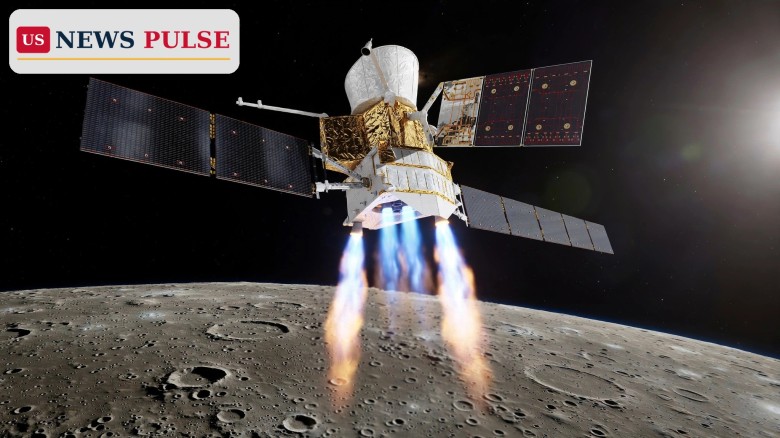
DARMSTADT, Germany. — BepiColombo reached orbit around Mercury on Saturday, Nov. 21, 2026, completing an eight-year journey to the innermost planet — but the European Space Agency revealed on Sunday that the historic arrival did not go entirely to plan. During the orbit-insertion manoeuvre, the spacecraft's thruster burn stopped shorter than intended after a software issue, leaving engineers at the European Space Operations Centre working to understand what happened to the ESA/JAXA mission.
Key Points
- BepiColombo entered orbit around Mercury on Sat Nov. 21, 2026, eight years after its launch on Oct. 20, 2018.
- ESA said on Sun Nov. 22 that "the thruster burn was shorter than planned following a software issue" during the orbit-insertion manoeuvre.
- The spacecraft is safe, ESA said, and teams at ESOC in Darmstadt are investigating, with updates promised for Monday, Nov. 23.
- BepiColombo is only the second mission ever to orbit Mercury, after NASA's MESSENGER (2011-2015), and the first to carry two spacecraft at once.
- ESA's Mercury Planetary Orbiter and JAXA's Mio are due to separate on Dec. 9-10, 2026, with routine science operations starting in April 2027.
What Happened
The decisive moment came as BepiColombo swept past Mercury's south pole. Four thrusters on the Mercury Planetary Orbiter fired to slow the stack enough for the planet's gravity to capture it, into an initial elliptical orbit from 590 kilometres at its closest point to 11,640 kilometres at its farthest. ESA confirmed the arrival on Saturday.
The celebration was tempered a day later. In a social media post on Sunday, ESA said the spacecraft had made a successful entry into orbit, but that during the manoeuvre "the thruster burn was shorter than planned following a software issue." The agency gave no further detail — not how much shorter the burn ran, nor whether the orbit differs from the one planners intended.
"The spacecraft is safe and teams at ESOC (the European Space Operations Centre) are working to understand what happened," ESA said, adding that "updates will be provided on Monday." The statement leaves open the key question: whether the short burn has any lasting effect, or whether engineers can correct it with a later firing.
Background: Eight Years to Mercury
BepiColombo launched on Oct. 20, 2018, aboard an Ariane 5 rocket, and spent eight years crossing the inner Solar System on flybys of Earth, Venus and Mercury to shed speed and fall towards the Sun. Mercury, only slightly larger than Earth's Moon, is the least explored of the four rocky planets.
The final approach was carefully rehearsed. In September, the Mercury Transfer Module separated, and on Sept. 24 the orbiter tested its axial thrusters, firing for 8 minutes and 42 seconds for a precise 11.4-metre-per-second push. BepiColombo's arrival at Mercury was confirmed by ESA on Saturday, Nov. 21.
Mercury is a world of extremes. Its diameter of 4,880 kilometres is less than 40 percent of Earth's, yet it sits about 60 percent closer to the Sun, so the Sun appears more than three times as large and seven times as luminous. NASA's MESSENGER orbited the planet from 2011 to 2015.
The BepiColombo Mercury Orbit Glitch
The glitch matters because the orbit-insertion burn was the single most critical manoeuvre of the eight-year cruise. Until that burn, BepiColombo was flying past Mercury on a trajectory that would have carried it back into space. A burn ending early delivers less braking than planned — and in the worst case, no capture at all.
That worst case did not happen. ESA confirmed orbit entry on Saturday and called it a "successful entry into orbit", so the burn still slowed the spacecraft enough for capture. The open question is the shape of the orbit, and whether a correction burn is needed. ESA has not said how far the actual orbit departs from the planned 590-by-11,640-kilometre ellipse.
Engineers at ESOC will work through the telemetry to pin down the fault — a timer or sequencing error, a sensor reading that triggered an early shutdown, or a command that did not execute as written. It matters because the same thrusters are needed again: the orbiter must reach its final science orbit by March 2027.
Reactions and Quotes
ESA's statements since the arrival have been brief and factual. On Sunday it said the spacecraft had entered orbit successfully, but that "the thruster burn was shorter than planned following a software issue." Its reassurance was equally direct: "The spacecraft is safe and teams at ESOC are working to understand what happened."
Why It Matters
BepiColombo is the most ambitious Mercury mission ever flown, and the first to carry two orbiters at once: ESA's Mercury Planetary Orbiter, flying as close as 400 to 480 kilometres above the surface to study its geology, structure and history, and JAXA's Mio, swinging out to about 11,000 kilometres to study the magnetic field and solar wind. Together they should answer why Mercury has a magnetic field, why water ice survives in polar craters, and what the "hollows" on its surface are.
The glitch is a reminder of how unforgiving deep-space flight remains: eight years near-flawless, then a fault at the last step, in the manoeuvre that mattered most. The riskiest moments cluster at the end, when a spacecraft must do something it has never done before, far from any help. The same lesson runs through other missions, including Voyager 1, which went silent for two days before answering on its own.
What Happens Next
The immediate next step is ESA's update on Monday, Nov. 23, which should give the first technical account of the software issue and the spacecraft's actual orbit. If a correction burn is needed, engineers can plan it once they know the offset. Separation is still due on Dec. 9-10, with no change signalled.
Beyond that, the schedule runs towards science: the orbiter reaches its final science orbit by March 2027, with the science phase beginning April 6, 2027. ESA holds a media briefing on Friday, Nov. 27. Like the Starship Flight 15 mission, which reached orbit even as its booster failed, BepiColombo is now a success with a fault to explain.
Frequently Asked Questions
Did BepiColombo reach Mercury orbit?
Yes. ESA confirmed on Sat Nov. 21, 2026 that BepiColombo had begun orbiting Mercury, only the second mission ever to do so. The glitch affected the burn's length, not the capture.
What caused the thruster glitch?
ESA has said only that the burn was shorter than planned "following a software issue." The cause is under investigation at the European Space Operations Centre, with updates promised for Monday, Nov. 23.
Is the spacecraft safe?
Yes. ESA said "the spacecraft is safe" and that engineers are working to understand what happened. No damage has been reported.
When will the two orbiters separate?
ESA's Mercury Planetary Orbiter and JAXA's Mio are due to separate on Dec. 9-10, 2026. ESA has announced no change to that date.
When does the science begin?
Routine science operations start in April 2027, with the science phase beginning on April 6, 2027. The orbiter should reach its final science orbit by March 2027.
© 2026 US News Pulse. All rights reserved.
 Print
 Save