
Iowa Lead Azide Detonation Succeeds as Army Blasts 68 Barrels in Middletown
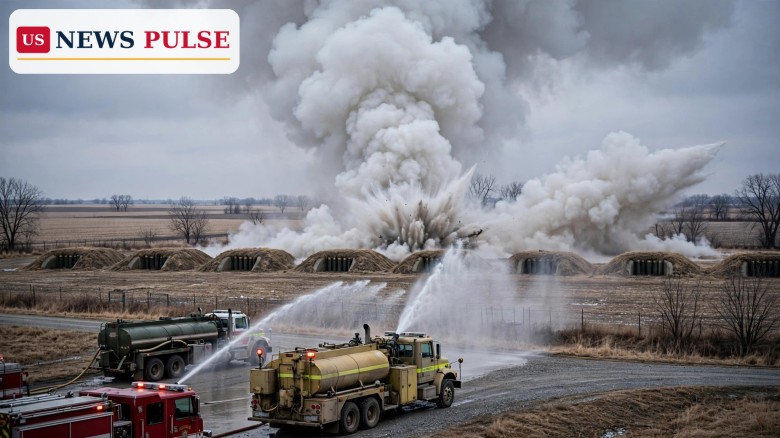
The United States Army detonated 68 barrels of unstable lead azide at the Iowa Army Ammunition Plant in Middletown, Iowa, on Wednesday morning, ending a five-day standoff over one of the country's most dangerous stockpiles. The blast, at about 9 a.m., sent a white-grey plume into the sky and was heard for miles, and the Army declared the Iowa lead azide detonation a success within hours. Early readings from the Environmental Protection Agency's air monitors showed no airborne lead, and officials said all of the barrels were destroyed.
Key Points
- The Army detonated 68 barrels of degraded lead azide, about 9,500 pounds, at about 9 a.m. CST on Wednesday, November 25, at the Iowa Army Ammunition Plant in Middletown.
- Acting Army Secretary Adam Telle called it a "huge success" and said the threat of an uncontrolled explosion is gone.
- The EPA said its real-time air monitors reported zero airborne lead one hour after the blast.
- Residents within 20 miles must shelter until the all-clear, with windows closed for 24 to 48 hours.
- About 350 farms in southeastern Iowa and northeastern Missouri could be affected.
What Happened
At about 9 a.m. CST, the Army set off the stockpile inside its earth-covered magazines. A loud boom rolled across the area and a white-grey cloud rose over the site, visible for miles. The blast ended five days of delays, a federal lawsuit and an intervention by President Donald Trump.
The Army ringed the magazines with a water wall, four 16,000-gallon water tanks, aqueous foam and earthen barriers to knock the dust down. Hourly plume maps showed the lead dust drifting southwest into northern Missouri. By early afternoon Middletown was quiet: no broken windows, no structural damage, no visible dust and no lingering smell, a Des Moines Register reporter found. Soldiers went door to door, and firefighters sprayed playground equipment at a local park.
Background and Context
The stockpile had sat at the plant since 2009, some of it for decades. Lead azide is a primary explosive, used in tiny amounts to set off larger charges, and dangerous because it explodes so easily. It had been kept stable in a bath of ethanol and water, but over 20 years the bath evaporated, the crystals dried out and recrystallised, and a March survey found the material too sensitive to move. Doing nothing, the Army said, risked a spontaneous, uncontrolled explosion.
The Army first planned the blast for Friday, November 20, and the EPA issued an emergency hazardous-waste permit on November 13. With only days of notice, residents, health experts and environmentalists protested. The Iowa Environmental Council and the Sierra Club sued and won a temporary stay, and the Army pushed the blast to Monday, November 23. Trump then told the Army to hold off unless the Eighth Circuit ruled in its favour — it did — and Telle set the detonation for Wednesday morning.
The plant has made ammunition, including secret nuclear weaponry, since the Second World War, and was the only Iowa property on the EPA's National Priorities List. A 20-year cleanup costing almost $140 million had only just finished in June. Wednesday's blast is expected to pollute the site again.
Iowa Lead Azide Detonation: What the First Readings Show
An hour after the blast, all of the EPA's real-time air monitors reported zero airborne lead, the agency said. Administrator Lee Zeldin told CNN he had received an initial report of a 0.0 reading, and said sampling of air, land, dust and water would be complete by the end of Thanksgiving Day.
Major General Eric Shirley called the operation "tremendously successful", said there was no infrastructure damage, and confirmed overhead coverage showed "all of the lead azide barrels were definitively removed".
Reactions and Quotes
Trump wrote on Truth Social that "early reports from Iowa are that the Army's mitigation efforts have far exceeded expectations." Telle called the blast a "huge success", writing that "the threat of an uncontrolled spontaneous detonation has been eliminated" and that "there are no readings so far above 0.0".
Governor-elect Rob Sand thanked those who "did all they could to make this detonation as safe as possible" but called the lead-up "chaotic and unclear", demanding "immediate transparency" and more testing before the impact can be called limited.
Senator-elect Josh Turek said the material "should never have been allowed to degrade to this point" and repeated his pledge of Senate investigations and hearings. Former congresswoman Marjorie Taylor Greene asked why the Army had not neutralised the material, saying "the real results won't truly be known for quite some time." The Army says crystallisation made the barrels too dangerous to open, and a contract with MuniRem Environmental to explore neutralisation was cancelled in May over safety concerns.
Why It Matters
The blast ends the immediate danger of a stockpile that could have exploded on its own, but it does not end the argument. Lead does not break down in soil, and what settles from Wednesday's plume will stay in the ground unless it is cleaned up. About 350 farms could be affected, and the first air readings are only the first readings.
The episode is also a test of how the military handles ageing explosives. The Middletown stockpile degraded for two decades until it was too dangerous to move, and the public learned of the plan only days before the first scheduled blast — a failure of communication now likely to be examined in Congress.
What Happens Next
Residents within 20 miles must shelter in place until the all-clear, with windows and doors closed for 24 to 48 hours. The EPA will keep monitoring air, land and water and deploy remediation if needed; Zeldin said the agency will be "on the ground as long as is necessary".
Longer term, Turek's Senate hearings will press the Army on how the stockpile degraded and why the public got so little notice, while state officials wait on test results showing how far the lead travelled — and whether the $140 million cleanup finished in June must be done again.
Frequently Asked Questions
When did the detonation happen?
The Army detonated 68 barrels of lead azide at about 9 a.m. CST on Wednesday, November 25, 2026, at the Iowa Army Ammunition Plant in Middletown.
Was any lead detected?
One hour after the blast, all of the EPA's real-time air monitors reported zero airborne lead. Soil, dust and water samples are still being tested.
Why detonate instead of moving it?
Stored since 2009, the stockpile had recrystallised after the ethanol and water bath keeping it stable evaporated. A March survey found it too sensitive to transport, so the Army destroyed it where it sat.
What should residents do now?
Residents within 20 miles should shelter until the all-clear, with windows and doors closed for 24 to 48 hours. Farmers in the plume area should test livestock and soil.
Will there be an investigation?
Senator-elect Josh Turek has promised Senate investigations and hearings into how the stockpile degraded and why the public got little notice.
Related: Army to detonate 68 barrels of lead azide in Iowa | Eighth Circuit clears Iowa lead azide detonation | Trump orders Army to halt Iowa lead azide detonation
© 2026 US News Pulse. All rights reserved.
 Print
 Save