
DOJ Clears Police to Track Drones and Read Pilots' Remote ID Without a Wiretap
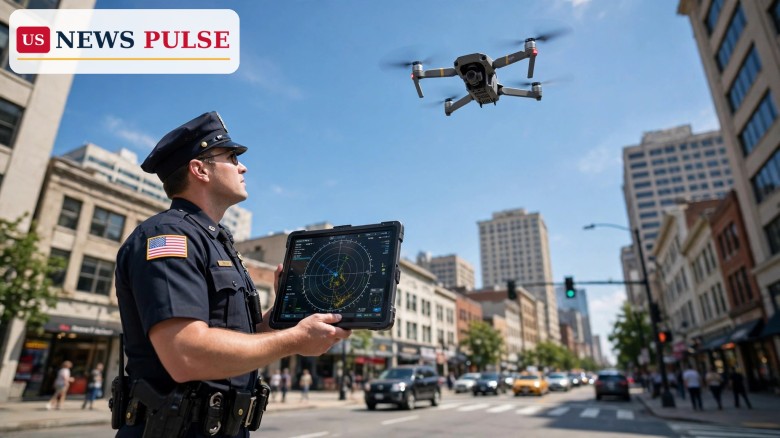
The Justice Department has told police across the United States that they can track drones and read the location of the people flying them without first getting a wiretap order, settling one of the most contested questions in US drone law. In a 55-page opinion dated November 24, released November 25, the department's Office of Legal Counsel concluded that intercepting the FAA-required Remote ID broadcasts — which carry a drone's serial number, position, speed and the location of its pilot — does not violate the federal Wiretap Act or the Pen-Trap Statute, because the signals are designed to be read by anyone.
Key Points
- The Justice Department's Office of Legal Counsel says police may generally use drone-detection systems without violating the Pen-Trap Statute or the Wiretap Act.
- Intercepting FAA-required Remote ID broadcasts is lawful without a wiretap order because they are unencrypted and follow the ASTM F3411 standard.
- Acoustic sensors, electro-optical and infrared cameras, radar and radiofrequency detection generally violate neither law, the 55-page opinion says.
- Intercepting DJI's OcuSync and Lightbridge control and video links may violate the Wiretap Act, because they show "indicia of intended privacy".
- Agencies may deploy detection systems without relying on the federal counter-drone statutes, the opinion says, citing a 2022 D.C. Circuit ruling.
What Happened
The opinion, signed by Assistant Attorney General T. Elliot Gaiser, who leads the Office of Legal Counsel, answers a question that has hung over American law enforcement for years: when does watching a drone become wiretapping? Agencies at every level have bought detection equipment to guard airports, stadiums and prisons, but many held back from switching it on, unsure whether the signals counted as intercepted communications under laws written before consumer drones existed.
The opinion draws a clear line. Acoustic sensors, electro-optical and infrared cameras and radar generally violate neither the Pen-Trap Statute nor the Wiretap Act, because they capture no communications metadata or protected content. Radiofrequency detection is also generally lawful. The centrepiece is Remote ID: the broadcasts carry the drone's serial number, position, velocity, emergency status and control-station location, and because they are sent in the clear, no wiretap order is needed.
Background and Context
The Remote ID rule was the FAA's answer to a practical problem: as millions of drones took to American skies, nobody on the ground could tell who was flying one, or from where. The rule requires most drones in US airspace to broadcast identification and location information that any suitably equipped receiver can pick up. Compliance has been required since 2023.
Even so, the legal status of listening to those broadcasts was unsettled. The Wiretap Act bars intercepting electronic communications, and the Pen-Trap Statute restricts collecting dialling and routing information. Police worried a detection system might count as an interception device, exposing officers to civil and criminal liability — a worry sharpened by the recent FBI hunt for three men accused of flying a drone over restricted airspace at Reagan National Airport.
Drone Remote ID: What Police Can Now Read Without a Warrant
Under the opinion, police with a Remote ID receiver can lawfully learn a great deal about a drone overhead without a court order: its serial number, where it is, how fast it is moving, whether it has declared an emergency, and — crucially — where its pilot is standing. That last data point is what makes the opinion powerful: a drone over a stadium or an airport can now be traced to its operator in real time.
The permission is general, not unlimited. The same reasoning does not extend to the proprietary links connecting a drone to its controller. DJI's OcuSync and Lightbridge systems, which carry control commands and live video, show what the opinion calls "indicia of intended privacy", so intercepting them may violate the Wiretap Act — decided case by case, leaving the most popular consumer drone brand in a legal grey area.
Reactions and Quotes
The opinion itself supplies the clearest language for the new boundary. On Remote ID, its reasoning is that the broadcasts are "designed to be publicly accessible", with no encryption and published signal parameters, so reading them is not an interception under the Wiretap Act. On the proprietary links, by contrast, it finds "indicia of intended privacy" — signs the manufacturer and pilot meant the communications to stay private.
The opinion also leans on a 2022 ruling by the US Court of Appeals for the D.C. Circuit, Brennan v. Dickson, which held that drone pilots generally lack a reasonable expectation of privacy in their drone's location during flight. The sky above a public event, in short, is not a private space.
Why It Matters
The opinion matters because it removes the legal fog that has kept many police departments from using drone-detection tools they already own. Airports, stadiums, prisons and power plants have all faced drone incursions, and the first question is always the same: whose drone is that? Remote ID was built to answer it, but only a legal green light makes the answer usable in court.
It also matters for the millions of Americans who fly drones for fun, photography or work. The opinion confirms that whenever their aircraft is in the air, its identity and location are effectively public information. At the same time, it protects the most sensitive part of flying — the live video feed and control link — which keeps the Wiretap Act's protections in play.
What Happens Next
Police departments and sheriffs' offices are expected to move quickly to switch on detection systems that have sat idle or been used only sparingly. Expect more airports, stadiums and event venues to deploy Remote ID receivers and radar trackers, with the first court tests likely to come from DJI owners.
Congress may also weigh in. Lawmakers have debated for years whether to widen federal counter-drone powers to state and local police, and this opinion changes that debate: detection, at least, no longer needs new legislation. What remains unresolved is what police may do once they find a threatening drone — jamming, disabling or seizing it — which the opinion does not address.
Frequently Asked Questions
Can police track my drone without a warrant now?
Yes, for detection: police may read Remote ID broadcasts without a wiretap order — they are unencrypted and designed to be public.
What information does Remote ID broadcast?
The drone's serial number, position, velocity, emergency status and control-station location, in the ASTM F3411 format.
Does the opinion let police watch my drone's camera feed?
No: intercepting proprietary links such as DJI's OcuSync and Lightbridge may violate the Wiretap Act.
Who signed the opinion, and when?
Assistant Attorney General T. Elliot Gaiser, who leads the Office of Legal Counsel. Dated November 24, 2026, it was released on November 25.
Does this let police shoot down or jam drones?
No: the opinion covers detection only. Taking down a drone still requires specific statutory authority, which most state and local agencies do not have.
Related coverage: FBI hunts three men who flew a drone in restricted airspace at Reagan National; Nvidia AI chips let Russian drones pick targets on their own, NYT finds; Trump slams Cornyn over Gaiser Texas block, saying 'feelings were hurt'.
© 2026 US News Pulse. All rights reserved.
 Print
 Save