


 | Today's Date:


Zipline Raises $1.5 Billion at $21.5 Billion Valuation to Build US Drone Delivery Network
Zipline, the American drone delivery startup, said on Thursday, November 5, 2026, that it has raised $1.5 billion in new funding, valuing the company at $21.5 billion and nearly tripling its worth in about 10 months. The Zipline drone delivery company plans to use the money to expand US manufacturing, hire more workers and build a nationwide network reaching millions of American homes.
Key Points
- Zipline raised $1.5 billion in its latest funding round, announced on Thursday, November 5, 2026, at a post-money valuation of $21.5 billion.
- The valuation is nearly three times the $7.6 billion Zipline was worth after raising $600 million earlier in 2026.
- The round was led by Paradigm, WCM Investment Management and Layer Global, with Uber, Tiger Global, J.P. Morgan, Fidelity, Valor Equity Partners, ARK Invest and Salesforce Ventures taking part.
- Walmart and Zipline plan to launch 300 additional delivery sites under a new multiyear national agreement.
- Uber is targeting one million deliveries a day with Zipline by 2029, as competition in drone delivery intensifies across the United States.
What Happened
Zipline announced the funding on Thursday, saying the round was led by Paradigm, WCM Investment Management and Layer Global. The participants include Uber, Tiger Global, J.P. Morgan, Fidelity, Valor Equity Partners, ARK Invest and Salesforce Ventures. The company did not disclose how much each investor contributed.
The $21.5 billion post-money valuation marks a sharp rise from the $7.6 billion Zipline was valued at after raising $600 million earlier this year. Investors are now willing to pay almost three times as much for a stake in the company as they were roughly 10 months ago, a rare jump when many startups have struggled to raise money at higher valuations.
Zipline said the new funding will go toward expanding its manufacturing capacity in the United States, hiring more workers and developing a nationwide drone delivery network. Its ambitions in the US market are now the centrepiece of its growth plan, with two of America's biggest consumer companies, Walmart and Uber, signed up as partners.
Background and Context
Zipline was founded in 2016 and first made its name delivering blood and medical supplies by drone in Rwanda, where its fixed-wing aircraft could reach remote clinics far faster than road transport. That work established the company's reputation for reliable autonomous flight, and it has since expanded into retail and restaurant deliveries in the United States and other markets.
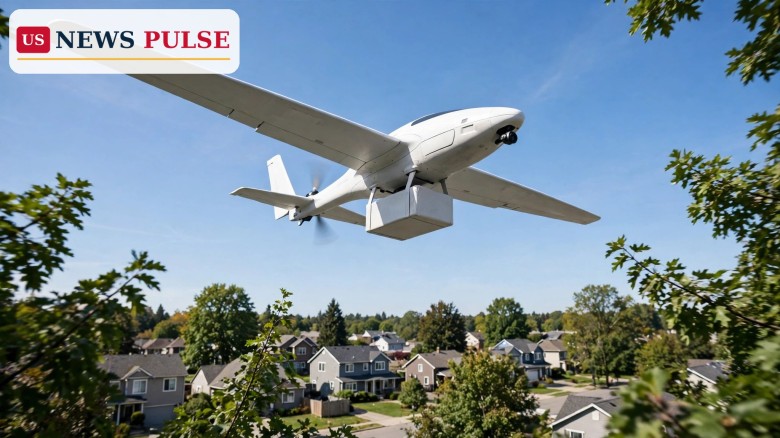
The company builds long-range fixed-wing drones that take off vertically, cruise to a delivery point and lower packages by parachute or tether, rather than landing in a customer's garden. Zipline says the design makes deliveries faster and cheaper than road-based couriers for many small, urgent orders, while cutting the risks of human delivery, including delays caused by weather or road accidents.
Drone delivery has been promised for years, but only recently has it begun to scale in the United States. The Federal Aviation Administration has gradually widened approvals for flying drones beyond the operator's line of sight, the key permission for a real delivery network. Even so, regulatory approvals and community concerns about noise and safety remain barriers to broader adoption.
Zipline Drone Delivery and the Race to Scale Up
The Zipline drone delivery expansion comes as competition in the sector intensifies. Amazon is stepping up its own drone delivery efforts, with plans to expand from 11 locations to about 500 US locales by the end of the year. Other operators, including Alphabet's Wing, are also pushing into more American towns and suburbs, and the race is now about who can build the densest, cheapest network first.
Zipline's partnerships give it a powerful head start. Walmart and Zipline plan to launch 300 additional delivery sites under a new multiyear national agreement. Uber, which took a strategic stake in Zipline when the two companies partnered in August to bring autonomous drone delivery to Uber Eats customers, is targeting one million deliveries a day with Zipline by 2029.
The scale of the ambition explains the size of the cheque. Building a nationwide network means manufacturing thousands of aircraft, hiring pilots, engineers and support staff, and setting up the local hubs, known as docks, from which the drones fly. The $1.5 billion gives Zipline the firepower to build while rivals are still raising their own rounds.
Reactions
Zipline said the funding will be used to expand US manufacturing capacity, hire more workers and build the nationwide network, framing the raise as a vote of confidence in drone delivery as everyday infrastructure rather than a novelty. The breadth of the investor list, spanning venture capital, public-market giants such as Fidelity and Tiger Global, and strategic partners Uber and Walmart, underlines how widely that view is now shared.
Why It Matters
Drone delivery matters because the last mile is the most expensive and slowest part of getting a package to a door. If drones can reliably carry small orders in minutes rather than hours, they could reshape how Americans shop for everyday goods and cut the number of delivery vans on the road.
For Walmart and Uber, the stakes are strategic. Walmart is using drone delivery to defend its position against Amazon in fast fulfilment, while Uber sees autonomous delivery as a way to expand its food delivery business without adding more couriers. If Zipline's network works at scale, it becomes shared infrastructure for the biggest names in American retail and food delivery.
What Happens Next
The immediate test is execution. Zipline must now turn the funding into aircraft, docks and approved flight routes, starting with the 300 additional Walmart sites and the Uber Eats rollout. Watch for announcements on where the new delivery hubs open first, likely where regulators and local communities are most supportive.
The regulatory picture will matter just as much. The FAA's approach to beyond-visual-line-of-sight flights will determine how quickly a truly nationwide network can be built, and any setback would delay the timetable. For now, Zipline has the money and the partners; the next year will show whether it can convert both into deliveries at a scale no drone company has yet achieved.
Frequently Asked Questions
How much did Zipline raise?
Zipline raised $1.5 billion, announced on Thursday, November 5, 2026, at a post-money valuation of $21.5 billion.
Who led the Zipline funding round?
The round was led by Paradigm, WCM Investment Management and Layer Global, with Uber, Tiger Global, J.P. Morgan, Fidelity, Valor Equity Partners, ARK Invest and Salesforce Ventures taking part.
What will Zipline use the money for?
Zipline plans to expand its US manufacturing capacity, hire more workers and build a nationwide drone delivery network, including 300 additional delivery sites with Walmart.
How many deliveries does Uber want with Zipline?
Uber is targeting one million deliveries a day with Zipline by 2029, under a partnership that began in August 2026 with autonomous drone delivery for Uber Eats customers.
What is Zipline's valuation now?
Zipline is valued at $21.5 billion post-money, nearly triple the $7.6 billion valuation it held after raising $600 million earlier in 2026.
Related coverage: OpenAI National Community Compact Will Pay Full Data Centre Power Costs and DuckDuckGo Pitches AI-Free Search to US Schools After Google AI Ultimatum. Sources: Reuters, GlobeNewswire, November 5, 2026.
Leave a Comment