

 | Today's Date:





Lewis Pugh Swims 15 km Through Strait of Hormuz as Tankers Burn - US News Pulse
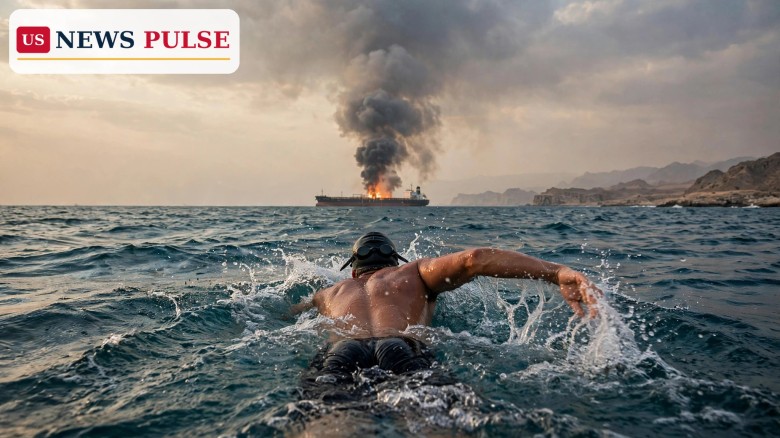
British endurance swimmer Lewis Pugh has swum about 15 kilometres (9.3 miles) through the Strait of Hormuz — past burning tankers and water set alight — to show the world what the war with Iran is doing to one of the planet's richest marine habitats. The Lewis Pugh Strait of Hormuz swim, done in sections over three days this week, took the 56-year-old United Nations Patron of the Oceans from the Musandam peninsula to the Cape of Hormuz.
Minutes after Pugh entered the water on Monday, November 16, two explosions rocked the sea. An oil tanker about four kilometres away had been hit. On later days he passed another vessel sending fireballs into the sky and watched a gas carrier burn with the water around it on fire. He is believed to be the first to attempt a long-distance swim in the strait since the war began.
Key Points
- Lewis Pugh, 56, a United Nations Patron of the Oceans, swam about 15 km in sections over three days, from the Musandam peninsula to the Cape of Hormuz.
- Minutes after entering the water on Monday, he heard two explosions and saw a tanker about 4 km away hit; later he passed a burning gas carrier.
- He swam about six and a half hours in total, in trunks, goggles and a UN-logo cap — believed to be the first long-distance swim there since the war began.
- Dozens of tankers have been damaged since February, and Pugh warned leaking oil could harm dolphins, turtles, coral reefs and mangroves for years or decades.
- His message: stop the war, open the strait, and clean up the pollution.
What Happened
Pugh began on Monday from the Musandam peninsula and finished by rounding the Cape of Hormuz. For safety the swim was done in sections over three days, adding up to about six and a half hours in the water.
The danger arrived almost immediately. "I looked up and I could see that an oil tanker about four kilometers away had been hit," Pugh told The Associated Press after returning to London. "The explosion was so loud, two booms, and then fighter jets coming in. And at that moment I realized we have to get out of here right now."
He kept going, and the attacks kept coming. On the second day, returning to the harbour, he saw a gas carrier that had been struck. "I'll never ever forget going past that gas carrier, the smell of the chemicals and then the flames, they were literally like fireballs going up into the sky. Around the ship, the water was on fire," he said.
Background: A Waterway at War
The strait Pugh swam is the narrow channel between Iran and Oman, and one of the most important shipping lanes on Earth. About a fifth of all traded oil passed through it before the United States and Israel launched the war against Iran on February 28. Since then, the waterway has become a battlefield.
Iran has stepped up attacks on vessels it says used unauthorised routes. Several tankers have struck sea mines laid by Tehran, exploding and bursting into flames. Dozens of tankers have been damaged since February.
The attacks have continued into this month: four tankers were hit in a single wave earlier in November, and the LPG tanker Tara Gas was struck twice off Oman, forcing its crew to abandon ship, with one Indian seafarer still missing. Read more: Tara Gas tanker hit twice off Oman and four tankers hit in Strait of Hormuz. ADNOC has also kept running a risky wartime oil shuttle through the strait under American protection. Read more: ADNOC wartime oil shuttle through Strait of Hormuz.
Lewis Pugh's Strait of Hormuz Swim
Pugh has spent much of the past 40 years swimming in extreme places to urge more action to protect marine environments. He was the first athlete to swim across the North Pole and to complete a long-distance swim in every one of the world's oceans.
His foundation says the challenges have helped secure agreements to protect more than 3.5 million square kilometres of vulnerable ocean. "Sport opens doors, it creates dialogue, it enables people to start thinking about these important issues," Pugh said.
"Most people, when they think about the Strait of Hormuz, they think of a shipping lane," he said. "But it is also one of the most beautiful places I have ever been … it's one of the treasure troves of the natural world."
Reactions and Quotes
Pugh's warning about the strait's wildlife was blunt. "With all these ships being sunk, this area is under severe threat," he said. "It's going to take years, decades for this area to recover."
He saw dolphins following his boat, as well as turtles and ospreys, and marvelled at the hundreds of turtles he saw along the Omani coast before the war. "When oil gets in there, when chemical pollution gets in there, it becomes very, very difficult to clean up that type of mess," he said. "It lasts for generations."
"My message is very simple," he added. "We've got to stop the war. We've got to open the strait, and we've got to clean up the pollution."
Why It Matters
The Strait of Hormuz is far more than a shipping lane. Its warm, shallow waters hold coral reefs, mangrove forests and seagrass beds, and its coasts are home to dolphins, turtles and ospreys. When a tanker is hit, oil coats coastlines, smothers reefs and poisons the food chain.
That damage is already happening at scale. With dozens of tankers damaged since February and mines still in the water, every new strike adds oil and chemicals to a sea that cannot flush them away quickly. A spill that lasts for generations would outlive the war itself and hit the fishing communities on both shores.
What Happens Next
Pugh has returned to London, but the war in the strait goes on, and so does the damage. More tankers are likely to be hit while the fighting continues, and any serious clean-up will have to wait for a ceasefire. His foundation will keep pressing governments to protect the strait's waters — but as Pugh warned, some of that damage will take decades to undo.
Frequently Asked Questions
Who is Lewis Pugh?
Lewis Pugh, 56, is a British endurance swimmer and a United Nations Patron of the Oceans, first to swim across the North Pole.
How far did Lewis Pugh swim in the Strait of Hormuz?
About 15 kilometres (9.3 miles) over three days, from the Musandam peninsula to the Cape of Hormuz, swimming about six and a half hours in total.
Why did he swim the Strait of Hormuz?
To highlight how the war threatens the strait's wildlife, as damaged tankers leak oil into waters home to dolphins, turtles and coral reefs.
What wildlife is at risk in the strait?
Dolphins, turtles, ospreys, coral reefs and mangrove forests, along with the fishing communities that depend on them.
Is the Strait of Hormuz still dangerous?
Yes. Tankers are still being attacked, mines remain in the water, and about a fifth of the world's traded oil passed through the strait before the war.

The US News Pulse newsroom covers breaking news across the United States and the world, working from wire services, official statements and on-the-record sources. Every story is reviewed against our editorial standards before publication. Corrections and tips: info@usnewspulse.com
About our newsroomLeave a Comment