


 | Today's Date:


Iran Leaves Doha Talks as Draft US Deal Circulates, Offering Hormuz Reopening in 2 Days

Iran Doha talks took a new turn on Monday, November 2, 2026, when Iranian negotiators left discussions with Qatari mediators aimed at ending the war with the United States, even as a draft proposal for a deal was being circulated and a follow-up meeting remained possible. The departure was not a walkout, according to an official briefed on the talks who spoke to Reuters: the delegation left on Sunday, not because of difficulties in the negotiations, and contacts through Qatar are continuing.
The development matters because it is the first time in this round of mediation that both sides can point to a text in circulation, rather than only to meetings. Tehran, meanwhile, has sharpened its offer in public: under a deal that meets its demands, the Strait of Hormuz could reopen within two days, rather than within the seven days originally envisaged in its September plan. That two-day timeline, put forward by Foreign Minister Abbas Araghchi on Saturday and confirmed in substance by Foreign Ministry spokesman Esmaeil Baghaei on Monday, compresses the sequence at the heart of the negotiation — an end to the US naval blockade of Iranian ports, in exchange for the reopening of one of the world's most important oil shipping lanes.
Key Points
- Iranian negotiators left Doha on Sunday after days of talks with Qatari mediators, but an official briefed on the talks told Reuters the departure was not caused by difficulties in the negotiations.
- A draft proposal for a US deal is being circulated, with a follow-up meeting possible, though the official gave no details of the draft itself.
- Tehran says the basis of the talks remains its seven-step plan drawn up in September to reopen the Strait of Hormuz and end the US naval blockade, now condensed so it could be implemented within two days.
- Foreign Minister Abbas Araghchi said on Saturday, via Al Jazeera, that Hormuz could open within two days under a deal, rather than within seven days as originally envisaged; President Donald Trump rejected the initial proposal.
- Contacts are continuing through Qatari intermediaries, with Deputy Foreign Minister Kazem Gharibabadi in Doha to facilitate the exchange of messages with Washington, according to Baghaei.
What Happened
Reuters reported on Monday that Iranian negotiators had left talks with Qatari mediators aimed at ending the war with the United States. The report, carried widely on Monday, was careful about what it did and did not establish. It established that the negotiators departed on Sunday, that a draft proposal is being circulated, and that a follow-up meeting is possible. It did not establish the contents of the draft, which side drafted it, or when any follow-up meeting might take place. The official briefed on the talks gave no further details on the draft proposal, and that part of the story — the departure and the circulating draft — rests on that one unnamed official, as reported by Reuters.
What Tehran said publicly on Monday adds texture, but it does not fill in the draft. Foreign Ministry spokesman Esmaeil Baghaei said the basis of the talks is still Iran's seven-step plan, drawn up in September, to reopen the Strait of Hormuz and end the US naval blockade on Iran. He said Deputy Foreign Minister Kazem Gharibabadi had been in Doha to facilitate the exchange of messages with Washington via Qatari intermediaries. Baghaei also said the proposal could now be implemented on a faster timeline under a deal, confirming the compression that Araghchi had described on Saturday.
Under the September proposal as described in Monday's reporting, the sequence envisaged a seven-day process, with the strait reopening on the sixth day after the United States met Iranian demands. The new two-day version, as described by Araghchi and Baghaei, would see Washington carry out a package of measures on the first day and the strait reopen on the second. The reporting does not specify which US measures would fall on day one, beyond the elements already associated with the plan: an end to the naval blockade, a waiver on Iranian oil sales, and the cancellation of new sanctions, followed by talks on other outstanding issues, including Iran's nuclear programme.
Iran also used Monday to reassure its Gulf neighbours. Baghaei said Iran had no hostility toward regional countries and supported cooperation to achieve lasting security, while reiterating Tehran's opposition to the use of neighbouring territory for attacks against Iran. Two Iranian officials also told the Associated Press, as reported on Monday, that messages between Tehran and Washington continued to be exchanged through Qatar, and Baghaei said Iran had communicated its demands and was awaiting Washington's response.
Background and Context
The Doha round did not begin on Monday. Qatari mediators spent more than 12 hours in Tehran on Friday, October 30, in regular contact with the White House, according to Axios reporting covered earlier by US News Pulse, and then carried the discussion to Doha for a third day of talks involving Iranian and Qatari officials. The mediation has unfolded against a backdrop of acute tension in the Gulf, including the Strait of Hormuz, where Iran's Islamic Revolutionary Guard Corps Navy said two oil tankers "exploded" after striking mines while travelling through an "unauthorized route," according to a summary of weekend developments.
The stakes extend well beyond the strait itself. The United States and Iran remain divided over the terms of a possible agreement, and President Donald Trump has not ruled out renewed military action. On Saturday, Israeli Prime Minister Benjamin Netanyahu pressed Trump in a phone call to strike Iran immediately after the midterm elections on Tuesday, November 3, according to Axios reporting, while Trump, for now, wants negotiations to play out. That tension — between a diplomatic track in Doha and a military option discussed in Washington and Jerusalem — is the context in which every draft, departure and public statement in this story should be read.
US Central Command added to the tension on Monday with a separate accusation, covered earlier by US News Pulse, that Iran had deliberately attacked civilian mariners at sea, killing more than 20 people. Tehran's Monday messaging, emphasising that it has no hostility toward Gulf neighbours and that its negotiators did not leave Doha because of difficulties, can be read as an attempt to keep the diplomatic track alive even as those accusations and the Netanyahu call pull in the opposite direction.
The September seven-step plan itself has a history. It was conveyed to Washington through Qatar, and President Trump rejected the initial proposal. The fact that the same plan, condensed from seven days to two, is now described by Tehran as the basis of the talks suggests that the negotiation is not about inventing a new framework from scratch, but about whether the sequencing and the price of the existing framework can be made acceptable to Washington. That is a narrower negotiation, but it is not necessarily an easier one: sequencing is often where deals of this kind succeed or fail, because each side wants the other to move first.
Iran Doha Talks: Why the Draft Matters
A draft in circulation matters for a practical reason: it gives both capitals something concrete to react to, rather than only positions stated in public. Negotiators can amend a draft, reject parts of it, or use it to test whether the other side is serious. A draft also creates a record. If talks later collapse, each side will point to the draft to argue that the other side moved the goalposts. If talks succeed, the draft becomes the skeleton of the agreement.
The two-day Hormuz offer matters for a different reason: it changes the cost of delay. A seven-day reopening sequence leaves a week in which shipping, oil prices and military calculations remain uncertain. A two-day sequence, if it were agreed, would compress that uncertainty, but it would also require Washington to move faster on its side of the bargain, on day one. That is why the compressed timeline should not be read as a concession in itself. It is a proposal about speed, not necessarily about substance, and speed benefits the side that wants the strait open quickly — which, in this case, includes Gulf neighbours, oil markets and anyone worried about escalation after the midterms.
It is also worth being clear about what has not happened. No breakdown has been announced, but no deal has been announced either. No US official has publicly confirmed the contents of the draft, and no timetable for a follow-up meeting has been given. The Iranian negotiators' departure, described as not caused by difficulties, could mean the delegation went home to consult Tehran, or it could mean the Qatari mediation has entered a phase in which written exchanges replace face-to-face meetings. The reporting does not settle that question, and this article does not pretend otherwise.
Reactions and Quotes
The most important quoted line in Monday's reporting is also the most limited. An official briefed on the talks told Reuters that the Iranian negotiators departed on Sunday, "though not because of difficulties in the negotiations," and that a draft proposal is being circulated with a follow-up meeting possible. The official gave no details of the draft. That single-sourced, detail-free formulation is common in sensitive mediation, but it means readers should treat the draft as a development, not as a deal.
Baghaei's public statements are more detailed, and they are on the record. He said: "The basis of dialogue and talks between Iran and the US via mediators is still Iran's seven-steps proposal, which is now condensed, making it possible to implement it within two days." That sentence does two things at once: it anchors the talks in a known September plan, so Tehran cannot be accused of inventing a new position, and it signals flexibility on timing, which is the kind of signal mediators often welcome.
Araghchi's Saturday statement, quoted by Al Jazeera, made the same point in plainer terms: under a deal, the Strait of Hormuz could be opened within a two-day timeline rather than within the seven days originally envisaged. The fact that the foreign minister said it on Saturday, before the negotiators left on Sunday, suggests the two-day offer was part of Tehran's position going into the final phase of the Doha round, not a reaction to leaving.
Washington's public position, as reflected in Monday's reporting, is silence on the draft itself, combined with the previously reported position that Trump has not ruled out renewed military action and that, for now, he wants negotiations to play out. That combination — no public rejection of the draft, no public embrace of it — is consistent with a White House that is still weighing its response, and with a president who is also, on Monday, delivering a closing midterm argument at home.
Why It Matters
The Doha talks matter to American readers for reasons that go beyond foreign policy. The Strait of Hormuz is a chokepoint for global oil, and any prolonged closure or threat to shipping there feeds directly into petrol prices, inflation expectations and the cost of living debate that has dominated the midterm campaign. US News Pulse has already reported on record Election Day petrol prices; a Hormuz reopening, if it happened, would be one of the few developments in this war that could move energy prices in the other direction.
The talks also matter because of timing. They are unfolding on the eve of the November 3 midterms, and several reports have raised the concern that the conflict could escalate again after Tuesday's elections. A draft in circulation before the election does not prevent escalation after it, but it does give the next administration phase — or, in this case, the post-election phase of the same administration — a document to return to. The alternative, a collapse of mediation with no text on the table, would leave escalation as the default.
Finally, the talks matter as a test of mediation itself. Qatar has invested heavily in this role, spending long hours in Tehran and then hosting the Doha round. If a Qatari-mediated draft leads to a reopening of Hormuz and a resumption of nuclear talks, it will strengthen the case for mediation as a tool in this conflict. If the draft stalls, it will strengthen the argument, made by Netanyahu and others, that only military pressure will change Tehran's calculations. Monday's development does not settle that argument, but it keeps the mediation track alive at a moment when it could easily have died.
What Happens Next
The next steps are, in order, Washington's response to the draft, any announcement of a follow-up meeting, and the behaviour of shipping and oil markets in the meantime. If Washington responds with amendments, the draft will become a negotiation in earnest. If Washington responds with silence, the draft will sit, and the risk is that events in the Gulf — a mine strike, a tanker incident, a CENTCOM accusation — will overtake it. If Washington rejects the draft, as Trump rejected the initial September proposal, the question will be whether Tehran returns with a new version or whether the mediation pauses until after the midterms.
Readers should also watch for three specific signals. First, any statement from the White House or the State Department that mentions the draft by name or describes its contents. Second, any movement of Iranian negotiators back to Doha, which would suggest the follow-up meeting is real. Third, any change in the US naval posture in the Gulf, which would suggest Washington is preparing for either a deal or an escalation. None of those signals had appeared in the reporting read for this article at the time of publication.
US News Pulse will follow the draft, the follow-up meeting if it is announced, and the post-election phase of the US-Iran confrontation as they develop, and will update this story when Washington's response is known.
Frequently Asked Questions
Did Iran walk out of the Doha talks?
No, according to an official briefed on the talks who spoke to Reuters. The Iranian negotiators left on Sunday, but not because of difficulties in the negotiations, and a draft proposal is being circulated with a follow-up meeting possible.
What is Iran offering on the Strait of Hormuz?
Tehran says that under a deal meeting its demands, Hormuz could reopen within two days, rather than within the seven days originally envisaged in its September seven-step plan.
What does Iran want in return?
Under the plan as described in Monday's reporting, the United States would end its naval blockade of Iranian ports, grant a waiver on Iranian oil sales and cancel new sanctions, before the two sides move on to other issues, including the nuclear programme.
Has the United States accepted the draft?
Not publicly, in the reporting read for this article. Iran says it has communicated its demands and is awaiting Washington's response, and Trump has not ruled out renewed military action.
What happens next?
Washington's response to the draft, any announcement of a follow-up meeting, and the post-midterm phase of the confrontation, with Netanyahu reported to be pressing for a strike immediately after the November 3 elections.
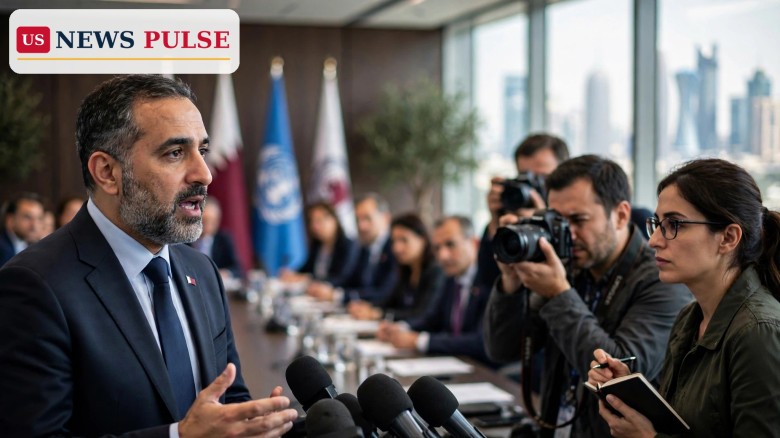
Related coverage: Netanyahu urges Trump to strike Iran right after the midterms, Axios reports and CENTCOM says Iran killed over 20 mariners in deliberate attacks on Gulf shipping. The featured image is an illustrative generated scene of a diplomatic meeting room, not a photograph of the Doha talks.
Leave a Comment