


 | Today's Date:



Trump Farm Aid: $15 Billion for Farmers as Diesel Costs Soar Before Midterms
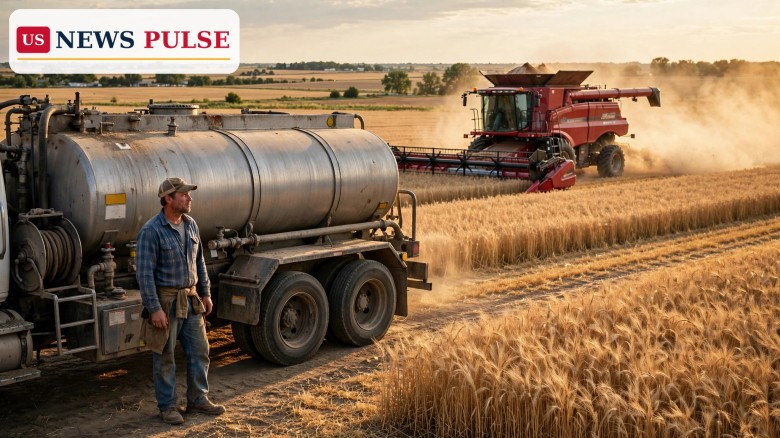
President Donald Trump's administration has promised American farmers more than $15 billion in payments, loans and other initiatives in the final weeks before Tuesday's midterm elections, an aid package aimed squarely at the soaring diesel and fertilizer costs that have squeezed farm incomes through a difficult year. The centrepiece is an $8 billion one-time Harvest Fuel Relief payment to help farmers offset higher fuel costs during this harvest season, with the Agriculture Department promising to release commodity-specific payment rates in November — though it has not yet said when the money will actually reach farm bank accounts.
The package, tallied by the Associated Press from announcements made in the weeks leading up to the November 3 vote, lands as Trump has stepped up his attention on rural America, including visits on Sunday to Iowa and Kansas, two days before an election in which traditionally Republican agricultural seats are now seen as competitive. Whether the money motivates rural voters — or simply helps them survive a brutal year — is, as one Kansas political scientist put it, the question that will decide whether the aid matters politically at all.
Key Points
- The Trump administration has promised more than $15 billion in farm payments, loans and initiatives in the weeks before the November 3 midterms.
- The largest piece is an $8 billion one-time Harvest Fuel Relief payment to offset diesel costs, announced on October 19, with payment rates due in November.
- At least $5 billion in guaranteed loans for ranchers and fishermen, $1.8 billion in conservation payments, $573 million for fertilizer manufacturing and $57 million to expand meat processing are also included.
- Diesel averaged $6.32 a gallon on Friday, about 70% higher than a year ago, so filling a 100-gallon tank now costs about $260 more than it did last year.
- The package sits on top of $13.8 billion in planned safety-net payments for eligible producers for the 2025 crop year.
What Happened
According to the Associated Press tally, published on Sunday, November 1, the administration's farm pledges break down into a series of distinct pots, rather than a single cheque. More than half of the $15 billion goes to the Harvest Fuel Relief programme: a one-time payment, unveiled by the Agriculture Department on October 19, that will cover a portion of modelled losses for the 2026 crop year. Payments will be calculated using a uniform formula based on planted acreage reported to the Farm Service Agency, cost-of-production estimates from the Economic Research Service, and yield and price figures from the department's monthly supply and demand estimates. Producers of the main programme commodities will be the first to receive rates, which the department said will be released in November, while a method for specialty crops, fishing and other producers will come later. The application period has not yet been announced, and enrolment in crop insurance is not required.
Beyond the fuel payment, at least $5 billion was announced in guaranteed loans for ranchers and fishermen. A further $1.8 billion in payments is for producers and landowners who participated in conservation programmes, $573 million will go toward fertilizer manufacturing projects, and $57 million is for expanding meat processors. For specialty crop producers, $86.6 million in grants will be awarded to innovative projects. On Thursday, the agency said it would purchase up to $472.5 million in agricultural commodities to support producers and give to charitable programmes.
The Agriculture Department also announced other efforts, such as expanding sales of a diesel normally used only for off-road use, helping ranchers by making cattle sale data more transparent, and strengthening wolf management policies to protect livestock. The initiatives will primarily use Agriculture Department funding and do not require immediate congressional approval.
Separately, the agency plans $13.8 billion in safety-net programme payments for eligible producers for the 2025 crop year, offsetting shortfalls for farmers who grow key crops such as corn, soybeans, wheat and rice. That money is distinct from the $15 billion in new pledges, but together the two sums underline how much federal support is now flowing into a farm sector that, by the department's own forecasts, is under real strain.
Background and Context
It has been a frustrating year for farmers. Increased costs for fertilizer and fuel have made it difficult to turn a profit. Last year, tariffs drove up expenses for other equipment that farmers use, and the trade war with China resulted in a near boycott of US agricultural goods, according to the Associated Press. This year, the war in Iran has fed through into energy prices, pushing diesel — the fuel that powers tractors, combines, irrigation pumps and trucks — to levels that have eaten directly into harvest margins.
The numbers at the pump tell the story. On Friday, diesel was averaging $6.32 per gallon, down slightly from its peak in September but 70% higher than the price a year ago, according to motor club AAA figures cited by the Associated Press. Filling up a 100-gallon tank now costs $260 more than it did one year ago. The Agriculture Department forecasts cited in coverage of the package put the wider picture in similar terms: production expenses are expected to rise 4.5% to $492.8 billion this year, including fertilizer costs up 15.3% and fuel expenses up 28.8%, while inflation-adjusted net farm income is expected to decline 5.5%.
That squeeze is the backdrop to the Harvest Fuel Relief announcement itself. Trump first announced the programme at a rally in Kansas, telling supporters: "Tonight I'm also pleased to announce that the Department of Agriculture will be launching a new harvest fuel relief program, providing our farmers with $8 billion dollars in support to offset diesel costs during this harvest season." Agriculture Secretary Brooke Rollins has described the initiative as a major investment in the sector. But the department has been clear that the payments cover only a portion of modelled losses — they are not a reimbursement of every dollar spent on diesel — and the timing remains open: rates in November, no confirmed payment date yet.
The farm package also fits a wider pre-election pattern. Trump has spent the final weeks of the campaign in rural and Farm Belt states, including the Iowa and Kansas stops on Sunday, as polls show Democrats near certain to take the House and with a shot at the Senate. Rural voters, including farmers and those who rely on the agricultural economy, have been an instrumental voting group for Trump — and, as the Associated Press notes, it is unclear whether the pledges will motivate more voters to turn out in agricultural states where traditionally Republican seats are now seen as competitive.
Trump's $15 Billion Farm Aid: What Farmers Actually Get
For an individual farmer, the most important number in the package is not $15 billion — it is the payment rate for their crop, which has not been published yet. The Harvest Fuel Relief formula is designed to be uniform: the same method applied to planted acreage, production costs, yields and prices, rather than a flat payment per farm. That means a large corn or soybean operation and a smaller diversified farm will receive very different sums, and neither will know the figure until the department publishes its commodity rates this month.
The rest of the package reaches farmers through different doors. Ranchers and fishermen benefit mainly through guaranteed loans rather than direct payments. Conservation participants receive payments for land stewardship. Fertilizer manufacturing projects and meat processors receive investment intended to ease supply bottlenecks further up the chain. Specialty crop growers — fruit, vegetable and nut producers who often fall outside the main commodity programmes — are covered by a smaller $86.6 million grant pot, with their Harvest Fuel Relief method still to come.
What the package does not do, by the administration's own framing, is fix the underlying cost problem. Diesel prices, fertilizer prices, equipment tariffs, export markets and labour all sit outside a one-time payment. That distinction matters for how farmers judge the aid: as a bridge through one harvest, it may be decisive; as a solution to a structural squeeze, it is, by design, temporary.
Reactions and Quotes
Gregg Ibendahl, a farm management specialist at Kansas State University, said he estimates the payments to "more than cover the increase in fuel costs," and that the money could help with high fertilizer prices. But he warned that the help is short-term. "That input side risk, I think, is the thing that really has hurt farmers this year, as well as the fact that there has been a lot more uncertainty about what's going to happen in the world," Ibendahl said. "It's hard to go to your lender in the next spring and say, 'OK, well, we're looking pretty good this year, but it's all because of these extra temporary government payments, so how much can you make me a loan [for] next year for my crop?' He said he expects these ad hoc payments to be a big help for farmers who otherwise would not make a profit this year, but they do not address the broader issues driving up prices.
Alexandra Middlewood, an associate professor of political science at Wichita State University, said she has heard mixed reactions from farmers, who are happy their business will survive this year but see these programmes as one-time bailouts rather than a long-term solution. Cost of living and access to health care are top issues for rural voters, Middlewood said, adding that there is a perception the administration has not done enough to address these issues, even as Trump boasts at campaign rallies about a booming economy. Middlewood, who is based in Kansas, does not expect frustrated rural voters to shift to the Democratic Party, given how long the state has been a Republican stronghold. But some voters may decide to sit out of this election or vote independent, which would hurt Republican candidates. "Independent voters make or break elections," she said. "And so that's really what it's going to come down to this year is those independent voters and who they're breaking for."
Michael Smith, a political science professor at Emporia State University, said many rural voters like the president, but some of his policies have hurt the agriculture industry. Immigrant deportations have threatened the agricultural labour force, and cuts to foreign aid and SNAP food stamps hurt the market for agricultural products. "Some people who admire Trump really just admire the person, the man," he said. "But it doesn't mean they necessarily like his policies. Well, Trump himself isn't on the ballot this year. His policies are."
Why It Matters
The farm package matters for three reasons at once. Economically, it is a large, fast injection into a sector where margins have been crushed by fuel and fertilizer prices and by lost export markets — and where a bad harvest year can tip otherwise viable farms into debt. Politically, it is a test of whether direct payments can hold a coalition that has been strained by the very policies — tariffs, deportations, the Iran war's energy shock — that created the costs the payments are meant to offset. And institutionally, it shows how much farm policy is now being made through executive and departmental action, without immediate congressional approval, in the run-up to an election that will decide who controls Congress for the next two years.
There is also a food-price dimension. Farmers are price-takers in most commodity markets: when their costs rise, they cannot simply pass the increase on, so the squeeze shows up first in farm incomes and only later, unevenly, in grocery prices. Aid that keeps farms solvent through harvest protects supply in the short term, but it does not lower diesel or fertilizer prices for the next planting season. If input costs stay high into spring, the same debate will return — with lenders, as Ibendahl notes, asking harder questions about what next year's income will look like without another round of temporary payments.
For the midterms specifically, the rural vote is the wild card. Trump won rural America heavily in past elections, but the Associated Press reporting suggests the administration itself is worried enough about turnout and competitiveness in agricultural states to have made farm aid a closing-argument theme, alongside the Iowa and Kansas rallies. If frustrated farmers stay home or vote independent, Republican candidates in farm states could feel it even in races Trump himself is not contesting.
What Happens Next
The immediate next step is administrative: the Agriculture Department is expected to release commodity-specific Harvest Fuel Relief payment rates in November, and to announce an application period. Until those details appear, farmers cannot calculate what they will receive, and lenders cannot treat the payment as certain income. Watch for the rate tables for corn, soybeans, wheat and rice first, followed by the method for specialty crops, fishing and other producers.
The political next step arrives on Tuesday, November 3, when voters decide control of the House and Senate. A Democratic House, which polls suggest is near certain, would change the farm-policy landscape: future aid would need congressional negotiation, and oversight of how the $15 billion is spent — who received what, and when — is likely to intensify. A Republican hold in the Senate would preserve more room for the administration's approach, but would not by itself lower diesel prices.
The economic next step is the market itself. Diesel and fertilizer prices, the direction of the Iran war and its effect on energy, the state of trade with China, and the outcome of the November data — including the manufacturing and jobs reports due this week — will all shape whether this harvest's relief is remembered as a bridge or as the first instalment of a longer support programme. Farmers will be watching the pump price and the payment-rate announcement with equal attention.
Frequently Asked Questions
How much farm aid has the Trump administration promised?
More than $15 billion in payments, loans and initiatives announced in the weeks before the November 3 midterms, led by an $8 billion one-time Harvest Fuel Relief payment for diesel costs.
When will farmers receive the Harvest Fuel Relief payments?
The Agriculture Department said commodity-specific payment rates will be released in November, but it has not announced an application period or a payment date, so the timing is still unclear.
What is driving farmers' costs so high?
Diesel averaged $6.32 a gallon on Friday, about 70% higher than a year ago, while fertilizer costs are up sharply; tariffs raised equipment costs and the trade war with China hit agricultural exports, and the Iran war has fed into energy prices.
Is the $15 billion on top of existing farm support?
Yes. The Agriculture Department separately plans $13.8 billion in safety-net programme payments for eligible producers for the 2025 crop year, covering crops such as corn, soybeans, wheat and rice.
Will the aid change how rural voters vote?
That is unclear. Experts cited by the Associated Press say farmers welcome the help for this year but see it as a one-time bailout, and independent voters in farm states could decide close races either way.
Related coverage: Keystone XL pipeline returns in Trump's Canada trade deal concept as talks resume and Magnificent Seven debt hits $578 billion as AI spending raises new alarm.
Leave a Comment