
Two Supertankers Explode in Strait of Hormuz After Hitting Mines, IRGC Says
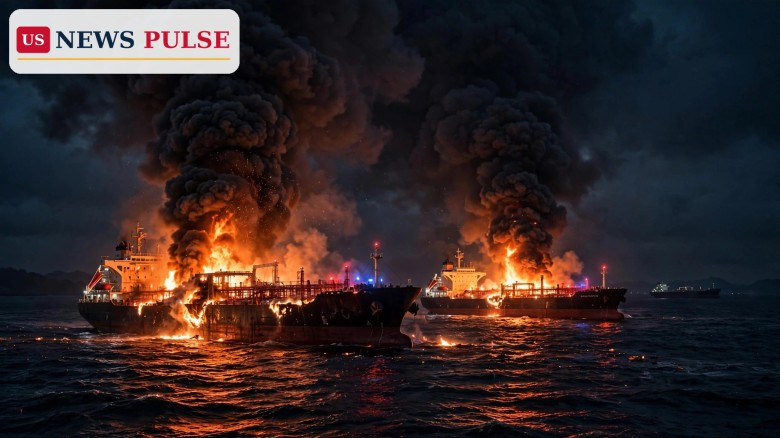
Two oil supertankers carrying more than 4 million barrels of oil were disabled by massive explosions in the Strait of Hormuz on Wednesday night, Iran's Revolutionary Guards Navy said on Thursday, after the vessels ignored repeated warnings against using an "unauthorised" southern shipping route.
The two vessels were left burning and immobilised in the strait, through which roughly one-fifth of global oil normally passes. Iranian state media later said the tankers exploded after hitting naval mines. The vessels have not been identified, and no crew details have been given.
Key Points
- Iran's Revolutionary Guards Navy said on Thursday, November 12, 2026, that two oil supertankers were disabled by massive explosions in the Strait of Hormuz on Wednesday night.
- The two vessels carried a combined cargo of more than 4 million barrels of oil and were left burning and unable to move.
- The IRGC said the tankers ignored repeated warnings against an "unauthorised" southern route, and Iranian state media later said they exploded after hitting naval mines.
- The Guards warned that any vessel in the Persian Gulf or the Strait of Hormuz that switches off its navigation systems and cooperates with the US military on the southern route would meet the same fate.
- The incident follows the IRGC's November 10 report of fires aboard three tankers on unauthorised routes, in the ninth month of the US-Iran war that began on February 28, 2026.
What Happened
According to the IRGC Navy, the two tankers were transiting the southern part of the strait late on Wednesday when the explosions struck. "Last night, two violating oil tankers — which had ignored repeated warnings from the Strait of Hormuz traffic control center of the IRGC Navy regarding the unauthorized and unsafe nature of the southern route — faced an incident while transiting through this unauthorized path in the Strait of Hormuz, and stopped sailing following a massive explosion," the statement said.
Reuters, reporting the announcement, said the two tankers were disabled by the blasts. No independent verification of the Iranian account has emerged, and the United Kingdom Maritime Trade Operations agency has said in several cases that tankers in the strait have been struck by unknown projectiles.
Background and Context
The Strait of Hormuz, the narrow passage between Iran and Oman that connects the Persian Gulf to the open sea, normally carries about one-fifth of the world's oil. Since the US-Iran war began on February 28, 2026, it has become the most dangerous shipping lane on earth, with dozens of vessels attacked, mined or set on fire.
Iran has imposed tight restrictions on transit. Its forces say they control passage, require prior authorisation, and confine safe transit to designated northern corridors, while southern routes near Omani waters have been declared unauthorised and mined.
Strait of Hormuz Supertankers Explode After Warnings Ignored
The scale of this latest incident sets it apart. Two supertankers — the largest class of oil carrier, each able to hold around two million barrels — were hit in a single night, with a combined cargo of more than four million barrels now burning or at risk. That is roughly a fifth of the oil the strait normally moves in a single day, and a reminder of how much crude is exposed every time a vessel takes the southern route.
Reactions and Quotes
The IRGC issued a stark warning alongside its announcement, aimed at vessels that place their trust in the US military, which it described as a "smuggling" force. "Any vessel in the Persian Gulf and the Strait of Hormuz that switches off its navigation systems and cooperates with the US smuggling army in transiting the unauthorized southern route through the Strait of Hormuz will meet a similar fate," the IRGC said.
There was no immediate public response from the United States or from the owners of the two vessels. US Central Command has previously said that mines in the waterway had been cleared — a claim the latest explosions appear to contradict.
Why It Matters
First, it is a direct threat to the world's oil supply. Every tanker disabled in the strait tightens the flow of crude to world markets. Oil prices have already swung sharply on Hormuz news during this war: Brent crude fell 7.6 percent to $104.77 on November 2 on hopes of a US-Iran deal, then rebounded above $106 after the US strikes on Iran's Qeshm Island. Another major incident in the strait is likely to push prices higher and add to the volatility that has gripped energy markets all month.
Second, it shows the war at sea is escalating rather than easing, and it lands at a delicate moment for diplomacy. Vice President JD Vance said on November 2 that Washington had made "progress" in talks with Iran and set no deadline for a deal, while President Donald Trump said an agreement was "coming together very nicely". A fresh tanker disaster in the strait will test whether that diplomacy can survive the war at sea.
What Happens Next
The immediate questions are practical: whether the two burning supertankers can be saved, whether their crews are safe, and whether the oil aboard them spills into the strait. With more than four million barrels at stake, a major spill would be an environmental disaster as well as a commercial one, and salvage work in a mined waterway during wartime is among the most difficult tasks in shipping.
Frequently Asked Questions
What happened in the Strait of Hormuz on Wednesday night?
Two oil supertankers carrying a combined cargo of more than 4 million barrels were disabled by massive explosions on Wednesday night, November 11, 2026, according to Iran's Revolutionary Guards Navy. Both vessels were left burning and immobilised.
Why were the tankers attacked?
The IRGC said the tankers ignored repeated warnings against using an "unauthorised" southern shipping route. Iranian state media later said they exploded after hitting naval mines. The claims have not been independently verified.
How much oil was on board?
More than 4 million barrels combined, according to the IRGC Navy. Each supertanker can carry around 2 million barrels, making this one of the largest single incidents of the shipping war in the strait.
Were any crew members hurt?
No casualty or crew details have been released. The vessels have not been identified, and it is not known how many crew were aboard or whether anyone was injured or killed.
How important is the Strait of Hormuz for world oil?
The strait normally carries about one-fifth of global oil. Shipping through it is running well below pre-war levels, and attacks on tankers there have repeatedly moved world oil prices during the nine-month US-Iran war.
Related coverage: three tankers caught fire in the Strait of Hormuz after hitting mines, Iran said on November 8; two Hormuz tankers exploded after hitting mines on November 1; and the Saudi East-West pipeline attack in the Madinah region.
© 2026 US News Pulse. All rights reserved.
 Print
 Save