


 | Today's Date:



Two Hormuz Tankers Explode After Hitting Mines as Trump Says Iran War Will End Soon
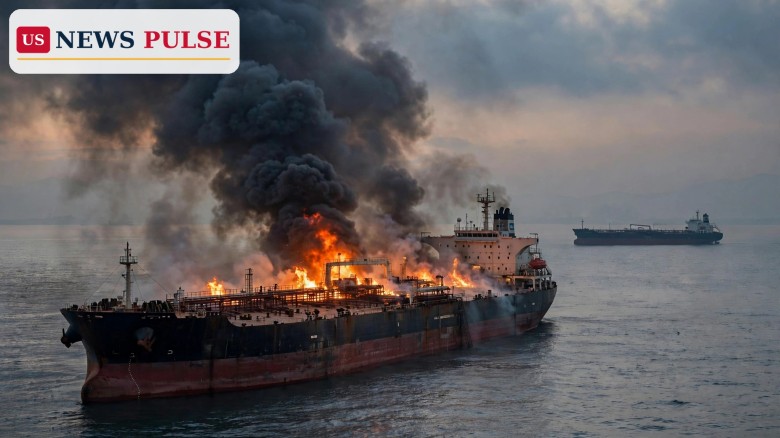
Two oil tankers have exploded after striking mines in the Strait of Hormuz, Iran's Islamic Revolutionary Guard Corps (IRGC) Navy said on Sunday, in the latest attack on shipping through the world's busiest oil chokepoint — as US President Donald Trump insisted the war on Iran will end "very soon, one way or the other" and mediators pressed a plan that could reopen the strait within two days. The Hormuz tankers claim, reported by Iranian state media and carried by Reuters, has not been independently verified, and no vessel names or crew details have been released.
Key Points
- Iran's IRGC Navy says two oil tankers "exploded" after hitting mines on an "unauthorised route" through the Strait of Hormuz on Sunday, 1 November 2026.
- One vessel, described as a supertanker, caught fire after a powerful explosion, and both ships were left immobilised, according to the IRGC statement.
- The IRGC accused the tankers of switching off navigation and identification systems and claimed they had US military support — claims that could not be independently verified.
- Separately, the UK Maritime Trade Operations agency (UKMTO) said a merchant ship relayed a mayday call reporting another vessel struck by an unknown projectile in the strait.
- Iranian Foreign Minister Abbas Araghchi said Tehran is discussing a proposal under which the strait could reopen within two days if the United States meets Iran's conditions, with no final agreement reached.
What Happened
Iranian state media reported on Sunday that the IRGC Navy said two oil tankers exploded after striking naval mines while travelling through an unauthorised route in the Strait of Hormuz. The force said one of the vessels, a supertanker, was engulfed in flames following a powerful explosion, and that both ships were left unable to move. It accused the crews of switching off their radar, navigation and positioning systems and ignoring repeated radio warnings against using restricted routes, and it claimed the tankers had US military support.
None of those details has been independently confirmed. The IRGC statement did not name either vessel, did not say where the tankers were flagged or where they were headed, and gave no information about their crews — including whether anyone was injured or killed. That absence of detail matters, because earlier claims in this shipping war have also rested largely on statements from one side, with outside confirmation arriving later, if at all.
Earlier on Sunday, UKMTO issued a separate warning. It said the master of a merchant vessel had relayed a mayday call on VHF channel 16 reporting that another vessel had been struck by an unknown projectile in the strait, with the incident reported at approximately 1509 UTC on 1 November. UKMTO did not say whether its alert and the IRGC statement referred to the same vessels, and news reports on Sunday were careful to note that it was not clear whether the two accounts describe one incident or two.
The timing is significant. The reported mine strikes came just two days after a Qatari liquefied natural gas carrier, the Al Mayeda, was attacked by unidentified objects in Gulf waters on Friday. Qatar's news agency said no crew were injured and there was no environmental damage in that attack, but Gulf nations condemned it — and Sunday's reported explosions raised the stakes again for every ship still trying to use the waterway.
Background and Context
The Strait of Hormuz is a narrow passage between Iran and Oman that connects the Persian Gulf with the Gulf of Oman and the open ocean. It is the route through which a large share of the world's seaborne oil and liquefied natural gas must pass, which is why even a single attack there moves oil markets and rattles governments far from the Gulf. Since the US-Israeli war on Iran began in late February, Iran has imposed restrictions on vessels seeking to pass through the strait and has attacked ships it says violate those restrictions, as it seeks to assert control over the waterway and put pressure on Washington. The United States has responded with a blockade on Iranian ports.
That contest over the strait has produced a drumbeat of claims and counter-claims. In late October, the IRGC said three oil tankers had exploded and caught fire after hitting sea mines on an unauthorised southern route through the strait. US Central Command pushed back, with its commander, Admiral Brad Cooper, saying in a video released on 30 October that US forces had "successfully cleared the strait's internationally recognised primary transit routes of Iranian sea mines" and would keep them free and clear. The IRGC has since challenged Washington to prove that mine-clearing claim with independent evidence rather than statements — and Sunday's reported explosions will be read in Tehran, and in Gulf capitals, as a direct challenge to that American assurance.
UKMTO tallies cited in recent reporting put the scale of the shipping war in stark terms: at least 35 attacks on shipping in the Gulf and around Hormuz were recorded during October alone, the highest monthly count since the conflict began. Each incident forces shipowners, insurers and crews to make a fresh calculation: whether the risk of transiting the strait, or of taking a longer and costlier route around it, is the safer commercial bet. Those calculations, repeated across hundreds of voyages, are how a regional war becomes a global energy and inflation story.
Hormuz Tankers and the Strait's Shipping War
The Hormuz tankers at the centre of Sunday's claim fit a pattern that has become familiar since February: Iran says a vessel broke its rules, switched off its tracking, and paid the price; Washington and its partners say the primary shipping lanes are open and safe; and independent verification lags behind both claims. What is different this time is the reported scale — two tankers, one of them a supertanker, both immobilised — and the diplomatic backdrop against which it happened.
Qatari mediators met Iranian officials for a third straight day on Sunday as they try to restart direct talks between Washington and Tehran. That mediation effort is the thread connecting the battlefield reports to the negotiating table: if the strait can be reopened under agreed terms, the shipping war loses its sharpest weapon; if it cannot, every new mine strike or projectile attack hardens the positions on both sides. Iran's message on Sunday was deliberately two-track — a military claim of control over the waterway, paired with a diplomatic opening on reopening it.
For the United States, the incident lands one day before the 3 November midterm elections, in a campaign already dominated by the cost of living and the fallout of the Iran war. President Trump has repeatedly told voters the war will end soon and that petrol prices will fall when it does. A fresh shipping incident in the strait tests that promise in public, because any sustained disruption to Gulf oil flows would push in exactly the opposite direction.
Reactions and Quotes
President Trump, in his latest public remarks on the war, said it will end "very soon, one way or the other", warning that Tehran will either make a deal or "we'll just end it". The comments, carried in Al Jazeera's live coverage on Monday, 2 November, repeat a message Trump has delivered several times in recent days: that Iran should negotiate, and that the alternative is a decisive American end to the conflict. He has previously said there would be no US strikes before the midterm elections, while demanding a guarantee that Tehran never obtains a nuclear weapon.
Iranian Foreign Minister Abbas Araghchi struck a different note, saying talks with mediators over a two-day plan to reopen the Strait of Hormuz are ongoing, and expressing hope that the US has "enough sense to choose diplomacy". Araghchi said Tehran was discussing a proposal under which the strait could reopen within two days if the United States met Iran's conditions, but he was explicit that no final agreement had been reached. The two-day framing is the most specific timeline yet attached to a reopening deal, and it puts a clock — however tentative — on the diplomacy.
Gulf nations, meanwhile, condemned Friday's attack on the Qatari LNG carrier, according to Al Jazeera's recap of recent developments, underscoring how the shipping war is straining relations even among states that have tried to stay out of the direct fighting. Qatar, which owns the Al Mayeda through Qatar Gas Transport Company, has been central to the mediation effort, and an attack on a Qatari vessel followed by reported mine strikes days later is a reminder that mediators themselves are exposed to the violence they are trying to stop.
The US military has not, in the reporting reviewed for this article, issued a fresh statement specifically confirming or denying Sunday's two-tanker claim. Its standing position, set out by Admiral Cooper on 30 October, is that the strait's primary transit routes have been cleared of mines and remain open. That position now faces its most direct public test since it was stated.
Why It Matters
Three things make Sunday's reported incident matter beyond the Gulf. First, energy: any credible threat to Hormuz shipping feeds straight into oil and gas prices, and from there into fuel costs, transport costs and household bills in the United States and around the world — just as voters head to the polls. Second, diplomacy: the incident arrived in the middle of a Qatari mediation push, and it will either strengthen Tehran's hand at that table, by showing it can still close the waterway, or undermine trust in the talks, by showing the violence is escalating even as negotiators meet. Third, escalation: with a third US aircraft carrier strike group heading toward the Middle East and American officials previously briefing Gulf allies to prepare for a possible short, intense round of strikes, the margin for miscalculation in and around the strait is narrowing.
For American readers, the most immediate question is practical rather than strategic: will this incident move petrol prices, and will it change what the president does next? Neither answer is available yet, and both depend on facts that are still unverified — which vessels were hit, how badly they were damaged, whether crews are safe, and whether the strait remains passable for other traffic. Until those facts are confirmed by independent sources, the responsible reading of Sunday's claim is as a claim: serious, consequential, and unproven in its specifics.
What Happens Next
The next 48 hours will be decisive in two ways. Diplomatically, the two-day reopening window described by Araghchi will either produce an agreement or expire without one, and the Qatari mediation — now in its third straight day of meetings with Iranian officials — will show whether direct US-Iran talks can be restarted. Militarily, the world will watch for independent confirmation of the two tankers' identities and condition, for any US or UKMTO update on the strait's status, and for any further incidents that would suggest a new phase of the shipping war rather than a single reported strike.
Oil markets will be an early signal: a sharp price move on Monday would suggest traders are treating the mine claim as credible and consequential, while a muted reaction would suggest scepticism or confidence that alternative routes and reserves can absorb the shock. Either way, shipowners' decisions in the coming days — whether to transit, wait, or reroute — will tell their own story about how safe the strait is judged to be.
US News Pulse will update this story as independent confirmation, vessel details, crew information or an official US response becomes available.
Frequently Asked Questions
What happened to the two tankers in the Strait of Hormuz?
Iran's IRGC Navy said on Sunday, 1 November 2026, that two oil tankers exploded after striking mines on an unauthorised route through the strait. One, described as a supertanker, reportedly caught fire, and both were left immobilised. The claims have not been independently verified.
Have the tankers been named, and are their crews safe?
No. The IRGC statement did not name the vessels or give any information about their crews. No injuries or deaths have been reported in the sources reviewed for this article, and that absence should not be read as confirmation that crews are unharmed.
Is this the same incident as the attack on the Qatari LNG carrier?
No. The Al Mayeda, a Qatari LNG carrier, was attacked by unidentified objects on Friday, 30 October, with no crew injuries and no environmental damage reported. Sunday's reported mine strikes are a separate claim, involving two oil tankers rather than an LNG carrier.
What is the two-day plan to reopen the Strait of Hormuz?
Iranian Foreign Minister Abbas Araghchi said Tehran is discussing a proposal under which the strait could reopen within two days if the United States meets Iran's conditions. He said no final agreement had been reached, and the proposal's terms have not been made public.
Is the Strait of Hormuz still open to shipping?
The United States says the strait's internationally recognised primary transit routes have been cleared of mines and remain open. Iran says vessels must get its permission to pass and has attacked ships it says break its rules. Independent confirmation of the current status after Sunday's reported strikes is still awaited.
Related coverage: Al Mayeda LNG tanker attack near Hormuz draws Qatar condemnation | US warns Iran over Strait of Hormuz | US-Iran strike plans: forces ready within 96 hours of Trump order, reports say
Leave a Comment