


 | Today's Date:


Three Tankers Catch Fire in Strait of Hormuz After Hitting Mines, Iran Says
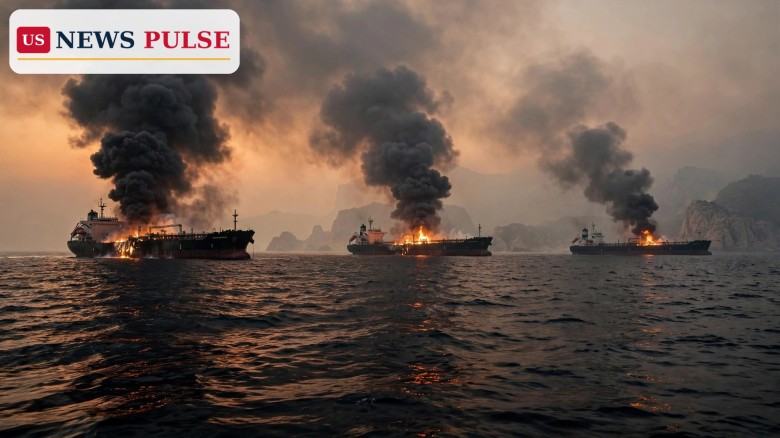
Three tankers caught fire in the Strait of Hormuz on Sunday after hitting naval mines, Iran's Revolutionary Guards said, in the latest strike on shipping in the world's most important oil waterway. The Islamic Revolutionary Guard Corps (IRGC) said the three "non-compliant" tankers exploded and caught fire in what it called an illegal channel, with their tracking systems switched off. The vessels were abandoned and left burning, without naming them. The claims have not been independently verified.
Key Points
- Iran's Revolutionary Guards say three non-compliant oil tankers exploded and caught fire on Sunday after hitting naval mines in an unauthorised channel of the strait.
- The Guards first reported two tankers hit; the semi-official Fars news agency later reported a third tanker had also exploded and caught fire.
- UKMTO separately reported a tanker on fire off Khasab, Oman, on Saturday, its crew evacuated, and another tanker hit by an "unknown projectile".
- It follows explosions heard along Iran's southern coast on Saturday evening and the US disabling of the cargo ship M/V Huda in the Gulf of Oman.
- At least 11 ships were attacked in and around the strait in the week to November 6, UKMTO said; three sank.
What Happened
The Guards announced the incident on Sunday morning, saying the tankers had been sailing in a channel Tehran does not authorise. "Since the early hours of this morning, three non-compliant tankers have exploded and caught fire while they were sailing in the illegal channel in the Strait of Hormuz," the Guards said. No names, flags or nationalities were given, and no word on casualties.
The announcement unfolded in stages: the Guards first said two tankers had hit mines, and Fars later reported a third had also exploded and caught fire. The Guards said the tankers had switched off their tracking systems and were sailing an unauthorised route.
UKMTO separately reported a tanker on fire off Khasab, Oman, a day earlier, its crew evacuated, and another tanker hit by an "unknown projectile" on Saturday. "Military authorities reported the tanker is on fire which has resulted in the evacuation of the crew," the agency said. The fires came a day after explosions were heard at Qeshm, Jask, Sirik and Bandar Abbas, and the US disabled the St Kitts-flagged ship M/V Huda in the Gulf of Oman.
Background: A Strait Under Siege
The Strait of Hormuz, the narrow passage between Iran and Oman linking the Gulf to the open sea, has been at the centre of the US-Iran war since February 28, 2026. The conflict is now in its ninth month.
Tehran has severely restricted traffic, insisting vessels use its authorised routes, while the United States has imposed a naval blockade of Iranian ports and helped tankers travel the strait, which normally carries about one-fifth of global oil consumption. US Central Command said last month it helped Gulf countries export 1.5 billion barrels of oil via Hormuz since the summer, and recently said all mines have been cleared.
The pattern has accelerated. On November 3, Iran said five tankers had caught fire in the strait. On November 6, the Guards said two more tankers caught fire after hitting mines. On November 7, two Hormuz tankers exploded after hitting mines. UKMTO counted at least 11 ships attacked in and around the strait in the week to November 6, with three sinking.
Three Tankers Catch Fire in the Strait of Hormuz: What We Know and What We Don't
The claim is clear in shape: three tankers, early Sunday morning, in a channel Iran says was unauthorised, tracking systems off, abandoned and burning after explosions the Guards blame on mines. UKMTO's reports of a tanker fire off Oman and a separate projectile strike on Saturday point to a dangerous weekend for shipping, even if the agency's incidents cannot yet be matched to the Guards' three tankers.
Much remains unknown. No names, flags or nationalities have been released, so the ships cannot yet be identified, and there has been no word on casualties. Tehran has made similar announcements in recent weeks, some impossible to verify independently. The "non-compliant" label matters: Iran uses it for vessels sailing with identification systems off or outside its authorised routes, and has treated sailing dark as grounds for targeting.
Reactions and Quotes
The Guards' statement was the fullest account. "Since the early hours of this morning, three non-compliant tankers have exploded and caught fire while they were sailing in the illegal channel in the Strait of Hormuz," the Guards said, without identifying the vessels.
UKMTO confirmed a tanker fire in the strait a day earlier. "Military authorities reported the tanker is on fire which has resulted in the evacuation of the crew," it said, and reported a second tanker struck by an "unknown projectile" on Saturday. Diplomacy continues in the background: Vice President JD Vance said on November 2 that Washington had made "progress" in talks with Iran, and President Donald Trump said a deal was "coming together very nicely". Neither had commented on Sunday's claim.
Why It Matters
The Strait of Hormuz is the world's most important oil chokepoint. About one-fifth of global oil consumption normally passes through it, so any threat to shipping there moves energy markets and raises costs far beyond the Gulf. Oil prices have already swung sharply on Hormuz news, with Brent crude rebounding above $106 a barrel earlier in the week after strikes on Iran's Qeshm Island.
It also tests competing claims about the strait. Washington says the waterway is cleared of mines and oil is flowing; Tehran says it can still strike vessels that defy its rules. Three burning tankers, if confirmed, would suggest the strait is far from safe. The timing is delicate, with US-mediated talks due in Abu Dhabi on November 10-11.
What Happens Next
Verification comes first. Ship-tracking firms, insurers and satellite analysts will work to identify the three vessels and establish whether the fires match the Guards' account. UKMTO is expected to issue further updates, and casualty figures should emerge through the ships' operators. Oil traders will watch Monday's open, and diplomats will watch Abu Dhabi on November 10-11.
Frequently Asked Questions
What happened in the Strait of Hormuz on Sunday?
Iran's Revolutionary Guards said three oil tankers exploded and caught fire early on Sunday after hitting naval mines in an unauthorised channel, and were left abandoned and burning, with no names given.
Were the tankers really hit by mines?
That is Iran's claim, and it has not been independently verified. US Central Command recently said all mines have been cleared from the waterway.
Is this the first such incident?
No. Iran has reported a series of tanker fires in recent weeks, including five on November 3 and two on November 6.
How does this affect oil prices?
The strait carries about one-fifth of the world's oil, so attacks on shipping there tend to push prices up. Brent rebounded above $106 a barrel earlier in the week, and traders will watch Monday's open.
More on the shipping war in the Gulf: the explosions heard along Iran's Hormuz coast on Saturday evening and the US disabling of the cargo ship M/V Huda in the Gulf of Oman.
Leave a Comment