
SpaceX Catches Ship 42 in First-Ever Tower Catch of an Orbital Starship Stage
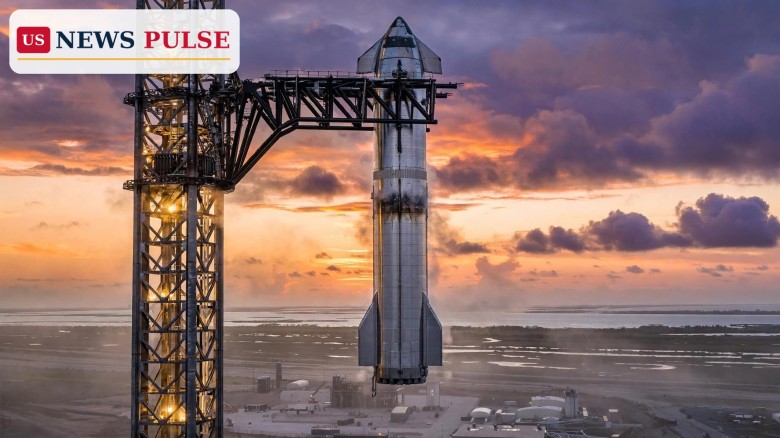
SpaceX made history on Saturday afternoon when the mechanical arms of its launch tower caught Ship 42, the upper stage of Starship, after a full day in orbit. The catch at Starbase, Texas, at 4:20 p.m. ET on Saturday, November 14, 2026, was the first time any spacecraft has been caught by a tower after flying in orbit, and the first recovery of a Block 3 Starship.
Key Points
- Mechazilla's tower arms caught Ship 42 at Starbase's Orbital Launch Pad 2 at 21:20:03 UTC on Saturday, after more than 22 hours in orbit.
- It is the first tower catch of a Starship upper stage after an orbital flight, and the first catch of a Block 3 ship.
- Ship 42 completed about 14 orbits at roughly 275 kilometres and deployed all 26 Starlink V3 satellites.
- The ship passed three in-flight go/no-go checkpoints, including heat-shield photos from three camera-carrying Starlink satellites.
- The Super Heavy Booster 22 catch failed on Friday, so the planned double catch did not happen.
What Happened
The return began with a deorbit burn at about 3:23 p.m. EST on Saturday, nearly an hour before the catch. Ship 42 fired its engines to leave orbit, re-entered the atmosphere over the Pacific Ocean, and steered across northern Mexico and southern Texas toward the tower at Starbase. Along the way it passed three go/no-go checkpoints, and controllers checked heat-shield photos sent back by three Starlink satellites carrying cameras, confirming the ship was fit to come home.
At 21:20:03 UTC, the tower's two giant arms, nicknamed Mechazilla's chopsticks, closed around the ship as it hovered beside the launch mount. The 165-foot spacecraft hung in the arms above the Texas coast, intact after a day in space. Friday's launch was previewed as the most ambitious Starship test yet, with the catch attempt set for Saturday afternoon if all systems checked out.
Background: The Road to the First Ship Catch
Flight 15 lifted off from Starbase on Friday, November 13, 2026, at 5:47 p.m. ET, the 15th test flight of the 407-foot Starship since 2023. The plan was to catch both stages in one mission, the booster minutes after launch and the ship a day later. The first half failed fast. About six and a half minutes after liftoff, onboard automation detected a guidance and navigation problem with Super Heavy Booster 22, the catch was aborted, and the booster was diverted offshore. It burst into flames and exploded just above the Gulf of Mexico moments before splashdown.
Above the drama, the rest of the flight went well. Ship 42 ignited all six Raptor engines, completed hot-staging and a second engine burn, and reached low Earth orbit at about 275 kilometres. It then deployed all 26 Starlink V3 satellites. The booster catch was already proven, with three Super Heavy catches, most recently in March 2025, but the upper stage had always been the harder problem, flying far faster and enduring far hotter re-entry.
Ship 42 Tower Catch: How the First Upper-Stage Recovery Worked
Catching a spacecraft that has just come back from orbit is a different problem from catching a booster. The booster never leaves the atmosphere; it turns around and flies home in minutes. Ship 42 spent more than 22 hours in space, circled the Earth about 14 times, and then had to hit a target the size of a launch tower after plunging back through the atmosphere at hypersonic speed.
That is why the three go/no-go checkpoints mattered. At each one, controllers had to confirm the ship's speed, position and engine health were inside tight limits before allowing it to continue toward the tower. The heat-shield photos from the three camera-carrying Starlink satellites gave engineers a look at the thermal protection that had just survived re-entry, a check that had never been part of a catch decision before.
Reactions and Quotes
Elon Musk had set expectations before the flight, calling the ship-catch odds "more likely than not". The result beat that cautious framing: the catch worked on the first attempt, after a full day in orbit and a re-entry that no vehicle of this size had ever attempted.
SpaceX has framed the flight as a defining test, saying a successful catch would be a "breakthrough moment in making Starship a reliable, rapidly reusable rocket". That language now applies to Saturday rather than Friday: the upper-stage catch, achieved after the booster was lost, is the breakthrough the company was describing. The booster outcome was a reminder of how narrow the margins are
Why It Matters
Today, the upper stage, the part of the rocket that actually reaches orbit, is discarded on every mission, by every operator. Recovering and reflying it would cut launch costs sharply and let SpaceX fly far more often, because the most expensive part of the rocket would no longer be thrown away after a single use.
Saturday's catch is the first proof that the idea can work. The ship catch shows it can catch one that has been to orbit and back, the far harder half of the reusability problem. NASA has given SpaceX about $3.2 billion since 2021 to develop Starship as the lander that will return astronauts to the Moon under the Artemis programme, and SpaceX has put at least $15 billion into the rocket, with a crewed Moon landing targeted for 2028. NASA recently announced a $10 billion suite of Moon Base contracts, including work that depends on heavy-lift rockets like Starship.
What Happens Next
Engineers will now inspect Ship 42 where it hangs in the tower arms, checking the heat shield, engines and structure for damage from re-entry and the catch itself. SpaceX will also work through what went wrong with Booster 22 on Friday, after automation detected a guidance and navigation problem and diverted it to the Gulf. The next Starship flight is expected within weeks. Flight 15 proved the ship can reach orbit, deploy satellites and come home to the tower.
Frequently Asked Questions
What is Ship 42?
Ship 42 is the upper stage of SpaceX's Starship rocket on Flight 15, the spacecraft that carries cargo and crew to orbit. It is a Block 3 Starship, the newest version of the design.
Has a Starship upper stage ever been caught before?
No. Saturday's catch was the first time any Starship upper stage has been caught by a launch tower, and the first time any spacecraft has been caught by a tower after an orbital flight.
How long was Ship 42 in orbit?
More than 22 hours, completing about 14 orbits at roughly 275 kilometres, during which it deployed all 26 Starlink V3 satellites it was carrying.
What happened to the Super Heavy booster?
The Booster 22 catch failed on Friday after onboard automation detected a guidance and navigation problem. It was diverted to the Gulf of Mexico and exploded just above the sea.
Why does catching the upper stage matter?
Every operator today discards the upper stage after one flight. Recovering and reflying it would cut launch costs sharply and make frequent flights, including NASA's Artemis Moon landings, far more affordable.
© 2026 US News Pulse. All rights reserved.
 Print
 Save