

 | Today's Date:





NTSB Says Steering Failure Sent New Orleans Tanker Into Docked Riverboat
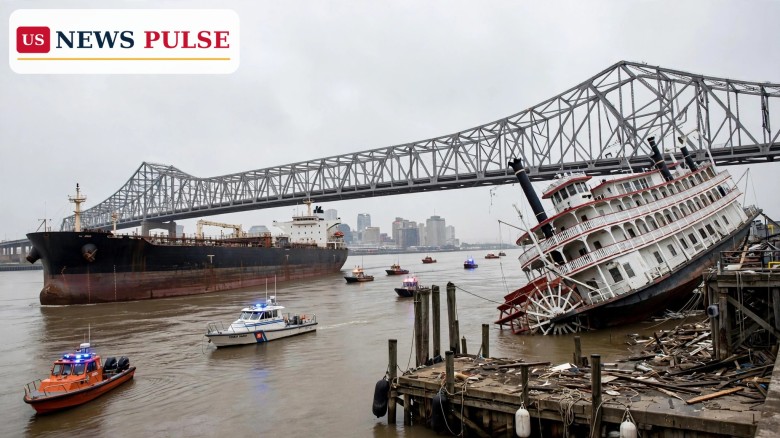
Federal investigators said on Sunday that a steering failure sent the tanker Atlantic Asphalt into a docked riverboat in New Orleans, releasing the most detailed account yet of the two minutes that ended with the American Heritage capsized on the Mississippi River. The National Transportation Safety Board said a preliminary review of the tanker's voyage data recorder shows the vessel suffered a "steering casualty" at about 12:26 p.m. on Friday, November 13, leaving its rudder stuck to starboard near the Crescent City Connection Bridge. About two minutes later, at 12:28 p.m., the tanker struck the docked American Heritage, which capsized in about 22 minutes. No one was killed, 32 people were taken to hospital, and six were still in hospital on Sunday.
Key Points
- The NTSB said on Sunday, November 15, that the Atlantic Asphalt suffered a steering casualty at about 12:26 p.m. on Friday, November 13, near the Crescent City Connection Bridge, leaving its rudder stuck to starboard.
- It veered toward the river's east bank and struck the docked American Heritage at about 12:28 p.m., and the riverboat capsized in about 22 minutes.
- Investigators downloaded more than nine hours of recorder data, including bridge audio, rudder angle, engine performance, speed and course.
- The cause is not yet known. "It could be many different things," said investigator-in-charge Bart Barnum. Crew interviews begin on Monday, November 16.
- No one was killed; 32 people were taken to hospital and six were still hospitalised on Sunday.
What Happened
The Atlantic Asphalt left the Lower 9 Mile Anchorage at Mile 83 at about 11 a.m. on Friday, carrying a crew of 19 and a local river pilot, and was heading upriver to an oil facility in Reserve, Louisiana. That same morning, the American Heritage arrived at the Thalia Street Wharf in New Orleans with 140 passengers and 50 crew members aboard. The riverboat was docked and passengers were disembarking when the tanker approached.
At about 12:26 p.m., as the tanker travelled upriver near the Crescent City Connection Bridge, its rudder stuck to starboard. The ship veered toward the east bank as bridge audio recorded warnings, requests for assistance and orders to drop anchor. The crew had about two minutes to react before the tanker struck at about 12:28 p.m. The American Heritage rolled onto its side, took on water and capsized in about 22 minutes. Rescuers from nearby vessels and first responders accounted for every passenger and crew member aboard. Thirty-two people were taken to hospitals, none with critical injuries, and six remained in hospital on Sunday. The riverboat was left partly submerged in about 25 feet of water alongside the dock.
Background and Context
The collision on Friday set off a major investigation. The NTSB sent a Go Team to New Orleans and recovered the tanker's voyage data recorder on Saturday, November 14. A 16-member NTSB team is on site for about a week, and the Coast Guard is also investigating. The river was closed between mile markers 93 and 96 after the crash, and a Coast Guard safety zone remains in effect, with one-way traffic restrictions for larger vessels as salvage planning continues.
The crash has already reached the courts. The Port of New Orleans sued on Friday for at least $1 million, alleging negligence in the ownership, operation, navigation and maintenance of the tanker. See NTSB recovers data recorder as Port of New Orleans sues over tanker collision and New Orleans riverboat collision: tanker capsizes docked ship, 32 hurt.
NTSB Steering Failure: What the Recorder Showed
The voyage data recorder is the centre of the investigation because it captured the final minutes in detail. Investigators downloaded more than nine hours of data, including bridge audio, rudder angle, engine performance, vessel speed and course. The review so far shows the steering casualty at 12:26 p.m. and the rudder stuck to starboard, but the agency stressed the review remains preliminary and investigators are still examining the recorder data and other evidence from the scene.
The recorder also captured the crew's response: the whistle, radio warnings and requests for assistance, commands to deploy anchors and emergency ship-handling orders. What it cannot yet answer is why the steering failed. The NTSB said it is investigating the personnel involved, the ships involved and the environment at the time, and it has asked anyone with videos, photos or other information about the collision to contact investigators.
Reactions and Quotes
NTSB member John DeLeeuw, speaking at the news conference on Sunday, said the investigation will look beyond what went wrong. "We are investigating the personnel involved, the ships involved, and the environment at the time," DeLeeuw said. "We are also going to investigate the things that went right. There were a number of reasons of why there were no fatalities, and so we are going to take that as part of our investigation."
New Orleans Mayor Helena Moreno has called the outcome "truly a miracle on the Mississippi" and said removal of the sunken riverboat might take weeks. President Donald Trump praised the Coast Guard and first responders on Truth Social after the crash, writing: "Incredibly, nobody was killed by this major collision. 32 people are in the hospital." American Cruise Lines said its guests and crew were evacuated. As of Sunday, 50 hotel rooms remained occupied by displaced passengers.
Why It Matters
A steering failure on a large tanker in one of America's busiest river ports is a serious safety question, and the NTSB's finding narrows the investigation to a specific mechanical event at a specific time. The Atlantic Asphalt is a Marshall Islands-flagged asphalt carrier owned by Nave Shipping S.A. of Liberia and managed by Thome Ship Management of Singapore; the riverboat is a 150-passenger paddlewheeler built in 2015. That a docked ship carrying 140 passengers and 50 crew could capsize in 22 minutes with no one killed is why investigators are studying what went right as well as what went wrong.
What Happens Next
Crew interviews begin on Monday, November 16, and the NTSB expects a preliminary report within about 30 days, with a final report in 18 to 24 months. Salvage planning continues under the Coast Guard safety zone, and Mayor Moreno has said removing the American Heritage could take weeks. The NTSB team remains on site for about a week.
Frequently Asked Questions
What caused the New Orleans riverboat crash?
The tanker Atlantic Asphalt suffered a steering failure at about 12:26 p.m. on Friday, November 13, leaving its rudder stuck to starboard, the NTSB says. The underlying cause is not yet known.
When did the tanker lose steering?
At about 12:26 p.m. local time on Friday, November 13, near the Crescent City Connection Bridge. It struck the docked American Heritage about two minutes later, at 12:28 p.m.
Was anyone killed?
No. All passengers and crew were accounted for; 32 people were taken to hospital and six were still hospitalised on Sunday.
What is the Atlantic Asphalt?
A Marshall Islands-flagged asphalt tanker owned by Nave Shipping S.A. of Liberia and managed by Thome Ship Management of Singapore.
When will the NTSB publish its findings?
A preliminary report is expected within about 30 days, and the final report in 18 to 24 months.

The US News Pulse newsroom covers breaking news across the United States and the world, working from wire services, official statements and on-the-record sources. Every story is reviewed against our editorial standards before publication. Corrections and tips: info@usnewspulse.com
About our newsroomLeave a Comment