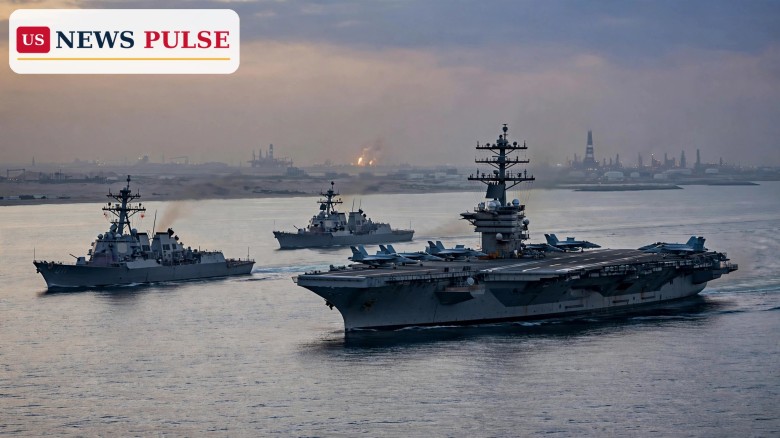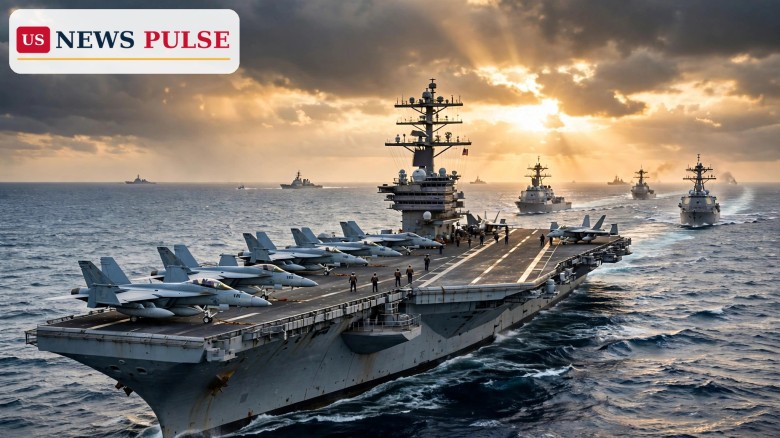
President Donald Trump has ordered a third United States aircraft carrier strike group toward the Middle East, the largest American naval surge in the region since the 2003 invasion of Iraq, even as he insisted on Friday that the war with Iran will soon be over. The deployment of the USS Theodore Roosevelt and its escort ships, expected to arrive by late November, puts three carrier strike groups in striking distance of Iran just days before the November 3 midterm elections, sharpening the contrast between the president's talk of a swift end to the conflict and a military build-up that points toward a possible new round of strikes.
Speaking to Kansas City radio station KCMO on Friday, Trump offered no timeline and no details of any agreement with Tehran, but he sounded confident. "It's going to get wrapped up soon," he said. "We need a guarantee there'll never be a nuclear weapon." The remark, his most direct public prediction yet that the war is nearing an end, came on the same day reports confirmed the third carrier was already on its way.
The deployment was confirmed on Friday, October 30, as the Trump administration weighed what comes next in a war that has now run for months. According to two US officials cited in the reporting, the Roosevelt strike group and the 13th Marine Expeditionary Unit are steaming toward the region and should be in place by late November. A separate amphibious group carrying more than 2,000 Marines has also departed, according to regional reporting.
The timing matters. The United States has not struck Iran since September 1, and Trump pledged on October 8 that there would be no new attacks before the midterm elections. The new force will therefore arrive after voters have had their say on November 3, which is exactly the window in which Gulf officials say strikes could resume. MS NOW reported on Friday, citing three senior Gulf Arab officials, that the administration has briefed its Gulf allies to prepare for a short, intense round of attacks as early as Wednesday, November 4. The White House declined to confirm or deny the report, saying only: "We do not comment on sensitive military plans that may or may not exist."
At the same time, the diplomatic track has not stopped. Qatari mediators were in Tehran on Friday pushing for an agreement, and the administration has been credited by its own senior envoy with keeping a channel open even as the carriers move. The result is a deliberate two-track posture: maximum military pressure on the water, and a last diplomatic push on land.
The American naval presence in the region has been building all year. The USS George H.W. Bush deployed in April, and the USS George Washington arrived in August to replace the USS Abraham Lincoln. NPR reported on Friday that two US aircraft carriers are already in the Arabian Sea, with a third now on the way. Three carrier strike groups operating together would be the heaviest concentration of American sea power in the Middle East in more than two decades, a level of force not seen since the invasion of Iraq in 2003.
The war itself grew out of the long confrontation over Iran's nuclear programme, and it has repeatedly spilled beyond Iran's borders. In recent weeks the fighting has opened a volatile new front in the south, where Yemen's Iran-aligned Houthis have stepped up attacks on Saudi Arabia. Yemen government forces said the Houthis attacked Aden airport and the Maashiq presidential palace complex with ballistic missiles, and the United States ordered non-emergency government employees and their family members to leave Saudi Arabia effective October 23, citing Houthi attacks on civilian airports and other critical infrastructure that caused casualties and severe travel disruption. Riyadh's King Khalid International Airport partially reopened on October 23 for domestic services and some international flights operated by Saudi national carriers.
The Strait of Hormuz, the narrow waterway through which a large share of the world's seaborne oil passes, remains the most sensitive flashpoint. Iran's Revolutionary Guard claimed on Friday that four tankers had hit mines in the strait, a claim the Associated Press said it could not verify. Any closure or mining of the strait would send oil prices soaring and drag Gulf states, which host American bases, directly into the firing line.
Military build-ups of this size are rarely just theatre. A single carrier strike group already carries dozens of strike aircraft, cruise-missile ships and thousands of personnel; three of them together give a president options ranging from sustained air strikes to a blockade enforced at scale. The Wall Street Journal reported that Admiral Brad Cooper, the US military's top commander for the Middle East, visited the White House on Thursday alongside Defence Secretary Pete Hegseth and General Dan Caine, chairman of the Joint Chiefs of Staff, to brief Trump on potential strike scenarios and on plans to maintain the ongoing regional blockade.
That briefing is the clearest sign yet that the Roosevelt's deployment is tied to a decision point, not routine rotation. Carriers take weeks to cross oceans, so ordering the third group now means the capability will be in place for whatever Trump decides after the midterms, whether that is a negotiated settlement he can present as a victory or a new round of strikes he can present as enforcement. The administration has kept both stories alive at once: the president says the war will end soon, while his officials warn allies to be ready for it to intensify.
The midterm calendar adds a political layer that even the administration's allies acknowledge. Axios reported on Saturday that Trump may be more inclined to order a major military operation against Iran if Republicans lose badly on November 3, citing an official familiar with the discussions. Senator Ted Cruz warned on Friday that Republicans would lose heavily if only early votes were counted, a reminder that more than 47 million Americans had already voted before Election Day, a midterm record. Trump has repeatedly suggested that hostilities could end shortly after the elections provided Republicans retain control of Congress, tying the war's endgame, in his own framing, to the election result.
Trump's own words on Friday set the tone for both tracks. To KCMO he said: "It's going to get wrapped up soon. We need a guarantee there'll never be a nuclear weapon." To reporters the same day he struck a more patient note: "There are talks. They want to talk. They keep talking. ... We have time, frankly. It's a war, but it is not a typical war." The two statements are not contradictory so much as complementary: talks continue, but only under the shadow of a guarantee backed by force.
On the diplomatic side, Vice President JD Vance has reportedly offered to meet Mohsen Rezaei, a former commander of Iran's Revolutionary Guard who now serves as secretary of Iran's Supreme National Security Council. The Washington Post reported that the administration views Rezaei as the essential point of contact in Tehran and the only person who could build a consensus behind an agreement to halt Iran's nuclear programme. Senior US envoy Tom Barrack told CNN on Thursday that regional allies, including Qatar and Pakistan, had helped create an opening for Washington and Tehran to agree on a process for de-escalation, and he urged both sides to pause hostilities before tensions escalate further.
The warnings from the region have been blunt. Axios reported that Iran has vowed to attack oil and gas facilities in five Gulf states if the United States hits its energy infrastructure, and Gulf officials have said strikes could resume as soon as November 4. Gulf allies, for their part, have been lobbying Washington to de-escalate, and one official has said they would not be surprised if some states resisted American strikes launched from their territory. No Gulf government has publicly confirmed the November 4 briefing, and the White House has refused to discuss it.
Three carriers change the arithmetic for everyone. For Iran, the build-up is a deadline: negotiate a guarantee on the nuclear programme, or face a force capable of a sustained campaign rather than a single night of strikes. For Gulf allies, it is a risk: their bases, airports and energy plants sit within range of Iranian retaliation, as the Houthi attacks on Saudi airports have already demonstrated. For American voters, it is a reminder that the midterm result may shape not just domestic policy but the timing of a war, with the president himself linking the conflict's end to Republicans holding Congress.
There is also a credibility question. Trump has now said twice in different ways that the war is near its end, while simultaneously assembling the largest naval force in the region in 23 years. If the Roosevelt arrives in late November and no deal follows, the pressure to use that force will grow, and the "wrapped up soon" promise will be tested against events. If a deal does follow, the build-up will be presented as the pressure that produced it. Either way, the deployment ensures the next decision on Iran will be made from a position of overwhelming force, and the world will be watching which story the president chooses.
The immediate calendar is fixed. Americans vote on Tuesday, November 3. The day after, according to the Gulf briefing reported by MS NOW, is the earliest date for a renewed round of strikes, though officials stress that no final decision has been made. The Roosevelt group is expected in the region by late November, which means the full three-carrier force will not be assembled until weeks after any early-November decision, a gap that suggests any initial strikes would be launched with the two carriers already in the Arabian Sea.
Diplomacy will run in parallel. Qatari mediation in Tehran continues, the Vance-Rezaei channel remains open, and Barrack's call for a pause gives both sides a face-saving route to talks. Watch for three signals in the coming days: whether the White House repeats the "wrapped up soon" line after the midterms, whether Gulf states publicly distance themselves from strike planning, and whether Houthi attacks on Saudi infrastructure escalate or subside. Any one of those will tell Americans whether the third carrier is a bargaining chip or a prelude.
Which carrier is being sent? The USS Theodore Roosevelt carrier strike group, accompanied by the 13th Marine Expeditionary Unit, with about 9,000 sailors and Marines aboard, according to MS NOW.
When will it arrive? US officials say the group is expected to reach the Middle East by late November, joining the USS George H.W. Bush and the USS George Washington already in the region.
Why is three carriers significant? US Central Command confirmed it would be the largest American naval surge in the Middle East since the 2003 invasion of Iraq.
Has Trump decided to strike Iran again? No final decision has been announced. Reports say Gulf allies were briefed to prepare for strikes as early as November 4, but the White House says it does not comment on sensitive military plans.
What does Trump say he wants? In his own words to KCMO radio: "We need a guarantee there'll never be a nuclear weapon." He also says the war is "going to get wrapped up soon."
Read more on US News Pulse: Iran Strikes November 4: US Warns Gulf Allies as Doha Talks Race to Avert War, US Approves $2.1 Billion Patriot Missile Sale to Ukraine After Delay Row, and US-Iran Strike Plans: Forces Ready Within 96 Hours of Trump Order, Reports Say.
Leave a Comment



 | Today's Date: