G20 foreign ministers ended two days of talks in Atlanta, Georgia, on Saturday, October 31, 2026, without reaching agreement on several critical global security questions, leaving the world's largest economies to close their meeting with a chairman's statement rather than a joint communique. The split, driven above all by Russia's war in Ukraine, overshadowed a gathering the United States had hoped would show unity ahead of the leaders' summit in Florida in December, and it exposed how far apart the group's members remain on Ukraine, Iran, tariffs and the South China Sea.
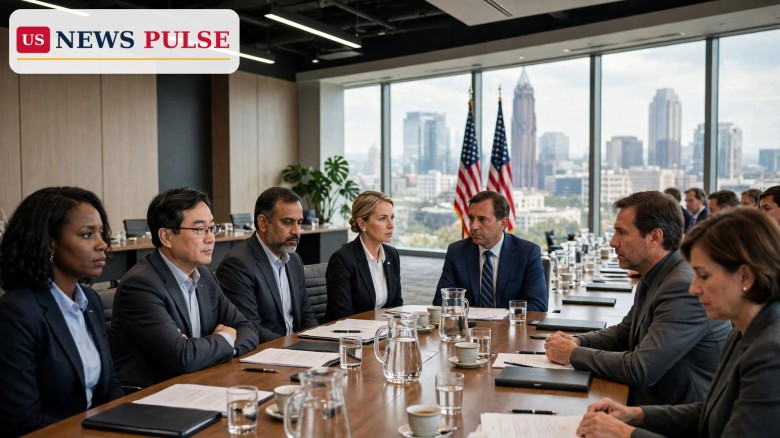
Top diplomats from the Group of 20 largest world economies closed their two-day meeting in Atlanta on Saturday without a shared position on the security issues at the top of the agenda, according to diplomats who attended the talks and spoke to the Associated Press. Instead of a communique agreed by all members, the meeting will rely on a chairman's statement, which Rubio, as host and chair, will release at the conclusion of the talks.
The outcome was not presented as a last-minute breakdown. Diplomats said a chairman's statement had long been the expected result, given the depth of the disagreements in the room. Those disagreements cover the Russia-Ukraine conflict, the United States-Israeli war against Iran, American tariffs, and Chinese actions in the South China Sea, all of which, diplomats said, have contributed to spikes in the global cost of fuel and to uncertainty about trade.
Rubio had opened the meeting with an appeal for unity, but the tensions were visible from the start. On Friday he cancelled the traditional group photograph of the foreign ministers after European diplomats objected to the inclusion of Lavrov and threatened to boycott the picture or walk out of it. The photograph, a routine ritual at such gatherings, became instead an early symbol of the divisions that would run through the two days of talks.
The G20 brings together 19 major economies plus the European Union and the African Union, and its foreign ministers' meeting in Atlanta was held under the United States presidency of the group, with Rubio in the chair. The Atlanta talks were a preparatory step toward the leaders' summit that President Donald Trump will host in December at his golf club in Miami, Florida. That summit, rather than the ministers' meeting, is where the group's leaders will be expected to show whether any common ground can be found.
Getting to Atlanta was itself contentious. Some G20 countries had already expressed concern that the United States invited Russia at a time when Moscow has intensified its attacks on Ukraine, especially after Trump pushed relations with Kyiv to new lows by waiving fresh sanctions on Moscow and temporarily limiting logistical and intelligence assistance to Ukraine. Against that background, Lavrov's presence in Atlanta, on the soil of a NATO member state, was notable in itself: the Russian foreign minister has travelled only infrequently to NATO countries since Russia invaded Ukraine in February 2022 and severe sanctions were imposed on Moscow.
It is still unclear whether Russian President Vladimir Putin will accept Trump's invitation to attend the December leaders' summit in Miami. That question now hangs over the next stage of the American presidency of the G20, and over whether the leaders' meeting can produce the kind of joint statement that the ministers in Atlanta could not.
The deepest divide remains Ukraine. Diplomats described the opening session as cordial, but said Russia's position on Ukraine is unyielding, and that Moscow also opposes Poland's membership of the G20. Poland's foreign minister, Radoslaw Sikorski, who was representing his country for the first time as a guest at a G20 meeting, said on Friday that he was not surprised by the failure to reach consensus.
“We have wars going on, and we have participants in those wars around the table, so it’s very difficult to agree on a common line,” Sikorski told reporters, in a remark that captured the structural problem facing the group: the countries at the table include both the parties to the wars under discussion and their critics, making a single agreed text exceptionally hard to draft.
Lavrov, for his part, restated Moscow's position in familiar terms, saying Russia will not allow a situation in which Ukraine poses a “military threat to legitimate security interests of the Russian Federation.” That language leaves little room for compromise on the central question of the war, and it helps explain why the ministers settled for a chairman's statement rather than a negotiated communique.
The disagreements go beyond Ukraine. Diplomats said the talks also exposed differences over the Trump administration's decision not to invite G20 member South Africa, over the objections of other members. And the wider agenda, from tariffs to maritime disputes, offered further ground for disagreement rather than a route around the Ukraine divide.
No minister claimed the Atlanta meeting as a success, but neither did the participants present it as a collapse. Those who spoke anonymously, because they were not authorised to discuss the closed-door talks, stressed that all sides had agreed to try to overcome their differences despite the long odds, and to work to make the December leaders' summit a success. That commitment, modest as it sounds, was the meeting's main forward-looking outcome.
The United States used the margins of the meeting to pursue its own priorities. Washington has said a top priority for the gathering was resolving differences over freedom of navigation, particularly in the Strait of Hormuz, the Red Sea, the Black Sea and the South China Sea, with discussions taking in Iran, Russia-Ukraine and China and its smaller neighbours. Rubio met on the sidelines with his Saudi counterpart, Prince Faisal bin Farhan, as well as Turkish Foreign Minister Hakan Fidan, whose country has been a key mediator in efforts to avoid a wider war.
At the same time, Washington underlined its support for Kyiv in a separate move: the State Department announced on Friday that it had approved a proposed $2.1 billion sale of Patriot air defence interceptors for Ukraine. The announcement, made while Lavrov was in Atlanta, was a reminder that the absence of consensus in the meeting room has not stopped the United States from acting on Ukraine through other channels.
A G20 meeting that ends without a communique is not unusual in a period of open war and trade conflict, but the Atlanta result matters because of what it signals about the December summit. The ministers' meeting was supposed to narrow differences and prepare agreed language for the leaders; instead it confirmed that the core disputes are unresolved, leaving Trump and the other leaders to confront them directly in Miami.
It also matters for the issues themselves. The disputes in Atlanta are not abstract: they concern a war in Europe that continues to kill civilians, a confrontation with Iran that has put the Gulf region, including G20 member Saudi Arabia, on edge, tariffs that are reshaping global trade, and maritime tensions in seas through which a large share of world commerce passes. When the world's largest economies cannot agree on a common line on those questions, the uncertainty feeds directly into fuel prices, shipping costs and investment decisions.
For the United States, as G20 president, the result is a mixed one. Hosting the meeting in Atlanta put American diplomacy at the centre of the effort, and the chairman's statement gives Rubio a vehicle to set out Washington's reading of the talks. But a chairman's statement is not a consensus, and the absence of a joint text will be read by allies and rivals alike as evidence of how divided the group has become.
The immediate next step is Rubio's chairman's statement, which will summarise the discussions as the American presidency sees them. Its wording will be watched closely for how it handles Ukraine, Iran and the South China Sea, and for whether it attempts to bridge the gaps or simply records them.
Beyond that, attention turns to the December leaders' summit in Miami. Diplomats in Atlanta said all sides had agreed to work to make that summit a success, but success will now have to be defined: a leaders' communique would be a significant achievement, while a second chairman's statement would confirm that the divisions on display in Atlanta run to the very top of the group.
Two questions will shape the run-up to Miami. The first is whether Putin accepts Trump's invitation and attends in person, a decision that would transform the politics of the summit. The second is whether the confrontation with Iran escalates or eases: the Associated Press has reported that US officials have told several Middle East countries and regional allies to be prepared for potential renewed strikes against Iran after Tuesday's midterm elections, and for the possibility that Iran will retaliate against them. How that situation develops in the coming days could either sharpen the divisions seen in Atlanta or give the leaders a new reason to seek common ground.
Did the G20 foreign ministers agree on a joint statement in Atlanta? No. The October 30-31 meeting ended without consensus on several critical global security issues, so no joint communique will be issued. Secretary of State Marco Rubio will instead release a chairman's statement.
Why was there no consensus? Diplomats cited deep differences over Russia's war in Ukraine, the US-Israeli war against Iran, US tariffs and Chinese actions in the South China Sea, as well as disagreement over the decision not to invite South Africa.
Why was the group photo cancelled? Rubio cancelled the traditional photograph on Friday after European diplomats objected to the inclusion of Russian Foreign Minister Sergey Lavrov and threatened to boycott or walk out of the picture.
What happens next for the G20? The leaders' summit hosted by President Donald Trump in Miami in December is the next major test. Ministers in Atlanta agreed to try to overcome their differences and make that summit a success.
Will Vladimir Putin attend the December summit? It is unclear. The Associated Press reported that it is not known whether Putin will accept Trump's invitation to attend the summit at his Miami golf club.
Related coverage: US, South Korea and Japan vow complete North Korea denuclearization in Atlanta, Iran strikes on November 4: US warns Gulf allies as Doha talks race to avert war, and US staff leave Saudi Arabia after Houthi airport attacks, embassy warns.
Leave a Comment



 | Today's Date: