The District of Columbia and Virginia filed a federal lawsuit on Saturday, October 31, 2026, to stop President Donald Trump’s planned 250-foot Triumphal Arch at Memorial Circle, calling the project “flagrantly unlawful” and accusing the administration of rushing to break ground before a court can rule. The Triumphal Arch lawsuit is the latest and broadest legal challenge yet to one of the president’s signature Washington building projects, and it lands just five days before planners are due to decide the arch’s final site and building plans.
The lawsuit, obtained by USA TODAY, was filed in federal court on Saturday by the District of Columbia and the Commonwealth of Virginia. It targets the planned arch at Memorial Circle, where Arlington Memorial Bridge and the George Washington Memorial Parkway meet in front of the entrance to Arlington National Cemetery. The administration has said the arch, first announced a year ago, will commemorate the country’s 250th anniversary.
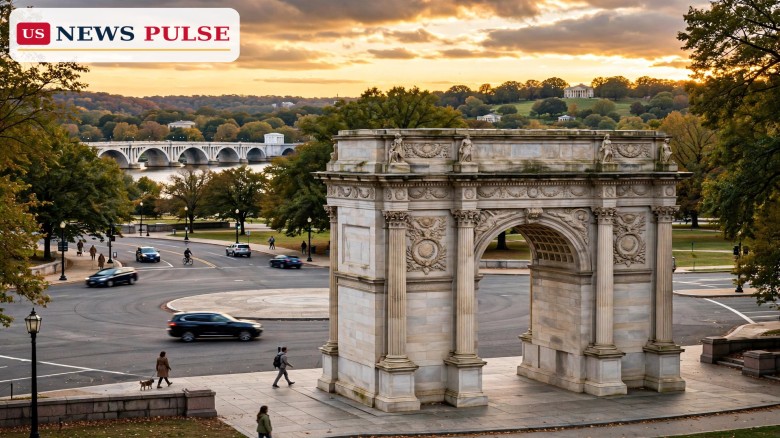
The structure is planned as concrete clad in granite, topped with two gilded eagles and a central winged figure. At 250 feet, it would tower over the capital’s other landmarks and over the low, classically ordered landscape of the memorial bridge axis that links the Lincoln Memorial with Arlington House.
“The Court should not allow this cynical gambit to succeed,” attorneys general Brian Schwalb and Jay Jones wrote in the suit. “As soon as Defendants break ground on this project, they will inflict irreparable harm on both the District and Virginia.” The suit adds, in its own words: “The Arch will change the District’s historic character.”
USA TODAY reported that it had sought comment from the National Park Service, the Department of the Interior and the White House. No response from those agencies was included in the report.
The arch has been contested since it was announced. A Washington Post analysis reported in October that a 3D model showed the 250-foot structure would cast shadows over burial grounds at Arlington National Cemetery on 284 days a year, touching more than 75,000 graves, and would shadow the John F. Kennedy eternal flame on 18 days. The Interior Department disputed those findings, saying its own models showed far shorter shadow effects, while veterans’ groups called the project a desecration of hallowed ground.
Just a day before this new filing, a separate hearing tested the administration’s case from a different direction. At an October 30 hearing, Judge Tanya Chutkan pressed government lawyers on the claim that the arch serves national security, asking what harm there would be in waiting three or four months and what would count as final agency action before bulldozers start digging. Vietnam veterans and a historian are seeking an injunction in that case before the November 5 planning decision.
The new lawsuit widens the fight beyond those earlier cases. Arlington County has already pursued its own Virginia suit, and veterans have sued separately. Now the two governments that actually own and manage the land, roads and services around Memorial Circle have joined the litigation, arguing that the project harms their sovereign interests, their budgets and their residents.
The core of the Triumphal Arch lawsuit is an authorisation argument. The attorneys general say building a monument of this kind requires approval from Congress, and that the administration has bypassed that legally required step. A monument rising at the ceremonial entrance to the nation’s most hallowed burial ground, they argue, cannot be treated as an ordinary executive construction project.
The second argument is about height. The suit says the arch would nearly double the legally permissible height of 130 feet for buildings in the nation’s capital. The 250-foot figure is symbolic — one foot for each year of American independence — but the states argue symbolism does not override a height regime that has shaped Washington’s skyline for more than a century.
The third argument is about timing. Lawyers for the administration have previously said in a court filing in a separate lawsuit that construction could begin as soon as November 5. The new suit says the administration is attempting to “outrun judicial review” by rushing groundbreaking so it can later argue that the project cannot be stopped once it has started. Courts are often reluctant to halt a project after major money has been spent and ground has been broken, and the states say that is precisely the outcome the schedule is designed to produce.
Finally, the suit sets out practical harms. It says construction will snarl traffic at a major artery between DC and Virginia, impede emergency responders, and damage the environment, particularly through stormwater runoff into the Potomac River, which the states say they will have to address with their own financial resources.
The states’ position is stated in the filing itself, in unusually blunt language. The project is “flagrantly unlawful,” the suit says, and the rush to build it is a “cynical gambit” that a court should not reward. The attorneys general frame the case as a defence of both the District’s historic character and Virginia’s riverfront, roads and emergency services.
The administration’s position, as set out in earlier proceedings and agency findings, is that the arch honours America’s founding principles and its 250th anniversary, and that a smaller arch would not carry the same meaning. The National Park Service said in an August report that the arch would “diminish the integrity” of key characteristics of other sites, but it backed the plans anyway and rejected proposals for a smaller structure.
Administration lawyers have also argued in the veterans’ case that the project is a generational national defence opportunity, pointing to declarations from defence officials, and that the first six to eight months of work would be excavation, with above-ground construction not beginning before May 2027 and the full project taking 33 to 39 months. The new suit treats that long timeline as an argument for, not against, judicial review: there is time, the states say, for a court to decide the legal questions before the ground is broken.
Veterans’ groups and preservationists, who have opposed the arch since its announcement, are likely to welcome the states’ intervention, while supporters of the project present it as a fitting monument for the semiquincentennial. The White House has previously described the arch as an enhancement of the visitor experience at one of the capital’s most visited ceremonial landscapes.
This case matters for three reasons. First, it tests how far a president can reshape the monumental core of Washington without Congress. If the states win, the ruling would reaffirm that major new monuments on federal ceremonial land need legislative authorisation, a constraint that would outlast this project. If the administration wins, the precedent would give future presidents far more freedom to build in the capital’s most symbolic spaces.
Second, it tests the height limit that has defined Washington’s skyline. The city’s low profile is not an accident: it is the product of law, planning and a deliberate decision to keep the Capitol and the Washington Monument dominant. A 250-foot arch at Memorial Circle would be visible across the Potomac and from the Lincoln Memorial, changing views that have been protected for generations.
Third, the timing matters. The November 5 planning decision and the possible start of construction the same week compress the legal calendar. Courts will have to decide, quickly, whether to pause a project that the administration wants to present as a fait accompli by the time the semiquincentennial celebrations arrive.
The immediate dates are November 5, when the National Capital Planning Commission is expected to meet and decide on approving the final site and building plans, and when the Department of the Interior will also issue a final decision authorising construction. Expect the states to seek emergency relief before that meeting, asking a judge to preserve the status quo until the authorisation and height questions are decided.
Judge Chutkan’s separate case is also pending: she has promised to rule expeditiously on the veterans’ request for an injunction, and her decision could arrive before or alongside any ruling in the states’ case. A ruling in either case that pauses construction would transform the November 5 timetable.
Longer term, the case could move through appeals even if construction is paused, and the political calendar will keep pressure on both sides. The arch is tied to the 250th anniversary, and every month of delay makes it harder to complete any version of the project in time for the celebrations the administration has planned.
Who sued to stop the Triumphal Arch? The District of Columbia and Virginia, through attorneys general Brian Schwalb and Jay Jones, filed a federal lawsuit on October 31, 2026.
Why do they say the arch is unlawful? They argue the administration bypassed legally required authorisation from Congress and that the 250-foot height nearly doubles the 130-foot limit for buildings in the capital.
Where would the arch stand? At Memorial Circle, where Arlington Memorial Bridge and the George Washington Memorial Parkway meet in front of the entrance to Arlington National Cemetery.
When could construction begin? As soon as November 5, 2026, according to an earlier administration court filing, with the National Capital Planning Commission due to decide final plans that day. Full construction could take two to three years of nearly round-the-clock work.
What happens next? Expect the states to seek emergency court relief before November 5, alongside the pending ruling from Judge Chutkan in the veterans’ separate case.
Related coverage: Trump’s 250-foot arch faces a judge’s test over its national-security claim and Trump arch shadow would fall on 75,000 Arlington graves, study finds. US News Pulse will follow the November 5 planning decision and any emergency court ruling in this case.

Leave a Comment



 | Today's Date: