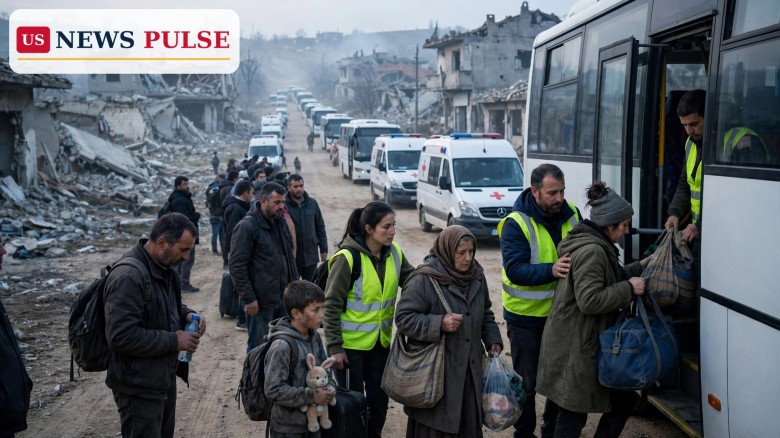
Residents evacuated from the Russian-occupied town of Oleshky have crossed back into Ukrainian-controlled territory, completing a rare humanitarian mission carried out under the longest local truce of the Ukraine war. Four planes carrying the evacuees landed in Belarus on Saturday, October 31, 2026, before the group continued by bus into Ukraine, ending a four-day operation that both sides described as incident-free.
The evacuation reached its conclusion on Saturday in stages. Ukrainian lawmaker Davyd Arakhamia said four planes transporting evacuees bound for Ukraine had landed in Belarus, and that the passengers would be on Ukrainian territory "within hours". By Saturday afternoon, Zelenskyy confirmed the final step on X: "As of now, Ukrainian citizens from Oleshky have crossed the Ukrainian border in the Chernihiv Oblast."
The journey itself was long and indirect. Civilians left Oleshky, on the Dnipro River in Ukraine's southern Kherson region, in bus convoys on Friday, travelling first into Russian-occupied territory and then to Anapa, a Russian city on the Black Sea coast, before flying to Gomel in south-eastern Belarus. From there they continued by bus to the Ukrainian border. Belarusian state media outlet Belta reported that the group was met in Gomel by rescue workers, medical teams and Red Cross volunteers.
Ukrainian human rights commissioner Dmytro Lubinets, who travelled with the evacuees, shared video of people disembarking in Belarus. "For now, we are on the territory of the Republic of Belarus, together with our people and even their beloved pets!" he wrote. Russia's human rights ombudsman Yana Lantratova, who visited Oleshky alongside Lubinets on Friday, said in a video post on Telegram: "The humanitarian mission in Oleshky is concluding. Everything went smoothly." Moscow said the operation had been completed "without any incidents".
Oleshky was captured by Russia in 2022 and has spent years near the front line, in what former residents and officials describe as a "kill zone" where Ukrainian military positions lie just five kilometres away. Its pre-war population of about 24,000 has collapsed to an estimated 1,700 to 2,000 people, who have endured months of food and medicine shortages, with former residents saying some were forced to hunt and eat pigeons. Several hundred people are understood to have decided to stay even now, despite widespread devastation and a lack of gas, electricity and running water, while others chose to travel to Russian-held territory instead.
The truce that made the evacuation possible began at 3 a.m. on Tuesday, October 27, and was brokered with the help of US First Lady Melania Trump, with the pope's involvement also reported. It was announced last week to pave the way for aid deliveries and evacuations, and it was later expanded to cover all of Kherson Oblast. Ukrainian officials said roads leading to Oleshky were demined during the pause, humanitarian aid was delivered, and people were evacuated from the town and surrounding area. Lubinets said that during the 87-hour truce, not a single airstrike was recorded, making it the longest pause in fighting anywhere on the front line since Russia's full-scale invasion in 2022. The ceasefire is set to remain in effect until 10:59 p.m. on Sunday, November 1.
On Friday, Ukrainian and Russian officials visited the town together, delivering aid and marshalling those who wanted to leave. After hours there, both sides said they had left with convoys of people, some heading to Russia and others on the long journey back to Kyiv-controlled territory. Melania Trump had posted on social media on Friday that the humanitarian convoy could safely evacuate more than 750 people, writing that it included "25 buses, 50 medical professionals, and ambulances".
The mission's achievement is narrow but significant: for four days, two armies at war cooperated on a single humanitarian task, moved civilians across three countries, and did so without a reported violation. In a war nearing its fifth year, that kind of joint operation is almost unheard of, and both Kyiv and Moscow have claimed it as a success. The presence of both countries' ombudsmen on the ground together, and the involvement of the Red Cross at the Belarusian end, gave the operation a legitimacy that unilateral claims rarely carry.
What it did not do is change the war. The truce covers one town and one region, and it expires on Sunday evening. While the evacuation was under way, the wider war continued: Russia's defence ministry said on Saturday that its forces had shot down 433 Ukrainian drones overnight, while Zelenskyy said Moscow had launched drone attacks on energy and railway infrastructure across Ukraine overnight, leaving 280,000 households in the Dnipro and Kyiv regions without power. Oleshky's evacuees are safe; the front line they left behind is not quiet.
The numbers also remain uncertain. Neither side has said how many people actually left, and the figures that do exist describe capacity rather than outcomes: 25 buses prepared for up to 750 people, nine ambulances deployed, four planes flown. How many of the town's remaining residents chose Ukraine, how many chose Russia, and how many stayed will shape how this mission is remembered, and that accounting has not yet been published.
Zelenskyy's confirmation was brief and factual, focused on the crossing itself: "As of now, Ukrainian citizens from Oleshky have crossed the Ukrainian border in the Chernihiv Oblast." Arakhamia, who had tracked the flights, said the fourth and final plane landed in Gomel at about 1 p.m. on Saturday, adding: "In a few hours, all Ukrainian citizens evacuated from Oleshky, together with the Ukrainian delegation, will be back on Ukrainian soil."
From the Russian side, Lantratova's assessment was equally spare: "The humanitarian mission in Oleshky is concluding. Everything went smoothly." Moscow's defence ministry confirmed that those who had chosen to travel to Ukrainian-held territory were transported to Anapa before boarding planes to Gomel, and said the operation was completed without incidents.
Lubinets, Ukraine's commissioner, emphasised the human detail, noting that evacuees travelled "together with our people and even their beloved pets", and that the expanded truce had passed without a single airstrike. The White House has previously credited Melania Trump with helping to broker the localised ceasefire, and the Jerusalem Post reported that the pope was also involved in the mediation.
The Oleshky evacuation matters first as a humanitarian fact: hundreds of people who had been cut off from food, medicine and basic services for months are now out, and those who stayed received replenished supplies. For the individuals involved, the distinction between a strategic breakthrough and a local pause is irrelevant; they are alive and, for the first time in years, reachable.
It matters second as a precedent. A truce brokered with American help, observed by both sides' ombudsmen, extended across an entire region and honoured for 87 hours shows that localised pauses are still possible even in a war that has resisted every broader ceasefire attempt. If the model can be repeated in other front-line towns, it could open a narrow but real humanitarian channel. If it cannot, Oleshky will stand as an exception that proves how hard such cooperation has become.
It matters third for what it reveals about the war's current shape. That a town five kilometres from the front line could only be evacuated by sending its people through Crimea, Anapa and Belarus, a journey of hundreds of kilometres in the wrong direction, says everything about how frozen and fragmented the battlefield has become. The evacuation's success is real, but so is the absurdity of its route.
The immediate question is what happens when the truce expires at 10:59 p.m. on Sunday, November 1. Residents who stayed in Oleshky will be left with replenished food and medical supplies but no guarantee of continued safety, and the town will return to the front line. Ukrainian officials will also face questions about how many people were evacuated and where they will be housed, while Russian officials will present their own account of those who chose Russian-held territory.
The broader question is whether the Oleshky model travels. Diplomats and aid agencies will be watching for any sign that the same mediation, involving the US First Lady's office and the pope, can produce a second local truce elsewhere in Kherson or beyond. For now, though, the war's wider dynamics, drone strikes on infrastructure, a grinding front line and no general ceasefire in sight, suggest Oleshky will remain a singular humanitarian bright spot in a dark week.
Civilians were evacuated from the Russian-occupied town of Oleshky in southern Ukraine under a rare local truce, travelling by bus via Crimea and Anapa to Belarus, then flying to Gomel and continuing into Ukraine.
On Saturday, October 31, 2026, when President Zelenskyy confirmed that the evacuated Ukrainian citizens had crossed the border into Chernihiv Oblast.
The local ceasefire was brokered with the help of US First Lady Melania Trump, with the pope's involvement also reported, and it began at 3 a.m. on Tuesday, October 27.
Neither side has disclosed the exact number. The convoy was prepared for up to 750 people with 25 buses, and four planes carried evacuees to Belarus.
The ceasefire is set to remain in effect until 10:59 p.m. on Sunday, November 1, 2026.
Related coverage: Melania Trump ceasefire brings hope to Oleshky as Ukraine aid mission begins, Ukraine refinery strike ends pause as fire hits Russian oil plant, US says Strait of Hormuz routes cleared as Oman rescues 25 sailors.
Leave a Comment



 | Today's Date: