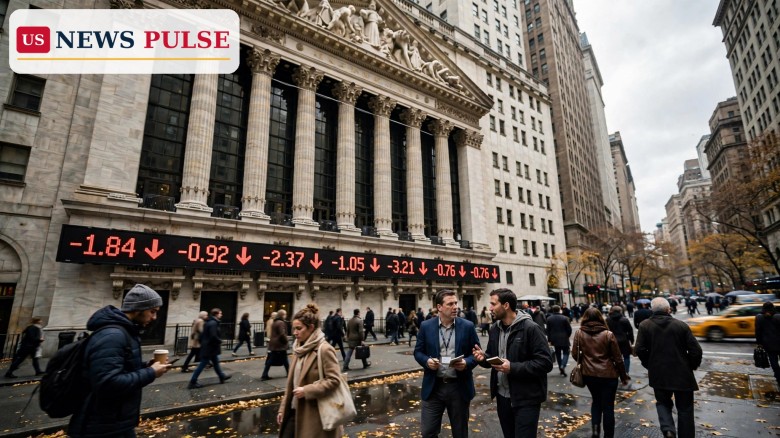
Wall Street suffered its worst day since June on Friday, October 30, 2026, as a deepening selloff in technology shares dragged the major indexes lower and capped a third straight losing week. The Wall Street selloff saw the S&P 500 fall 1.8 percent, the Nasdaq composite sink 2.9 percent and the Dow Jones Industrial Average drop 572 points, as investors questioned whether the artificial intelligence boom that powered this year's rally has pushed share prices too high.
The selloff gathered pace through Friday's session in New York. Technology stocks, which have led the market higher for much of the year, led it lower instead. The Nasdaq composite's 2.9 percent fall was its biggest one-day decline since June, and the S&P 500's 1.8 percent drop matched that unwanted milestone. The Dow, which holds fewer technology names, fell a more modest 1.1 percent but still lost 572 points. All three indexes closed out a third consecutive losing week, a run that has left traders asking whether the market's long climb has finally run out of easy momentum.
Intel was the day's most dramatic casualty. Its shares plunged 28.6 percent, the chipmaker's worst single-day fall since 1974, after weak guidance erased roughly 140 billion dollars in market value and dragged the wider market down with it. Social media firm Reddit fell 29 percent, and chipmaker Sandisk, one of the great beneficiaries of the AI capital-spending boom, dropped 13 percent. The Nasdaq 100 index of large non-financial stocks fell 3.5 percent, putting it on the brink of a correction, defined as a fall of 10 percent from a recent high. The Nasdaq composite is now down 7.8 percent from its closing high, after its worst month since March 2025 wiped out a chunk of this year's AI-fuelled gains.
The damage went well beyond technology. Financial stocks were hit hard, with Goldman Sachs down 4 percent and Jefferies off 6 percent, reflecting a broad pullback from risk as government bonds rallied. Silver dropped 6 percent, putting it down 31 percent for the year, and gold fell 3.5 percent, putting it down 10 percent for 2026. Oil moved the other way, rising 2 percent, adding to concern about an economy that many investors see as dependent on the AI buildout for its energy. Bitcoin fell 3 percent, dropping below 77,000 dollars from more than 86,000 dollars earlier in the month, after hackers took more than 6 billion dollars from Binance, the world's biggest crypto exchange, in an attack a United States-based blockchain intelligence firm said was likely carried out by a North Korean unit.
Friday's fall did not come out of nowhere. It followed a bruising week for the big technology firms at the centre of the AI buildout: Microsoft, Meta Platforms, Amazon and Google parent Alphabet. Their shares dropped 1 to 2 percent on Friday after significant declines earlier in the week. The four so-called hyperscalers have been collectively responsible for more than a third of all the capital spending undertaken by the current constituents of the S&P 500 over the past 12 months, according to Capital Economics, and they have outlined plans to spend more than 740 billion dollars on capital expenditure this year.
That spending is the heart of the market's argument with itself. On one side, business investment has been genuinely strong. The United States Bureau of Economic Analysis reported on October 29 that real gross domestic product expanded at an annualised rate of 3.4 percent in the third quarter of 2026, up from 2.2 percent in the second quarter, with business investment rising 12.7 percent, driven largely by spending on information processing equipment for AI infrastructure. Consumer spending rose 3.8 percent, matching the second quarter and marking its strongest growth since the end of 2024.
On the other side, the bills are starting to show. Amazon reported a weaker profit for the summer than analysts expected, and more concerning for investors, it burned through 42.4 billion dollars of cash over the prior 12 months on a free cash flow measure, after spending 94.8 billion dollars on property and equipment, primarily for AI technology. At the same time, ordinary Americans feel squeezed: the University of Michigan's monthly survey, released on October 26, showed consumer sentiment at its second-lowest level in 74 years, inflation remains stubbornly above the Federal Reserve's 2 percent target, and petrol prices averaged 4.22 dollars a gallon, 1.19 dollars higher than a year earlier.
The Wall Street selloff is, at its core, a repricing of the AI trade. For two years, investors have paid ever-higher prices for companies building AI infrastructure, on the assumption that the spending would turn into profits quickly. Friday's trading suggested that patience is thinning. When Intel warned on its outlook, when Amazon showed how much cash its AI buildout consumes, and when the hyperscalers' shares slipped for a fourth straight session, the market's answer was to sell first and ask questions later.
The timing adds a political edge. The selloff comes days before Tuesday's midterm elections, and worries about AI in general have already become a concern for voters across political parties. President Donald Trump has historically used the stock market's performance as a measure of his own success, so a market that is suddenly shaky, even while still close to its highs, is an unwelcome backdrop for the final days of campaigning. The Federal Reserve, which left interest rates unchanged at its October 28 meeting following a quarter-point rise the previous month, now faces a market that is simultaneously worried about inflation and about growth.
Oil's rise to six-month highs sharpened the anxiety. Brent crude settled at 117.64 dollars and West Texas Intermediate at 104.12 dollars after a limpet mine attack on a tanker in the Strait of Hormuz, the first successful strike in the waterway since the conflict began in February. Higher oil prices feed directly into petrol prices and transport costs, and they arrive just as voters are already listing the cost of living as their top concern.
Market watchers described Friday as a reckoning rather than a panic. The Associated Press account of the session noted that the market remains only 3.1 percent below its all-time high, a level that has boosted the value of workers' retirement accounts, but that it has become increasingly shaky as the midterm elections approach. Analysts quoted in the coverage pointed to the same tension: expectations for company profits remain high, even as people around the world feel discouraged by high inflation and high fuel prices.
The numbers told their own story. Intel's 28.6 percent plunge, its worst since 1974, was described as the single biggest drag on the day, erasing about 140 billion dollars in value. Amazon's 1.4 percent fall looked modest by comparison, but its cash-burn figures, 42.4 billion dollars over 12 months, were cited as the detail that most worried investors about the sustainability of AI spending. In the crypto market, the Binance hack, worth more than 6 billion dollars, added a separate shock, pushing bitcoin below 77,000 dollars.
Friday's selloff matters because it tests the central bet of this market: that AI spending will pay for itself. If the hyperscalers' 740 billion dollars of planned capital expenditure produces strong returns, the selloff will look like a healthy correction. If it produces mainly costs, as Amazon's cash figures suggest it might in the short term, then the market's most crowded trade has further to fall. The Nasdaq 100 sitting on the brink of a correction is a warning that the second outcome is now being priced seriously.
It also matters for households. A market 3.1 percent below its high is still a market that has delivered strong returns, and retirement accounts remain far above where they were a year ago. But a third straight losing week, combined with petrol at 4.22 dollars a gallon and consumer sentiment near a 74-year low, feeds a mood in which voters feel the economy is working against them even when headline growth, at 3.4 percent in the third quarter, looks strong. That gap between the data and the mood is the defining economic story of this election.
Monday brings a brand-new trading month, a prospect that appeals to many after what one market report called a doozy of a last session in October. Traders will watch whether buyers return at the lower levels, particularly in the Nasdaq 100, which is close to correction territory, and whether the hyperscalers can steady after a week of declines. Any fresh company results, inflation data or Federal Reserve signals will be read for clues about whether interest rates stay where they are or move again before the end of the year.
The midterm elections on Tuesday, November 3, are the other immediate catalyst. Markets have historically preferred certainty, and the vote will decide control of Congress and, with it, the shape of tax, spending and regulation for the next two years. Until then, volatility is likely to remain high, and Friday's session is a reminder that a market can fall hard even when it is still near its peak.
How much did the market fall on Friday? The S&P 500 fell 1.8 percent to 7,580.07, the Nasdaq composite dropped 2.9 percent to 25,437.00, and the Dow fell 572 points to 51,770.31.
Why did stocks fall? Worries that Wall Street's frenzy around AI sent prices too high, triggered by weak guidance from Intel, Amazon's weaker profit and heavy AI cash spending, and doubts about the sustainability of the hyperscalers' investment plans.
Which stocks fell most? Intel plunged 28.6 percent, its worst day since 1974, Reddit fell 29 percent, Sandisk dropped 13 percent, and Goldman Sachs and Jefferies fell 4 and 6 percent.
Is the market in a correction? Not yet. The Nasdaq 100 is on the brink of a correction, down close to 10 percent from its high, and the Nasdaq composite is down 7.8 percent from its closing high, while the wider market remains 3.1 percent below its all-time high.
What happens next? A new trading month begins on Monday, and the midterm elections on Tuesday, November 3, will decide control of Congress, both of which could move markets sharply.
Read more on US News Pulse: US stock market selloff deepens as Amazon and Intel sink and US stock market selloff: Nasdaq slides as Alphabet AI spending spooks investors.
Leave a Comment



 | Today's Date: