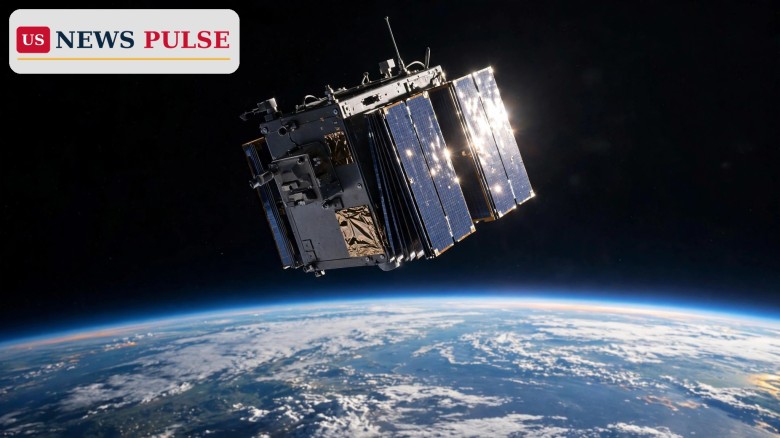
Google has received the first artificial intelligence answer ever generated in orbit, a three-line haiku beamed back from a prototype satellite carrying the company's data-centre chips. The poem, written by Google's Gemma 4 model high above Earth, marks the first working test of Project Suncatcher, Google's long-term research effort to find out whether AI computing can move off the planet and into space.
After about three weeks of commissioning in orbit, Google's engineers used a ground-station pass to send a command up to the prototype satellite, boot up its Tensor Processing Unit, run a prompt and wait for the reply. The prompt was deliberately simple: write a haiku about being in space. As the spacecraft passed over a ground station in Svalbard, Norway, the answer came back down to Earth intact, the first complete response ever produced by a data-centre-class TPU operating in orbit.
Google chief executive Sundar Pichai announced the milestone in a post on X, calling it a "'hello world' milestone for Project Suncatcher". "After launching our prototype satellite a few weeks ago, we've now successfully sent a command up to orbit, booted up the TPU, ran the prompt, and received our first complete response back on earth - a haiku!" Pichai wrote. A Google spokesperson told TechCrunch that the satellite is operating nominally, and the team followed the haiku with further trials, including space-themed limericks and prompts asking the payload to report on the technical status of its own systems.
The haiku itself quickly became the story's calling card: "Blue marble below / Data streams in silent grace / Starlight feeds my core." It also carried a quiet coincidence noted by several reports: haiku is the name Google rival Anthropic gives to its lightweight Claude model family, making Google's first orbital poem an accidental nod to a competitor's brand.
Project Suncatcher is Google's research programme for testing whether satellites could one day carry real AI workloads. The idea is straightforward: a satellite in the right orbit sits in near-constant sunlight, so its solar panels could power AI computing on clean energy around the clock, without the land, water and grid constraints of a terrestrial data centre. Google's vision, if the tests hold up, is a constellation of close-flying satellites handling large inference workloads in orbit, linked by optical connections.
The prototype now flying is deliberately modest. Built in partnership with satellite company Planet, it rode to orbit on October 1 as part of a SpaceX Falcon 9 rideshare mission carrying more than 100 spacecraft. It carries four TPUs, the same class of chip that powers Google's data centres on Earth, but the power budget is tight: the satellite generates only about one kilowatt of electricity, so only one TPU can operate at a time, and each session lasts at most about 20 minutes. What the prototype proves so far is therefore narrow but real: a small-scale AI workload running in orbit, not a working orbital data centre.
The timing matters because demand for AI computing is straining power grids and water supplies on the ground, and every major cloud provider is hunting for new capacity. Google is not alone in looking upward, but Suncatcher is the most concrete public test yet of putting data-centre-grade silicon, rather than a small experimental processor, into orbit and asking it to do useful work.
Choosing a poem as the first prompt was both a practical engineering decision and a piece of theatre. A haiku is short, self-contained and easy to verify end to end: if the exact lines come back intact, the whole chain, uplink, onboard inference and downlink, has worked. It is the same reason the first message of any new computing system is usually "hello world": the content matters less than proof that the machine answers at all.
Google framed the result exactly that way. Travis Beals, a senior director on Google's Paradigms of Intelligence team, wrote that the company's chips "have officially earned their space wings". The company described the haiku as its "Hello World" for computing in orbit, a deliberate echo of the first programme every coder writes, and a signal that the hard part, getting a data-centre chip to run reliably in space, has at least begun.
The follow-up tests show the team is already moving past the stunt. Asking the payload to report its own system status exercises a different skill: reading telemetry and summarising it, the kind of job an orbital AI would actually need to do if it were managing a satellite's health on its own. The limericks, meanwhile, test longer, more structured generation under the same tight power and time limits.
Pichai's announcement set the tone, presenting the haiku as a beginning rather than a destination. "After launching our prototype satellite a few weeks ago, we've now successfully sent a command up to orbit, booted up the TPU, ran the prompt, and received our first complete response back on earth - a haiku!" he wrote on X.
Beals struck a similar note, writing that the chips "have officially earned their space wings", a line Google's research blog used to mark the moment the hardware crossed from ground testing into real orbital operation. A company spokesperson told TechCrunch the satellite is operating nominally, a deliberately undramatic update that, for a first-of-its-kind test, is itself the news.
Independent coverage has been measured. Reports have stressed what the test does not yet prove: a single short poem from one chip in 20-minute bursts is a long way from an orbital data centre, and experts quoted across the coverage point to cosmic radiation, thermal management, the difficulty of on-orbit maintenance and space debris as obstacles that will take years to work through. The consensus is that Suncatcher has cleared its first gate, not that it has answered the bigger question.
The test matters for two reasons, one technical and one strategic. Technically, it shows that a data-centre-class AI accelerator can boot, run a model and return a coherent result in the radiation and thermal environment of low Earth orbit. That is not a given: space is hostile to electronics, and a chip designed for a cooled server hall has never before been asked to do inference work above the atmosphere. Passing even a small version of that test de-risks the entire Suncatcher concept.
Strategically, it puts Google first in a race that is only just forming. As AI demand grows, power has become the binding constraint on new data centres, and the promise of near-constant solar power in orbit is genuinely attractive. If Google can show, over the next year, that its chips survive heat and radiation and that satellites can be linked into a working network, it will own the early lead in orbital computing, with implications for cost, energy use and where AI infrastructure physically lives. If the chips degrade quickly, the project will have produced a memorable poem and a useful negative result.
Google says the ongoing test campaign will now examine how the TPUs perform under thermal stress and radiation exposure in orbit, the two biggest open questions for computing off Earth. Those results will decide whether the programme advances or stalls: a chip that throttles, errors or degrades under sustained orbital conditions cannot anchor a constellation.
If the tests go well, Google plans its next milestone for 2027: launching two more satellites with higher power generation, designed to demonstrate inter-satellite optical links. That step would move Suncatcher from a single satellite answering prompts to a small network passing work between spacecraft, the smallest version of the constellation the project ultimately imagines. Full commercialisation, experts caution, is still likely years away even on the optimistic path.
Project Suncatcher is Google's research effort to test whether AI computing infrastructure can operate in space, using satellites carrying data-centre-class Tensor Processing Units powered by near-constant sunlight.
A haiku written by Google's Gemma 4 model aboard the Suncatcher prototype: "Blue marble below / Data streams in silent grace / Starlight feeds my core."
The prototype launched on October 1, 2026, aboard a SpaceX Falcon 9 rideshare mission, and completed about three weeks of commissioning before its first AI test.
It carries four TPUs but generates only about 1 kilowatt of solar power, so only one TPU runs at a time, for up to 20 minutes per session.
Google will test the chips against thermal stress and radiation in orbit, and, if those tests pass, launch two more powerful satellites in 2027 to demonstrate inter-satellite links.
Related coverage: ChatGPT teen weapons limits: OpenAI tightens safety for teens, Waymo picks Toyota bZ4X as its next robotaxi, Claude Code backdoor hit up to 5,000 Cursor users.
Leave a Comment



 | Today's Date: