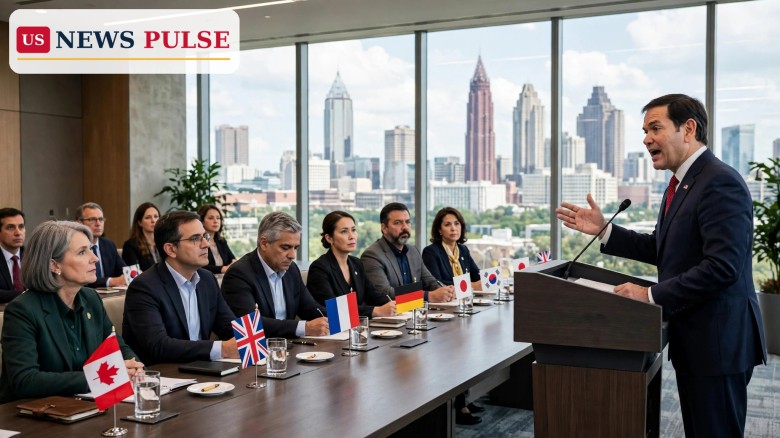
Poland G20 membership moved to the centre of the United States' diplomacy on Saturday, October 31, 2026, as Secretary of State Marco Rubio said President Donald Trump firmly believes Warsaw deserves a seat at the table of the world's leading economies. Speaking to reporters at the conclusion of the G20 foreign ministers' meeting in Atlanta, Georgia, Rubio singled out the Polish delegation among the invited participants and praised the country's economic growth and military modernisation.
Rubio addressed reporters as the two-day meeting of G20 foreign ministers in Atlanta drew to a close. The gathering was the ministerial stage of a year in which the United States holds the G20 presidency, and it was intended to prepare the ground for the leaders' summit in Doral, Florida, in December, which Trump will chair. In his closing remarks, Rubio praised Poland's progress and linked its growing strength directly to American interests.
"President Trump believes very strongly that Poland deserves a seat at this table of global leaders and we very much hope to see them and other strong nations on the rise invited back next year," Rubio said. He added that Poland's economic success and growing global influence were exactly what the forum needed to tackle major economic challenges. At a welcome reception at Atlanta's Georgia Aquarium on Friday evening, Rubio had gone further, welcoming Poland as a "full participant" in the G20 and saying the administration was excited to have the delegation in Atlanta for the week.
Rubio did not, however, announce a collective decision to grant Poland permanent membership, and he did not set out a process or criteria for changing the forum's composition. His reference to invitations next year also extended to other rising economies, which he did not name. The distinction matters: attending as a guest of the host presidency is not the same as becoming a permanent member, and permanent membership is understood to require consensus among existing members.
The G20 was established in 1999 and elevated to leaders' summits in 2008 after the global financial crisis. It brings together 19 countries plus the European Union and the African Union, and it describes itself as the premier forum for international economic cooperation. Host presidencies may invite guest countries to meetings, but guest participation does not itself confer permanent membership. Poland is a member of the European Union, so it is already represented indirectly through the EU, but it has no seat of its own in the way Germany or France do.
Poland's case, as presented in Atlanta, rests on scale and trajectory. It is one of Europe's larger economies, it has grown rapidly in recent years, and it has sharply increased defence spending in response to Russia's war in Ukraine, now in its fifth year. Warsaw is also a frontline NATO ally: it borders Ukraine and Belarus, it hosts allied forces, and it has been a leading voice in Europe for tougher action against Moscow. Supporters argue that a forum built to steer the world economy should include one of the continent's fastest-growing economies and a country at the centre of European security.
The Atlanta meeting itself ended without a joint communique, reflecting divisions over the Russia-Ukraine war and other global security issues. Rubio was expected to release a chairman's statement instead. Against that backdrop, the Poland question became one of the clearest outcomes of the week: a public American endorsement, a Polish lobbying campaign in the corridors, and a Russian objection, all on the record.
Sikorski used his time in Atlanta to press the case directly. He told reporters he had discussed permanent membership with a number of G20 member countries in bilateral meetings, and he said India was among the countries he had lobbied. According to Sikorski, the United States has tabled a resolution to the effect that Poland would become a permanent member, and he welcomed the American push.
He also used the platform for a second message: a rapid ceasefire in the Black Sea to allow safe passage for grain shipments from both Ukraine and Russia. "I spoke in favor of doing something quickly because the people of the Global South need this grain," Sikorski said. He added that Ukraine must be included in any effort to end Russia's invasion, that Europe also had "cards" in the issue and should be involved, and that Moscow must end its war before being allowed to resume energy sales to Europe, formerly its most lucrative market. The Black Sea question was already on the Atlanta agenda, with Rubio noting growing interest in a limited deal halting attacks on grain and, in some cases, energy ships.
The obstacles are formidable. Western officials quoted in reporting from Atlanta said it could take years for Poland to be accepted as a full member, given Russia's opposition and the G20's requirement for consensual decisions. Lavrov told reporters that inviting Poland to attend G20 meetings was counterproductive and broke with the diplomatic practice of seeking consensus, saying it violated the principles of multilateral diplomacy when members work on the basis of consensus. Any single member can therefore slow or block a change, and Russia has every incentive to do so given Poland's hawkish stance on Ukraine.
There is also a structural question that goes beyond one country. If Poland joins, other large economies that are not members will ask why they were passed over, and existing members will weigh whether expansion strengthens the forum or dilutes it. The United States, as 2026 president, can invite guests and champion a candidate, but it cannot admit a member alone. That is why Sikorski's other announcement matters: Britain, which takes over the G20 presidency next year, has already invited Prime Minister Donald Tusk to attend the 2027 leaders' summit in Manchester, England. An invitation from the next chair keeps Poland in the room even if permanent membership takes years.
Rubio's closing statement was the clearest endorsement: "President Trump believes very strongly that Poland deserves a seat at this table of global leaders and we very much hope to see them and other strong nations on the rise invited back next year." At the Georgia Aquarium reception he had said: "President Trump believes their economic success and growing global influence is exactly what the G20 needs to tackle the major economic challenges we all face, and we're very excited to have them with us here today and this week."
Sikorski welcomed the push and said he had discussed it with a number of G20 members in bilateral meetings in Atlanta. Lavrov, by contrast, said inviting Poland was counterproductive: "Of course, this violates the principles of diplomacy, and especially multilateral diplomacy, when members of associations such as the G20 work on the basis of consensus," he was quoted as saying by Russian news agencies.
Rubio also framed the week in broader terms, describing the December summit in Florida, to be led by Trump, as the culmination of the administration's multilateral work this year, and saying the US presidency had sought to focus the forum on its core economic purpose.
The Poland question is about more than protocol. It signals how the Trump administration wants to reshape the institutions it inherited: rewarding allies that spend on defence and grow quickly, and bringing them inside the rooms where economic rules are set. For Poland, a permanent seat would confirm a transformation from a country once seen as a peripheral EU member to a central player in European security and economics. For Ukraine, a stronger Polish voice inside the G20 is a friendly one, given Warsaw's support for Kyiv and its insistence that Ukraine be included in any peace effort.
For the G20 itself, the episode exposes a tension. The forum's legitimacy rests on representing the world's major economies, but its membership has barely changed since 2008 while the economic map has shifted. Expanding it could make it more representative; it could also make consensus harder in a body that already struggled to agree a communique in Atlanta. Russia's objection shows that even a guest invitation can become a flashpoint when the candidate is a vocal critic of Moscow.
The immediate test is the leaders' summit in Doral, Florida, in December, where Trump will chair the G20 and where Poland's status will be watched closely: whether Warsaw is again invited, and in what capacity. Beyond that, the chair passes to Britain, which has already invited Tusk to Manchester in 2027, giving Poland a second consecutive year in the room. The longer question — a formal resolution on permanent membership and the consensus it requires — is likely to play out over years rather than weeks, with lobbying in capitals and, inevitably, Russian resistance.
Watch also for whether other rising economies named or unnamed in Rubio's remarks emerge as candidates, and whether the Black Sea grain proposal Sikorski championed in Atlanta gains traction alongside the membership debate. Both threads — who sits at the table, and what the table can deliver on food security — will shape the G20's next chapter.
Related coverage: G20 Atlanta meeting opens as Rubio hosts divided ministers, Rubio says growing interest in limited Black Sea ceasefire.
No. Poland attended the Atlanta meeting as a guest invited by the United States. Rubio backed its bid and Sikorski said the US has tabled a resolution, but no collective decision on permanent membership was announced.
Rubio cited Poland's economic success, military modernisation and growing global influence, saying those qualities are exactly what the G20 needs to tackle major economic challenges.
Russia. Foreign Minister Sergei Lavrov called the invitation counterproductive and said it broke with the G20's consensus-based practice.
Trump will chair the leaders' summit in Doral, Florida, the culmination of the US presidency year. Poland's invitation status there will be closely watched.
Sikorski said Britain, which chairs the G20 next year, has already invited Prime Minister Donald Tusk to the 2027 leaders' summit in Manchester, England.
Leave a Comment



 | Today's Date: