


 | Today's Date:





NASA X-70 Fractal: New Crewed Jet to Test Flight Controls Never Flown Before
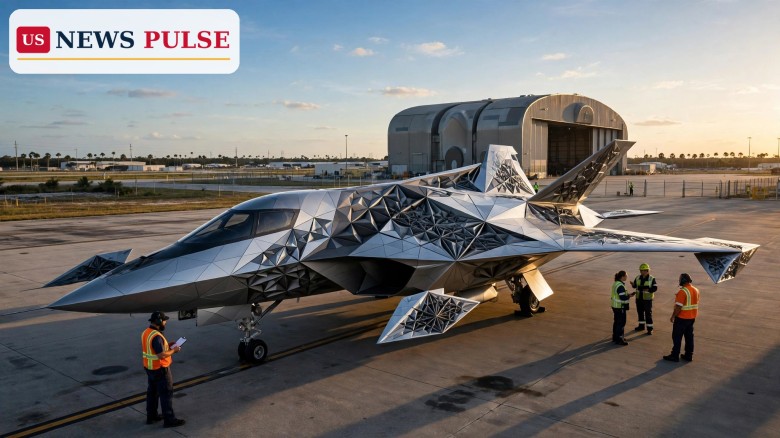
NASA has unveiled a new experimental aircraft unlike anything it has flown before. The X-70 "Fractal", revealed on Wednesday, November 4, 2026, at the UP.Summit at Kennedy Space Center in Florida, is a crewed, high-performance research jet built to test advanced flight controls that have never been demonstrated in crewed flight. Announced by NASA Administrator Jared Isaacman, the aircraft is designed to cruise at Mach 0.75, reach altitudes of up to 45,000 feet and fly more than 1,500 nautical miles, carrying up to 2,000 pounds of experimental payload. NASA expects the X-70 to make its first flight under the agency's banner within two years, and Isaacman has already promised that more new X-planes will follow.
Key Points
- NASA unveiled the X-70 "Fractal" on November 4, 2026, at the UP.Summit at Kennedy Space Center in Florida.
- The crewed jet is a high-performance research platform with rapidly reconfigurable flight controls.
- It will cruise at Mach 0.75, reach 45,000 feet and fly over 1,500 nautical miles; maximum takeoff weight is 10,000 pounds.
- It carries up to 2,000 pounds of experimental payload, inside and outside, swappable quickly between test campaigns.
- First flight is expected within two years; another X-plane announcement is due at the UP.Summit on November 6.
What Happened
NASA introduced the X-70 Fractal at the UP.Summit, a gathering of aerospace and technology leaders held at Kennedy Space Center. NASA Administrator Jared Isaacman made the announcement, presenting the aircraft as the agency's newest experimental platform and the first new X-plane announced under his leadership. Its mission is to test flight-control technology that has never been flown by a crewed aircraft before.
The X-70 is designed as a flying laboratory. Rather than carrying passengers or cargo, it will carry experiments. Its flight-control systems can be reconfigured rapidly, allowing engineers to test different ways of controlling an aircraft in flight without building a new airframe for each idea. Payloads of up to 2,000 pounds can be fitted inside the aircraft or mounted externally, and swapped quickly between test campaigns, so the same jet can support many different experiments over its life.
NASA has not disclosed who built the aircraft, its final design or the programme cost, and the image released is labelled as generated content.
Background: A Lineage of X-Planes
The X-70 joins one of the most storied lines in aviation history. NASA and its predecessors have used X-planes since the late 1940s to answer questions that no ordinary aircraft could answer, flying designs too radical, too fast or too experimental for commercial or military service. The data from those flights has shaped almost every aircraft flying today.
The lineage began with the Bell X-1, which became the first aircraft to break the sound barrier in 1947. The rocket-powered X-15 followed, flying to the edge of space at speeds above Mach 6. More recently, the X-59 quiet supersonic demonstrator was built to test supersonic flight without the loud sonic boom, and it recently flew to Kennedy Space Center, where the X-70 was unveiled.
NASA X-70 Fractal: Reconfigurable Flight Controls
The heart of the X-70 Fractal is its rapidly reconfigurable flight-control technology. In plain terms, the aircraft's control system can be changed between flights so engineers can test different ways of steering, stabilising and manoeuvring an aircraft. That matters because the next generation of aircraft — from quiet supersonic jets to new kinds of air taxis and autonomous cargo planes — will need control systems very different from those used today.
Testing those systems on a crewed aircraft is a deliberate choice. A crewed research jet can fly more complex test profiles, react to unexpected results in real time and carry a wider range of instruments than an uncrewed demonstrator of the same size. NASA says the flight controls the X-70 will test have never been demonstrated in crewed flight before, which makes the programme a genuine first rather than an incremental upgrade.
Reactions and Quotes
Isaacman, who announced the aircraft, signalled that the X-70 is the start of a broader push rather than a one-off project. He promised that "there will be more" new X-planes, and another X-plane announcement was expected at the UP.Summit on November 6, the day after the X-70 reveal. The message is that NASA intends to restart a steady flow of experimental aircraft after years in which new X-plane announcements were rare.
Why It Matters
Flight controls are the invisible technology inside every modern aircraft, and they are becoming more important, not less. As aircraft designs grow more unusual — blended wings, distributed electric propulsion, autonomous operation — the software and hardware that keep them stable in the air must keep up. Testing new control ideas on a dedicated research aircraft is far safer and faster than testing them on a passenger jet, and it is how aviation has advanced for eighty years.
What Happens Next
The immediate next step is the second X-plane announcement expected at the UP.Summit on November 6, which will show whether Isaacman's promise of more X-planes is a series or a slogan. After that, attention turns to the X-70 itself: NASA has said its first flight under the agency's banner should come within two years, which points to late 2028. Before that flight, NASA will need to reveal more about the aircraft — its manufacturer, its final configuration and the first test campaign it will fly.
Frequently Asked Questions
What is the NASA X-70 Fractal?
A crewed experimental aircraft unveiled by NASA on November 4, 2026, built to test flight-control technology never demonstrated in crewed flight before.
When will the X-70 Fractal fly?
NASA expects its first flight under the NASA banner within two years of the announcement, which points to late 2028.
How fast and how high can it fly?
It cruises at Mach 0.75, reaches 45,000 feet and flies more than 1,500 nautical miles, with a maximum takeoff weight of 10,000 pounds.
Who announced the X-70?
NASA Administrator Jared Isaacman announced it at the UP.Summit at Kennedy Space Center in Florida, and he promised that more new X-planes will follow.
Is the X-70 a military aircraft?
No. It is a NASA research aircraft. Its job is to test flight controls and carry experimental payloads of up to 2,000 pounds, not to serve as a combat aircraft.
Related coverage: SpaceX picks Qualcomm to build Starlink Mobile's nationwide 5G network | FAA orders fuel-tank sealant checks on 60 Boeing 787s and 31 747s over lightning risk | NTSB finds engine piece in Florida Learjet crash investigation
Leave a Comment