

 | Today's Date:


Nine Nations Sign San Francisco Declaration to Shield AI Supply Chains From China
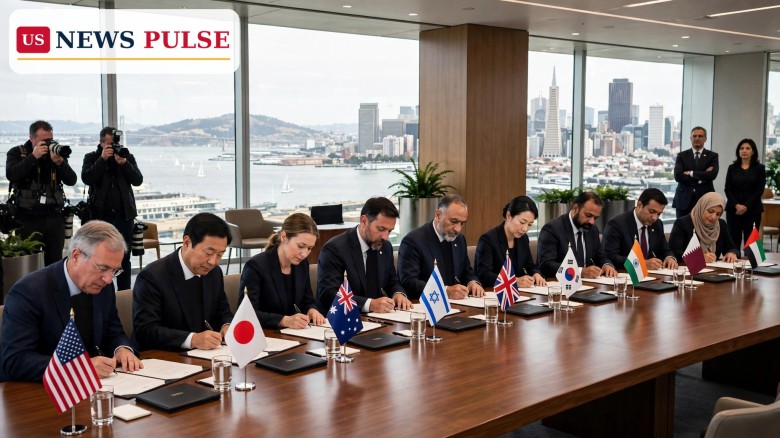
Nine nations signed the San Francisco Declaration on Sunday, November 15, 2026, pledging to shield the artificial intelligence supply chains of the modern economy from China, the Financial Times reported. Signed in San Francisco by the United States and eight partners, the pact commits the group to draw up a joint list of AI technologies and supply chains needing protection — semiconductors, critical minerals, energy and industrial capacity — and to coordinate against theft and unauthorised transfers. It is the most concrete step yet in Pax Silica, days before President Donald Trump meets Chinese President Xi Jinping in Shenzhen on November 19.
Key Points
- The United States, Japan, Australia, Israel, the United Kingdom, South Korea, India, Qatar and the United Arab Emirates signed the San Francisco Declaration on Sunday, November 15, 2026.
- The nine will draw up a joint list of AI technologies and supply chains needing protection from China: semiconductors, critical minerals, energy and industrial capacity.
- US Under Secretary of State Jacob Helberg negotiated the pact and called it historic, saying partners agreed to treat the security of those technologies as a shared responsibility.
- Germany, Sweden, the Netherlands and the European Commission are expected to sign next week.
- The pact is part of Pax Silica, the US-led AI supply-chain initiative launched in December 2025, whose original declaration now has 24 to 25 signatories.
What Happened
The signing brought together nine governments spanning the most important links in the global AI supply chain: the United States, Japan, South Korea, India, Australia, Israel, the United Kingdom, Qatar and the United Arab Emirates — covering chip design, manufacturing equipment, critical minerals, AI research and energy.
The declaration commits the signatories to identify the AI technologies and supply chains needing protection and to coordinate their defences — semiconductors, critical minerals, energy and industrial capacity — as well as the less visible threats of theft and unauthorised transfers. Helberg, who negotiated the pact, briefed the Financial Times after the signing and called it historic because the partners agreed to treat the security of those technologies as a shared responsibility. No full text had been published yet, and the joint list is still to be drawn up.
Background and Context
Pax Silica is the Trump administration's effort to organise friendly nations around AI supply-chain security. Launched in December 2025 by Helberg, it takes its name from silicon, the element at the heart of every chip.
The original Pax Silica declaration already has 24 to 25 signatories; the San Francisco text is a deeper commitment by nine of them to do the detailed work of listing what must be protected. It builds on the Quad's trusted-AI plan and critical-minerals pledge of October 31, 2026, and extends that logic beyond the Quad. It also comes amid turbulence in the chip industry: Nvidia has been in a leadership crisis since chief executive Jensen Huang resigned on November 12, 2026, after a spying scandal, and Washington has pressed it over whether its chips reached China through intermediaries.
The San Francisco Declaration: What the Nine Nations Agreed
At the heart of the declaration is the joint list: the nine governments will draw up a list of AI technologies and supply chains needing protection from China, so the signatories can coordinate export controls and enforcement around it instead of acting alone.
The four areas named map the AI supply chain end to end. Rare earths and other minerals go into chips and data-centre hardware, and China dominates their processing. AI data centres consume enormous amounts of electricity. The second pillar is coordination against theft and unauthorised transfers: espionage, illicit procurement and grey-market routes to restricted buyers. The third element is the open door: Germany, Sweden, the Netherlands and the European Commission are expected to sign next week, extending the pact across Europe's chipmaking base, including Dutch lithography, which makes the machines behind the world's most advanced chips.
Reactions and Quotes
Helberg called the agreement historic because the partners agreed to treat the security of those technologies as a shared responsibility — the point of Pax Silica being that the United States cannot secure the AI supply chain alone.
The timing is itself a message. The signing comes four days before President Donald Trump meets President Xi Jinping in Shenzhen on November 19 at the APEC summit, which will also include Russian President Vladimir Putin. It gives Trump a nine-nation coalition to carry into that meeting, publicly committed to protecting AI supply chains from China. No public response from Beijing had been reported. China has previously denounced American chip controls as containment, and answered past restrictions with its own controls on critical minerals.
Why It Matters
Artificial intelligence is now treated in Washington as a strategic technology, and the supply chain behind it is the new front line of great-power competition. The country that controls the most advanced chips, minerals and energy has an advantage in commerce, military capability, research and growth. The San Francisco Declaration is the clearest statement yet that the US and its closest partners intend to treat that supply chain as a shared security asset.
In practical terms, the chips, minerals and energy it covers feed the devices, data centres and services of daily life. Signed days before the Trump-Xi meeting, it also tells Beijing the United States is not negotiating alone. A declaration is a promise; the joint list, the European signings and the enforcement that follows will decide whether it becomes a working system.
What Happens Next
First, the European wave: Germany, Sweden, the Netherlands and the European Commission are expected to sign next week, bringing the coalition to thirteen. Then comes the joint list, negotiated by industry, security agencies and trade officials in each capital. A narrow list would suggest caution; a broad one would signal a far-reaching effort to wall off China's access to AI technology.
Then comes November 19, when President Trump meets President Xi in Shenzhen; any Chinese response will shape the next phase of the rivalry. Longer term, the pact will be judged by enforcement: if the coalition holds, Pax Silica moves from slogan to system; if it frays, the declaration will be remembered as a photograph, not a policy.
Frequently Asked Questions
What is the San Francisco Declaration?
The San Francisco Declaration on the Secure Foundations of Enduring Prosperity, signed on November 15, 2026, by nine US-led nations, committing them to a joint list of AI technologies needing protection from China.
Which countries signed it?
The United States, Japan, Australia, Israel, the United Kingdom, South Korea, India, Qatar and the United Arab Emirates — with Germany, Sweden, the Netherlands and the European Commission expected next week.
What is Pax Silica?
The US-led AI supply-chain security initiative, launched in December 2025 by Jacob Helberg, whose original declaration has 24 to 25 signatories.
What technologies does the pact cover?
Semiconductors, critical minerals, energy and industrial capacity.
Why was it signed just before the Trump-Xi meeting?
It comes days before President Trump meets President Xi in Shenzhen on November 19, giving the US a nine-nation coalition behind its position.
Read more: the Quad's trusted-AI plan, the confirmed Trump-Xi-Putin trilateral meeting, and the resignation of Nvidia chief Jensen Huang.

The US News Pulse newsroom covers breaking news across the United States and the world, working from wire services, official statements and on-the-record sources. Every story is reviewed against our editorial standards before publication. Corrections and tips: info@usnewspulse.com
About our newsroomLeave a Comment