Quad AI Minerals Plan took a concrete step forward on Saturday, October 31, 2026, when the United States, India, Japan and Australia unveiled more than $85 million in technical and financial assistance to expand access to trusted artificial intelligence across the Indo-Pacific, alongside a $10 million United States commitment for critical minerals recycling. The announcements, made after a 40-minute meeting of the four countries' foreign ministers in Atlanta, turn a year of Quad talk about economic security into funded work on AI, semiconductors, minerals and maritime cooperation — and they arrive with an unmistakable, if unnamed, focus on reducing dependence on China.
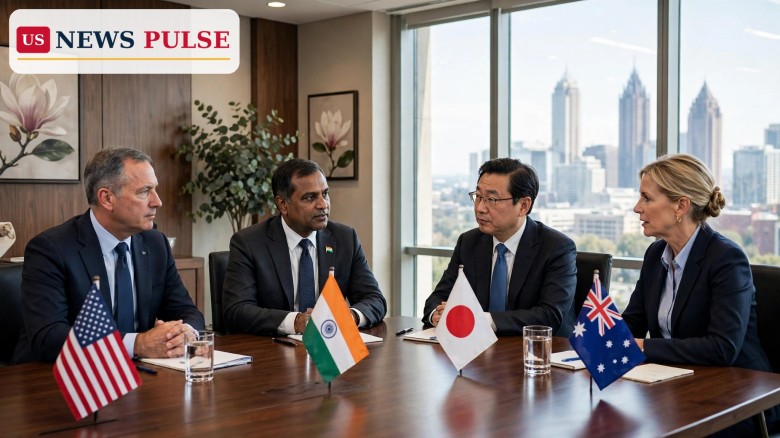
The meeting brought together US Secretary of State Marco Rubio, Indian External Affairs Minister S. Jaishankar, Japanese Foreign Minister Toshimitsu Motegi and Australian Foreign Minister Penny Wong on the sidelines of the G20 foreign ministers' meeting in Atlanta. It was the third Quad ministerial meeting of the year, following talks in May and July, and its joint statement ranged far beyond the headline figures, covering supply-chain chokepoints, 5G and 6G networks, export credit, undersea cables, port development in Fiji and a new crackdown on cyber-scam operations that the ministers said steal tens of billions of dollars a year from citizens of the four countries.
The four ministers met in Atlanta on Saturday, with Japan reporting that the talks lasted about 40 minutes. Their joint statement, issued after the meeting, expressed their intention to provide more than $85 million of technical and financial assistance to support access to trusted AI across the Indo-Pacific, including through the Quad SI Accelerator. The release used the term "Super Intelligence", with a footnote explaining that it refers to artificial intelligence in Australia, India and Japan, and it highlighted the importance of AI and initiatives such as Pax Silica to future economic growth.
Crucially, the statement did not say how much each country will contribute or how the money will be distributed. That gap matters: an intention to provide assistance is not the same as money already allocated, and the next test will be whether individual governments publish their shares and the countries and projects that will receive support. What the statement did make concrete was the direction of travel — trusted, rather than merely available, technology — and the mechanisms, including the accelerator, through which the partners say they will work.
Alongside the AI pledge, the ministers welcomed a $10 million United States commitment to promote infrastructure and facilities in India and ASEAN countries that recover critical minerals from waste. The four countries are working to extract minerals from discarded electronics and scrap to reduce reliance on any single supplier, and they welcomed private investment in waste collection networks, processing plants and refineries. They also said they will explore streamlining export and import procedures for recyclable materials moving across borders, while strengthening the implementation of existing regulations.
The technology agenda went further. The partners will launch an effort to identify semiconductor and AI supply-chain chokepoints before they cause disruption, and they stressed the need for secure and trusted supplies of advanced semiconductors and AI hardware. They will identify priority countries for cooperation on 5G, 6G, Open Radio Access Networks and AI-enabled radio access networks, develop a pipeline of trusted 5G projects, and continue work on mapping digital identity standards to help public and private sectors cooperate. Senior Quad cyber officials met earlier this month and pledged further support for a trusted and resilient cybersecurity environment.
The Quad — the United States, India, Japan and Australia — was revived as a grouping to promote a free and open Indo-Pacific, and its agenda has steadily widened from maritime security and disaster relief to economic prosperity and critical and emerging technologies. This year has already produced building blocks for Saturday's announcements: a Quad Critical Minerals Initiative framework was announced in May 2026, and cooperation among the four countries' export credit agencies builds on a memorandum signed in 2024.
The context for the minerals and AI pledges is a supply chain in which China dominates the processing of many critical minerals and the manufacture of key technology components. The ministers' language on Saturday — grave concern over economic coercion, including arbitrary export restrictions, and criticism of non-market policies and practices that create overcapacity and disrupt supply chains in critical industries — tracks that concern closely, even though the joint release did not name a country in that passage. The emphasis on recycling is part of the same logic: recovering minerals from waste already inside friendly economies is faster, in the short term, than opening new mines, and it reduces exposure to a single supplier.
The AI pledge sits in a similar frame. Access to trusted AI is presented not just as a technology question but as an economic-security one: who builds the models, who supplies the chips, and whose standards govern digital identity and networks. Pax Silica, cited in the statement, is part of that push to secure the silicon and AI supply chain among trusted partners. The $85 million figure is modest beside the trillions being spent by private AI companies, but as a government-to-government signal — money for access, standards and capacity in the Indo-Pacific, rather than for a single domestic project — it is designed to be read by partners and rivals alike.
The heart of the Quad AI minerals plan is the pairing of two ideas that are usually discussed separately: trusted AI and critical minerals. Modern AI runs on advanced semiconductors, and those chips depend on minerals and materials whose supply chains are concentrated and, in the ministers' words, vulnerable to coercion and arbitrary restrictions. By announcing the AI and minerals measures together, the Quad is arguing that the two cannot be separated — that a trusted AI future requires trusted mineral and chip supply chains, and that recycling, refining and processing capacity are as strategic as the models themselves.
The commercial machinery announced on Saturday reinforces that reading. The first Quad Business Leaders' Forum will bring together industry leaders, government representatives and policy experts to strengthen commercial ties and promote deals in key sectors. Quad export credit agencies will meet in Tokyo on November 18 to identify opportunities for practical cooperation. Those are not headline-grabbing sums, but they are the plumbing through which government intentions become contracts, factories and shipping routes — and they follow a pattern in Quad statements of pairing ministerial language with a dated next meeting.
The partners also reviewed the first Quad Fuel Security Forum, held in September, where discussions included strengthening strategic petroleum reserves and fuel stockholdings across the four countries. Energy security, minerals security and technology security are being treated, in other words, as one connected agenda rather than three separate files.
The joint statement's own words set the tone. The ministers expressed "grave concerns regarding economic coercion, including through arbitrary export restrictions", a formulation that stops short of naming China but leaves little doubt about the practice being criticised. They also criticised non-market policies and practices that create overcapacity and disrupt supply chains in critical industries.
India's Jaishankar, posting on X after the meeting, highlighted freedom of choice, resilient supply chains and action against non-market practices as his priorities, and called for a more contemporary, practical Quad agenda. That framing — freedom of choice for smaller Indo-Pacific states, rather than a choice between great powers — is the language New Delhi has consistently used to describe its Quad engagement, and it featured prominently in Indian coverage of the Atlanta talks.
Japan's account of the meeting added a security dimension that the joint statement handled more briefly. Motegi opposed unilateral attempts to change the status quo by force or coercion, according to the Japanese account, and emphasised North Korea's complete denuclearisation and the need to address malicious cyber activities. He also thanked India, Australia and the United States for supporting an immediate resolution of the abductions issue, a long-standing Japanese priority.
On maritime issues, the ministers stressed the need to protect navigational rights and freedoms in the Strait of Hormuz, the Red Sea and the Bab el-Mandeb Strait, consistent with international law as reflected in the UN Convention on the Law of the Sea. They underlined the importance of uninterrupted commerce, energy security and safe passage for crews and vessels without tolls — language that resonates well beyond the Indo-Pacific, given the recent attacks and blockages in those waterways.
For the United States, the Atlanta announcements matter because they show the Quad moving from statements of principle to shared spending, however modest, on the supply chains that underpin both AI leadership and military capability. A $10 million recycling commitment will not, on its own, change the global minerals market, but it signals to allies in India and Southeast Asia that Washington is willing to fund processing capacity outside China — and to private investors that waste collection, processing and refining in those countries have government backing.
For India and Southeast Asia, the value lies in access: to trusted AI tools, to 5G and 6G cooperation, to digital identity standards and to the infrastructure fellowships the Quad says it has already provided — more than 2,000 across the Pacific, Southeast Asia and South Asia. The partners are also working with Fiji on infrastructure modernisation at ports in Suva and Lautoka, with the US Millennium Challenge Corporation supporting a port development framework and Australia assessing a new transshipment facility. Those projects, like the trusted undersea cable routes the ministers backed, are about giving smaller states alternatives, so that dependence on any one supplier or route is a choice, not a necessity.
For the wider region, the cyber-scam pledge may matter most immediately. The ministers condemned criminal groups that traffic people and force them to conduct online scams, saying these operations steal tens of billions of dollars annually from citizens of the four countries, and committed to dismantling them and holding transnational criminal groups and their leaders accountable. That is a human-security issue as much as a technology one, and it affects families in all four countries directly.
The next dated milestone is November 18, when Quad export credit agencies meet in Tokyo. Moves are also under way to convene a Quad leaders' summit, hosted by US President Donald Trump on the sidelines of the ASEAN-East Asia summits in mid-November, although the joint statement did not specify a timeline for that summit. Any announcement of a leaders' date, or of country-by-country contributions to the $85 million, would be the next genuine development.
On maritime cooperation, the second Quad-at-Sea Ship Observer mission sailed from Chennai to Perth between September 25 and October 7, with representatives of all four countries aboard an Indian Coast Guard offshore patrol vessel. The partners plan their first exercise under the Indo-Pacific Maritime Surveillance Collaboration initiative at Sea Dragon 2027, and a first Quad Maritime Domain Awareness Track 1.5 Symposium is planned for early 2027 under the Maritime Training Initiative, or MAITRI. Australia, Japan and the United States will also send observers to India's annual joint humanitarian assistance and disaster relief exercise in November, after the ministers offered condolences for deaths in Nepal's August 26 flash floods and recognised India's leading role as first responder.
Until those meetings, the Atlanta package will be judged on follow-through: whether the $85 million is broken down, allocated and spent; whether the $10 million builds recycling plants or merely funds studies; and whether the business forum and export-credit meeting produce deals. The ministers have set the agenda; the next weeks will show whether it becomes infrastructure.
What is the Quad AI minerals plan? It is the package announced in Atlanta on October 31, 2026, pairing more than $85 million for trusted AI across the Indo-Pacific with a $10 million US commitment for critical minerals recycling in India and Southeast Asia.
Who met in Atlanta? US Secretary of State Marco Rubio, Indian External Affairs Minister S. Jaishankar, Japanese Foreign Minister Toshimitsu Motegi and Australian Foreign Minister Penny Wong, on the sidelines of the G20 foreign ministers' meeting.
Does the $85 million go to one country? No breakdown has been published yet. The joint statement expressed an intention to provide the assistance, including through the Quad SI Accelerator, without specifying individual contributions or distribution.
Why focus on recycling critical minerals? Recovering minerals from discarded electronics and scrap reduces reliance on any single supplier and can be built faster than new mining and refining capacity.
What happens next? Quad export credit agencies meet in Tokyo on November 18, a Quad Business Leaders' Forum is to be held, and moves are under way for a leaders' summit on the ASEAN sidelines in mid-November, with no date yet in the joint statement.
Related coverage: Quad Ministers Meet in Atlanta to Ready Indo-Pacific Leaders Summit and G20 Atlanta Meeting Opens as Rubio Hosts Divided Ministers on Iran and Ukraine.
Leave a Comment



 | Today's Date: