

 | Today's Date:




China Seeks Nvidia Chips for AI Weapons Despite US Curbs, Report Warns
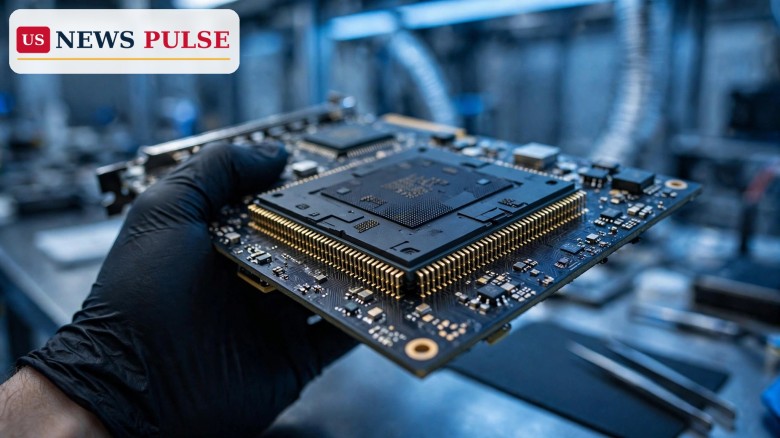
China's military is seeking advanced Nvidia chips for AI weapons as Chinese-made processors continue to lag behind American rivals, a United States congressional commission warned in its annual report released on Wednesday, November 18, 2026.
The US-China Economic and Security Review Commission said Beijing is trying to circumvent American export controls to obtain the semiconductors behind its push for what the People's Liberation Army calls "intelligentized warfare". The report was approved unanimously by all 10 sitting commissioners.
Key Points
- The commission said China's military is seeking advanced Nvidia chips for AI-enabled weapons, with domestic processors still lagging behind US rivals.
- Beijing is seeking to evade US export controls for semiconductors critical to "intelligentized warfare" — the PLA's term for AI in weapons and command.
- Domestic Chinese AI chips, including Huawei's Ascend and Cambricon's Siyuan series, still trail more advanced products from Nvidia and AMD.
- A Reuters review found more than $3 billion in Chinese computing projects using Nvidia's restricted chips, some via data centres in third countries including Malaysia.
- The commission urged Congress to make chip exporters certify shipments will not divert US manufacturing capacity, with criminal penalties for false statements, and to force disclosure when US products use Chinese AI models.
What Happened
The commission released its annual report on Wednesday, November 18, 2026, after its first official visit to mainland China since 2019. All 10 sitting commissioners approved it unanimously.
Its central warning is blunt. "China is seeking to evade US export controls to gain the most advanced semiconductors that underpin its intelligentization drive," the report said, according to Reuters. The chips sit at the heart of the PLA's drive for "intelligentized warfare" — AI woven into weapons, command and control, kill chains and logistics. Whoever controls the most powerful AI hardware, the commission argued, gains an edge in how quickly a military can see, decide and strike.
The report lands as Trump meets China's leaders in Shenzhen, with talks with President Xi Jinping and a first-ever three-way meeting with Xi and Vladimir Putin set for Thursday.
Background: The Chip War So Far
Washington has spent four years tightening the flow of advanced semiconductors to China. Controls first imposed in 2022 barred the most powerful AI chips and the equipment used to make them, and the rules have been widened repeatedly, including a November 16 Commerce Department move to cut off remote access via third-country data centres.
Nvidia has said the controls have effectively shut it out of China's AI data-centre market. Yet a Reuters review found more than $3 billion in Chinese computing projects using its restricted chips, with Chinese companies obtaining remote access through data centres in countries including Malaysia.
Scrutiny of Nvidia's China business has intensified since former chief executive Jensen Huang resigned on November 12 over his extramarital affairs, including one with a woman US authorities suspected of spying for China. The board has ruled out Huang's return, while the company reported quarterly revenue of $115.8 billion, more than double a year earlier. The Trump administration is separately weighing a plan to force US firms to disclose their use of Chinese AI models. US firms may have to disclose Chinese AI use under the Trump plan, with Airbnb named as using Alibaba's Qwen model.
China Seeks Nvidia Chips for AI Weapons
The commission's case rests on a gap it says has not closed. Domestic Chinese AI chips, including Huawei's Ascend and Cambricon's Siyuan series, still trail Nvidia and AMD products. That gap is why Beijing keeps chasing American hardware, even as Chinese firms pour money into home-grown alternatives.
The report describes a pattern of evasion, not one smuggling route. Alongside remote access through third-country data centres, Chinese entities have grown more sophisticated at using output from leading American AI models to train domestic rivals, Reuters reported this week.
Its recommendations go further than past reports. Congress should require exporters of advanced AI chips to certify shipments will not divert manufacturing capacity from the US market, with Commerce-auditable data on fabrication, high-bandwidth memory and packaging — and criminal penalties for false certifications. Companies should also disclose when US products use Chinese AI models. Trump's own Nvidia stake grew to as much as $62 million, a Washington Post review found.
Reactions
The commission's language leaves little doubt about its view of Beijing's intent. "China is seeking to evade US export controls to gain the most advanced semiconductors that underpin its intelligentization drive," the report said — a direct accusation that China is working around Washington's rules.
Nvidia has said the controls have effectively shut it out of China's AI data-centre market, a claim that sits uneasily with the $3 billion Reuters finding. The company is not accused of wrongdoing; the report points to evasion by Chinese buyers and intermediaries. Neither the White House nor the Treasury immediately responded to requests for comment on the disclosure plan.
Why It Matters
The stakes go beyond one company's sales. With the most advanced AI chips, China's military could decide targets faster, coordinate drones and missiles more effectively, and process battlefield data at a speed domestic hardware cannot yet match. That is why Washington treats AI chips as a national security asset, not an ordinary export.
The report also matters for American industry. Certification with criminal penalties would force chip exporters to open fabrication, memory and packaging data to Commerce auditors, and a disclosure rule would force US firms to admit how much of their technology depends on Beijing's software.
What Happens Next
Congress will now decide whether to act. Certification would need legislation, and the call for criminal penalties signals the panel wants prosecution, not just fines, behind the paperwork. Lawmakers on both sides have already pressed the administration on AI-chip loopholes this year.
Enforcement of the November 16 Commerce rule is the first test. The Shenzhen meetings on Thursday, November 19, will show whether chip policy becomes a bargaining point or a red line. Trump has said he may raise Nvidia spying claims with Xi.
Frequently Asked Questions
What did the US-China commission say about Nvidia chips?
The commission said China's military is seeking advanced Nvidia chips for AI-enabled weapons, and that Beijing is trying to evade US export controls to obtain the semiconductors behind its "intelligentized warfare" drive.
What is "intelligentized warfare"?
It is the People's Liberation Army's term for integrating artificial intelligence into weapons, command and control, kill chains and logistics — using AI to see, decide and strike faster.
Why can't China just use its own chips?
According to the commission, domestic chips including Huawei's Ascend and Cambricon's Siyuan still trail Nvidia and AMD products, leaving a gap Beijing is trying to close with American hardware.
How is China getting Nvidia chips despite the curbs?
The commission pointed to evasion, including remote access to Nvidia chips through data centres in third countries such as Malaysia. A Reuters review found more than $3 billion in Chinese projects using restricted Nvidia chips.
What does the commission want Congress to do?
It urged Congress to require exporters to certify shipments will not divert US manufacturing capacity, with Commerce-auditable data and criminal penalties for false statements, and to require disclosure when US products use Chinese AI models.

The US News Pulse newsroom covers breaking news across the United States and the world, working from wire services, official statements and on-the-record sources. Every story is reviewed against our editorial standards before publication. Corrections and tips: info@usnewspulse.com
About our newsroomLeave a Comment