

 | Today's Date:



US Firms May Have to Disclose Chinese AI Use in Trump 'Name and Shame' Plan
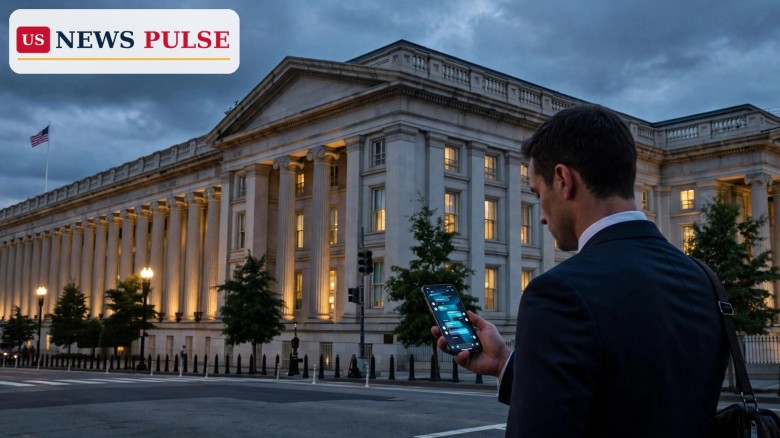
The Trump administration is weighing a plan to require American companies to disclose Chinese AI use in their products and services, in a "name and shame" push meant to discourage reliance on Chinese artificial intelligence without new restrictions, Reuters reported on Wednesday, November 18, 2026.
The idea has been discussed by the Treasury Department and the White House Office of Science and Technology Policy, according to three people familiar with the talks. Companies would have to post the information publicly on their own websites, naming the Chinese AI models behind the tools they offer. It is not yet clear whether the plan is gaining traction, or whether it would go through formal rulemaking if it moves forward.
Key Points
- The Trump administration is considering requiring US companies to publicly disclose their use of Chinese AI models, Reuters reported on November 18, 2026, citing three people familiar with the talks.
- The Treasury Department and the White House Office of Science and Technology Policy have discussed the plan, which would require companies to post the disclosure on their websites.
- Airbnb was named as an example: it uses Qwen, an AI model made by China's Alibaba, to power its AI customer service agent.
- The push follows Treasury Secretary Scott Bessent's July warning of possible sanctions on Chinese AI firms found guilty of stealing US intellectual property, and a congressional inquiry into US companies' use of Chinese AI.
What Happened
Reuters reported on Wednesday that the Trump administration is weighing a disclosure requirement for American companies that use Chinese AI models. The plan would not ban the models. Instead, it would force the practice into the open, betting that public scrutiny — the "name and shame" effect — would push companies toward American alternatives.
The proposal would apply to companies such as Airbnb, which uses Qwen, Alibaba's AI model, to run its AI customer service agent. Those companies would have to state that fact on their websites, where customers, investors and rivals could see it. The White House, Treasury, Alibaba and the Chinese Embassy did not respond to requests for comment, Reuters said; Airbnb declined to comment.
Background: The US-China AI Rivalry
Chinese AI models have become hard to avoid. Alibaba's Qwen and DeepSeek's models are open-weight systems developers can download and build into their own products, often far cheaper than American alternatives — powerful, cheap and already embedded in tools used by American consumers, sometimes without the end user knowing.
The administration has already moved on hardware. This week the Commerce Department closed a cloud-computing loophole that let Chinese companies reach advanced American AI chips via data centres in third countries, as our report on the new export rule targeting China explains. Bessent has also pressed Nvidia over whether its AI chips reached China, as our report on Bessent's ten-day demand to Nvidia shows.
Washington also worries about how Chinese models were built. Bessent said in July the administration could sanction Chinese AI firms found guilty of intellectual property theft by "distilling" American models — training on US models' outputs to copy their abilities cheaply. Chinese firms deny the charge.
Disclose Chinese AI Use: How the Plan Would Work
The plan would be simple in design but broad in reach. Any American company using a Chinese AI model in a public product or service would have to say so openly, on its own website, naming the model and the company behind it.
The point is to make the choice visible: a travel chatbot running on Qwen, or a coding tool built on a Chinese model, would have to carry that fact in public, letting customers choose differently.
A ban would anger American industry, which relies on these models, and Beijing, which would see it as another step toward decoupling the two countries' technology sectors. Disclosure, by contrast, lets the administration say it has imposed no new restriction — while still making Chinese AI use a reputational risk. Coverage, enforcement and what counts as "use" are all unclear.
Reactions
The push has allies in Congress. Republican Representatives Andrew Garbarino, chair of the House Homeland Security Committee, and John Moolenaar, chair of the House select committee on China, launched a 2026 investigation into American companies' use of Chinese AI, sending letters to Airbnb and to Anysphere, maker of the AI coding tool Cursor. They called it a national security question.
Bessent's July warning added a harder edge, signalling the disclosure debate is one front in a wider campaign against Chinese AI. Industry has stayed quiet: Airbnb declined to comment, and neither the White House nor Treasury responded. Beijing denies its AI companies steal American technology, calling such claims a smear.
Why It Matters
The plan matters because it could change how millions of Americans encounter AI without them ever noticing a rule was made: if companies must label their use of Chinese models, the quiet spread of systems like Qwen becomes a public fact — and a choice consumers can see.
It is also a test of a new kind of technology policy. Rather than banning a rival's technology outright, Washington would use transparency as a weapon: letting the market, the press and political pressure do the work a regulation would normally do. For companies, the stakes are practical — many adopted Chinese models because they are cheap, open and good, and disclosure would force them to weigh those savings against the reputational cost of being named.
What Happens Next
The next step is a decision inside the administration: whether the idea has enough support to move from discussion to a formal proposal. If it does, officials must choose between rulemaking — public, slow and open to challenge — or a lighter touch.
Congress will keep pushing in parallel. The Garbarino-Moolenaar investigation into Airbnb and Anysphere is already under way, and its findings could give the administration political cover — or a reason to go further. For now, the plan remains an idea under discussion, with no decision taken and no timetable set.
Frequently Asked Questions
What is the Trump administration considering?
Requiring US companies to publicly disclose their use of Chinese AI models on their own websites, as part of a "name and shame" effort to discourage reliance on the technology.
Would the plan ban Chinese AI models?
No. The idea is to force disclosure, not prohibit use. Officials want to discourage reliance on Chinese AI without new restrictions that could anger American industry or Beijing.
Which companies would be affected?
Companies using Chinese AI models in products or services, such as Airbnb, which uses Alibaba's Qwen to power its AI customer service agent. The full scope has not been decided.
What is Qwen?
Qwen is an AI model made by China's Alibaba. It is open-weight, so developers can download and build it into their own products, and it powers Airbnb's customer service agent and Apple's AI features in China.
What happens next?
It is not clear whether the idea is gaining traction or will go through formal rulemaking. Treasury and the White House science office have discussed it, and a congressional investigation into US companies' use of Chinese AI is already under way.

The US News Pulse newsroom covers breaking news across the United States and the world, working from wire services, official statements and on-the-record sources. Every story is reviewed against our editorial standards before publication. Corrections and tips: info@usnewspulse.com
About our newsroomLeave a Comment