

 | Today's Date:




Trump Warns China's Nuclear Buildup Is 'Hot and Heavy' as Beijing Catches Up
Washington — President Donald Trump warned on Friday that China is building nuclear weapons at a "hot and heavy" pace and could catch the United States within a decade, his bluntest warning yet about Beijing's expanding arsenal, delivered one day after meeting Chinese leader Xi Jinping and Russian President Vladimir Putin in Shenzhen.
The China nuclear buildup is at the centre of the first trilateral summit of the world's three nuclear superpowers. At a White House news conference on Friday, November 20, Trump said Beijing's programme was advancing fast. "They'll catch us within 10 years," he said. "They're going at it hot and heavy, but they have a lot."
Key Points
- President Donald Trump said on Friday, November 20, 2026, that China is building nuclear weapons at a "hot and heavy" pace and could catch the US within 10 years.
- The warning came a day after the first-ever trilateral summit in Shenzhen, where Trump, Xi Jinping and Vladimir Putin agreed to talks on preventing nuclear proliferation.
- The Pentagon's annual review said China's warhead stockpile stayed in the low 600s through 2024 but is on track to pass 1,000 by 2030.
- The United States and Russia each possess thousands of nuclear warheads, far ahead of China's current arsenal.
- Secretary of State Marco Rubio, speaking alongside Trump, said the three nuclear powers must talk.
What Happened
Trump's remarks were his first public comments since the trilateral summit in Shenzhen on Thursday, November 19, where the leaders of the United States, China and Russia met as a group for the first time. The summit ended with a peace declaration and an agreement to open talks on preventing the spread of nuclear weapons, but no wider breakthrough.
Asked about China's arsenal on Friday, Trump said Beijing was building nuclear weapons quickly and at scale, and predicted China would close the gap within a decade if the current pace continues. His language was unusually direct, and it signalled that the White House now sees China's nuclear expansion as a central challenge.
Background: How China's Arsenal Has Grown
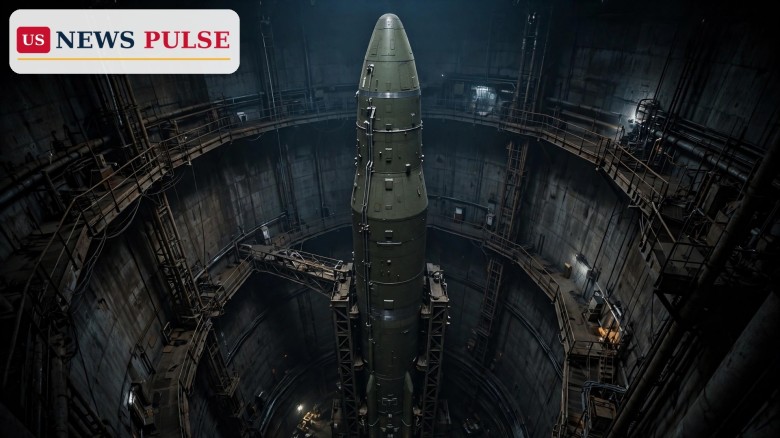
For decades, China kept a relatively small nuclear arsenal and a policy of minimum deterrence, holding enough warheads to guarantee retaliation but far fewer than the United States or Russia. That picture has changed sharply: the Pentagon's annual review said its warhead stockpile remained in the low 600s through 2024 but is on track to exceed 1,000 by 2030.
The growth reflects a wider military expansion — new missile silo fields, more nuclear-capable submarines and bombers, and new land-based missiles — and the Pentagon's figures have consistently pointed upward.
Even so, the gap remains wide: Russia and the United States each possess thousands of warheads. Trump's warning was not that China has caught up, but that its buildup could close the distance within ten years.
China's Nuclear Buildup and the New Three-Power Race
The China nuclear buildup is reshaping a nuclear order dominated by two powers since the Cold War. For decades, arms control was essentially bilateral between Washington and Moscow, built around treaties capping each side's deployed strategic weapons. China stayed outside that framework.
That structure is now under strain. A third nuclear power growing toward 1,000 warheads changes the arithmetic of deterrence and crisis stability: a deal capping American and Russian weapons while leaving China's force free to grow would look very different from past treaties.
The Shenzhen summit was the first attempt to do that at leader level: Trump, Xi and Putin agreed to talks on preventing nuclear proliferation — a modest step, but the first time the three leaders have put the nuclear question on a shared agenda. Trump's warning is the other side of that diplomacy: making clear why those talks matter.
Reactions and Quotes
Trump's own words carried the day. "They'll catch us within 10 years," he said at the White House news conference, adding: "They're going at it hot and heavy, but they have a lot." The phrase immediately became the headline, striking for its bluntness. He did not qualify the warning or suggest the buildup might slow; he presented it as a fact and a trajectory.
Secretary of State Marco Rubio, speaking alongside Trump, said it was imperative for the three nuclear powers to talk, framing the Shenzhen agreement as the necessary response to a changing nuclear landscape.
Why It Matters
The size and speed of China's nuclear buildup matters because it changes how the world's three largest nuclear powers calculate risk. When one side's arsenal grows quickly, the others must decide whether their own forces and alliances still hold.
For the United States, the buildup raises hard questions about its modernisation programme, its missile defences and its commitments to allies in Asia. Japan, South Korea, Australia and Taiwan all watch China's nuclear growth closely. A China moving toward 1,000 warheads does not overturn the balance overnight, but it narrows the margin.
For the wider world, the warning is a reminder that nuclear risk is no longer a two-player problem. A three-power nuclear order is more complex and less tested than the Cold War system, with more room for miscalculation.
What Happens Next
The immediate next step is the follow-up to the Shenzhen agreement: talks between the three nuclear powers on preventing proliferation. No date, venue or format has been announced, and turning a summit commitment into a working negotiation will take time. Whether China engages seriously — and whether Russia stays at the table — will be the first test.
The Pentagon's annual review will remain the benchmark: its projection of more than 1,000 Chinese warheads by 2030 gives the debate a number and a deadline. In Washington, Trump's warning is likely to feed into the debate over the American nuclear modernisation programme and the defence budget.
Frequently Asked Questions
How many nuclear weapons does China have?
The Pentagon's annual review said China's warhead stockpile remained in the low 600s through 2024, but is on track to exceed 1,000 warheads by 2030.
Will China really catch the United States within 10 years?
President Trump said Beijing "will catch us within 10 years" if the current pace continues. The US and Russia each hold thousands of warheads today, so catching up would require a very rapid buildup.
What did Trump, Xi and Putin agree in Shenzhen?
At the first-ever trilateral summit on Thursday, November 19, the three leaders agreed to talks on preventing nuclear proliferation, ending with a peace declaration but no wider breakthrough.
What is the Pentagon's China military report?
It is the US Defence Department's annual review of China's military buildup, including its nuclear forces. Its latest edition put China's stockpile in the low 600s through 2024, on track to pass 1,000 by 2030.
What happens next on nuclear talks?
The three powers agreed in Shenzhen to hold talks on preventing proliferation, but no date or format has been announced. Secretary of State Marco Rubio said it was imperative for the three nuclear powers to talk.
Read more on US News Pulse: Trump, Xi and Putin Open First-Ever Trilateral Summit in Shenzhen, China and Trump, Xi and Putin End First Trilateral Summit With Peace Declaration, No Breakthrough.

The US News Pulse newsroom covers breaking news across the United States and the world, working from wire services, official statements and on-the-record sources. Every story is reviewed against our editorial standards before publication. Corrections and tips: info@usnewspulse.com
About our newsroomLeave a Comment