

 | Today's Date:





AI Infrastructure Stocks Lose $4.2 Trillion Since June as Data-Centre Boom Unravels
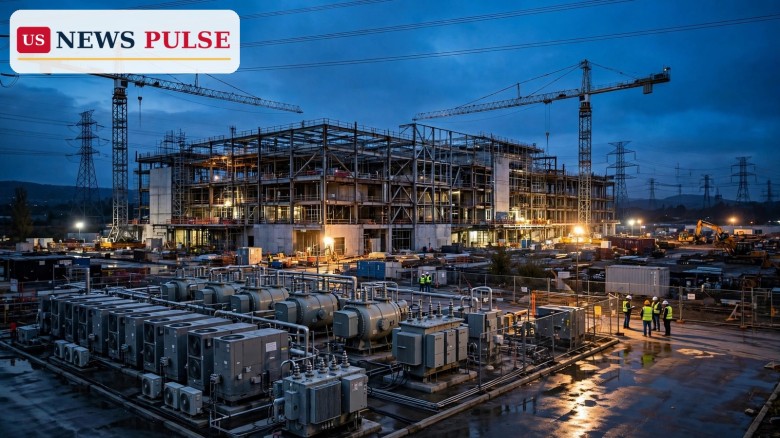
NEW YORK — Companies building the physical backbone of the artificial intelligence boom have lost $4.2 trillion in market value since June, according to a Financial Times analysis published Sunday, November 15, 2026, in the sharpest sign yet that investors doubt whether the AI infrastructure stocks at the centre of the boom can ever earn back the money being poured into them. The losses have erased nearly half of the $9.4 trillion those companies gained in the previous 12 months.
Key Points
- $4.2 trillion gone: Manufacturers, utilities and miners tied to data-centre construction have lost $4.2 trillion since June, erasing nearly half of the $9.4 trillion gained in the prior year.
- Caterpillar leads the fall: Down 44% from its June 30 record high, losing about $214 billion; Oklo is down 49%, and Comfort Systems and Corning have each lost about half their value.
- Sector-wide damage: Industrials are the second-worst S&P 500 sector since the summer, behind only technology.
- The trigger: Doubt over whether AI infrastructure spending will turn into real earnings, plus uncertainty over data-centre regulation after the midterms.
- Orders still strong: Caterpillar’s backlog is a record $78 billion and Siemens’ data-centre backlog is up 60% to 7 billion euros.
What Happened
The Financial Times analysis, reported on Sunday, November 15, 2026, tracks global manufacturing, utility and mining companies tied to building data centres — the halls of servers, cooling systems and power equipment that run artificial intelligence. Since June, that group has shed $4.2 trillion in market value, wiping out nearly half of the $9.4 trillion it added over the previous year, when the AI build-out was the hottest trade on Wall Street.
The selloff has not been confined to chipmakers. It has struck the suppliers underneath them — the companies making gas generators, cooling equipment, fibre-optic cable and construction materials. Industrials have become the second-worst performing sector in the S&P 500 since the summer, behind only technology. Caterpillar has fallen 44% from its June 30 all-time high, losing about $214 billion; Oklo is down 49%; Comfort Systems and Corning have each lost about half their value.
Background: How the AI Build-Out Became a $9.4 Trillion Bet
The losses follow one of the fastest wealth-creation runs in market history. Over the 12 months before June, companies tied to data-centre construction added $9.4 trillion in market value as investors raced to own every part of the AI supply chain. The logic was simple: if artificial intelligence was going to change the world, somebody had to build the power plants, lay the cable, pour the concrete and cool the servers — and those somebodies would be paid handsomely.
Tech giants and AI labs have committed hundreds of billions of dollars to new data centres. Anthropic agreed to take over orders for 1.7 gigawatts of gas-fired generators worth about $3.4 billion, with the machines ordered from Caterpillar. But the question investors now ask is not whether data centres will be built — they are being built at a record pace — but whether the companies paying for them will ever earn enough from AI to justify the cost.
AI Infrastructure Stocks: The Picks and Shovels Hit Hardest
The Financial Times calls these companies the “picks and shovels” of the AI boom — the toolmakers of a gold rush. In a gold rush, shovel-sellers are supposed to make money whatever happens to the miners. That is why their fall is so striking: the suppliers were meant to be the safe way to bet on AI, insulated from arguments about which chatbot or model would win.
Instead, they have fallen further and faster than many expected, even as Caterpillar’s power-generation sales rose 75% year on year. Part of the pressure comes from politics: the midterm elections brought to power lawmakers who campaigned against unchecked data-centre expansion, raising the prospect of tougher regulation and higher costs for new sites. Texas, which holds about a quarter of US data-centre capacity due online by 2030, is among the states where the debate is sharpest.
Reactions: Investors Ask When the Spending Pays Off
The mood in the market has shifted from excitement to scrutiny. The central doubt, as the Financial Times analysis frames it, is whether heavy AI infrastructure spending will translate into actual corporate earnings and profitability. Until companies can show that the billions going into data centres are producing matching revenue, the suppliers’ valuations rest on faith in a payoff that has not yet arrived.
That scepticism is spreading: technology stocks have also slid, with the Nasdaq 100 entering correction territory earlier this month. The two falls are linked: if the AI labs and cloud giants slow their building, the order books that support Caterpillar, Siemens and the rest will thin out — and the market is pricing in that risk before it happens. For now, the companies point to their backlogs: Caterpillar’s record $78 billion and Siemens’ data-centre backlog up 60% to 7 billion euros.
Why It Matters
A $4.2 trillion loss is not a niche market event. It touches pension funds, retirement accounts and index funds holding these industrial and utility names, and signals a wider reassessment of the AI trade that has driven global markets for two years. It also matters for the real economy: data-centre construction has become a major source of jobs, power demand and industrial orders across the United States, and a slowdown would ripple through construction, manufacturing and energy — just as the boom did on the way up.
What Happens Next
Investors face a further test this week. Nvidia, the chipmaker at the centre of the AI trade, reports earnings on Tuesday, November 17, and its numbers will be read as a verdict on the whole build-out. Anthropic’s expected listing is also being watched as a measure of appetite for AI companies. Beyond this week, the story turns on two things: whether AI companies can show their spending is producing real revenue, and whether the new political landscape produces concrete rules for data-centre building.
Frequently Asked Questions
What are AI infrastructure stocks?
Shares of companies supplying the physical backbone of AI: power generators, cooling systems, fibre-optic cable, construction and mining firms tied to building data centres.
How much value has been lost?
About $4.2 trillion since June 2026, according to a Financial Times analysis, erasing nearly half of the $9.4 trillion gained in the previous 12 months.
Why are Caterpillar and Oklo falling so far?
Caterpillar is down 44% from its June 30 record high, losing about $214 billion, and Oklo is down 49%, as investors doubt AI spending will become earnings and fear tougher regulation.
Is the AI boom over?
Not on the evidence of order books: Caterpillar’s backlog is a record $78 billion and Siemens’ data-centre backlog is up 60%. But investors will not pay for future growth without proof of profits.
What should investors watch next?
Nvidia’s earnings on Tuesday, November 17, Anthropic’s expected listing, and data-centre regulation after the midterm elections.
Related coverage: Data-centre opponents emerge as big winners of Democrats’ midterm sweep; Tesla and SpaceX lose about $456 billion in two days after Democrats’ midterm sweep; Anthropic’s $3.4 billion gas generator deal to power its AI data centres.

The US News Pulse newsroom covers breaking news across the United States and the world, working from wire services, official statements and on-the-record sources. Every story is reviewed against our editorial standards before publication. Corrections and tips: info@usnewspulse.com
About our newsroomLeave a Comment