


 | Today's Date:





CERN Finds First Evidence of Rarest Beauty Particle Decay After 42 Years
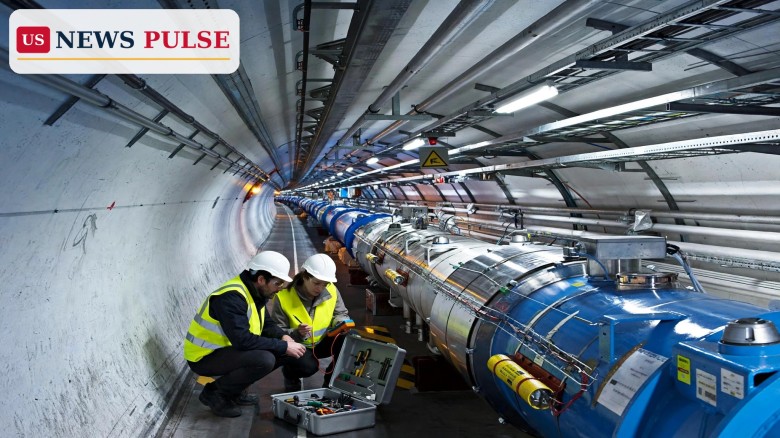
Physicists at CERN have found the first evidence of the rarest beauty-particle decay ever observed, a process so unlikely it happens only about once in every ten billion beauty particles. Announced on Tuesday, November 3, 2026, the result ends a search that began in 1984 and gives scientists a powerful new test of the Standard Model of particle physics.
The decay, in which a B0 meson turns into a pair of muons, was spotted by the LHCb collaboration at the Large Hadron Collider near Geneva, Switzerland. The evidence clears the three-standard-deviation threshold, but falls short of the five needed for a discovery.
Key Points
- CERN's LHCb collaboration announced on Tuesday, November 3, 2026, the first single-experiment evidence of a B0 meson decaying into two muons (B0 → μ+μ−).
- The decay happens only about once in every ten billion beauty particles, making it the rarest beauty-particle decay ever observed if confirmed.
- Data from the upgraded LHCb detector in 2024-2025 reached 3.0 sigma; combined with 2011-2018 data, it rose to 3.2 sigma, past the evidence threshold, short of the 5-sigma discovery standard.
- The measured rate is about 1.14 decays per ten billion, matching Standard Model predictions, and the same analysis gave the most precise measurement yet of the sister Bs0 decay.
- The paper (arXiv:2611.00230) was submitted November 3 and is not yet peer-reviewed; the upgraded LHCb detector collects data five times faster than before.
What Happened
The LHCb collaboration announced the result at a seminar at CERN on Tuesday, November 3, 2026, with the first single-experiment evidence of the B0 → μ+μ− decay. In this process, a beauty quark and a down antiquark inside a B0 meson annihilate, releasing energy that becomes a muon and its antiparticle. A muon is a heavier cousin of the electron, and spotting the pair among the flood of particles from LHC collisions is a formidable challenge.
Data from the upgraded LHCb detector in 2024 and 2025 alone showed evidence at 3.0 standard deviations, meaning only about a 0.3 percent chance the signal appeared by random fluctuation. Combined with measurements from 2011 to 2018, the significance rose to 3.2 standard deviations. The measured rate came out at about 1.14 in ten billion, close to the Standard Model prediction.
The same analysis also gave the most precise measurement yet of the sister decay, Bs0 → μ+μ−, at about 3.25 per billion, with an effective lifetime of 1.60 ± 0.16 picoseconds. The Bs0 decay is about thirty times more common and was first observed in a joint LHCb-CMS analysis in 2015.
Background and Context
The search stretches back to 1984, when physicists first realised such rare decays could reveal particles too heavy to be made directly in a collider. Quantum physics says even particles too massive to appear in a collision can briefly influence a decay, so a precise measurement can reveal their fingerprints. The rarer the decay, the more sensitive it is, which is why these processes are called "golden channels" in the hunt for new physics.
The breakthrough followed a major upgrade of the LHCb experiment in 2024. The upgraded detector collects data five times faster than between 2010 and 2018 and tells different particle types apart more reliably. With machine learning, those gains let the 19-person team suppress the vast background that would otherwise have swamped the tiny signal.
The analysis was co-led by Dr Harry Cliff of the University of Cambridge, LHCb's Rare Decays Convener, with Professor Tim Gershon of the University of Warwick leading the LHCb collaboration.
CERN Beauty Particle Decay: One in Ten Billion
The headline number is hard to grasp: for every ten billion beauty particles produced, only about one B0 meson is expected to decay into a pair of muons. That rarity is what makes the decay valuable. Because the process is so heavily suppressed in the Standard Model, even a small contribution from an undiscovered particle could shift its rate noticeably, setting strict limits on particles too heavy for the LHC to create directly.
Physicists call the reach of these measurements the "zeptoverse". A zeptometre is 10&supminus;²¹ metres, a scale far smaller than anything a collider can probe head-on. The B0 decay is sensitive to physics at that scale, which is why physicists chased it for more than four decades.
Reactions and Statements
Marco Santimaria, who co-led the 19-person analysis team, said the hunt had tested a generation of physicists. "Physicists have been chasing this decay for more than forty years," he said. "Extreme precision is required to pick the muons out of the overwhelming background."
Harry Cliff, LHCb's Rare Decays Convener, said the evidence opens a new avenue for exploring physics beyond the LHC's direct reach. "Seeing evidence of this rare decay is incredibly exciting, opening up new possibilities to probe beyond the direct reach of the LHC," he said. "The future LHCb upgrade will allow us to observe many more of these decays, providing even greater sensitivity to undiscovered particles."
Why It Matters
This result turns a decades-old prediction into a measured reality. Physicists now have a second ultra-rare beauty decay to measure with growing precision, alongside the Bs0 decay observed in 2015. Each measurement tightens the net around theories predicting new particles, such as supersymmetry.
It is also proof of the upgraded LHCb detector. The machine now gathers data five times faster than before and will keep collecting a much larger dataset into the early 2030s, pushing this result from evidence toward a full discovery.
What Happens Next
Further research will aim to confirm the B0 decay by reaching five standard deviations, the level for a discovery. That would make it the rarest beauty-particle decay ever observed. The High-Luminosity LHC, starting in 2030, and a planned LHCb upgrade in the mid-2030s could raise the data rate by another order of magnitude.
Meanwhile, the paper will go through peer review as the collaboration keeps analysing the growing dataset. If the rate stays in line with the Standard Model, the limits on new particles will keep tightening. If it drifts, physicists may finally have a clue about what lies beyond it.
Read more on US News Pulse: Earth Has a Temporary Second Moon as Tiny Asteroid 2026 QQ8 Loops in Orbit, NASA's Swift Observatory Plunges to Earth Over Indonesia After 22 Years.
Frequently Asked Questions
What did CERN find?
The LHCb collaboration found the first single-experiment evidence of a B0 meson decaying into two muons, expected only about once in every ten billion beauty particles.
How rare is the B0 decay?
It is the rarest beauty-particle decay ever observed. Its rate is about thirty times lower than the sister Bs0 decay, at about three times per billion beauty particles.
Is this a discovery?
Not yet. The result reached 3.2 standard deviations, enough for evidence, but a discovery requires 5.
What is the zeptoverse?
It is the scale of a zeptometre, 10&supminus;²¹ metres. Rare decays like this are sensitive to new particles at that tiny scale, far beyond the LHC's direct reach.
Who led the analysis?
Dr Harry Cliff of the University of Cambridge co-led the analysis, with Professor Tim Gershon of the University of Warwick leading the LHCb collaboration.
Leave a Comment