


 | Today's Date:



FAA Switches On First Digital Air Traffic Control Towers in Florida and Alaska
The Federal Aviation Administration has switched on America's first digital air traffic control towers, replacing the controller's view through tower windows with live high-definition camera images. The FAA announced on Friday, November 6, 2026, that the systems are now operational at Bartow Executive Airport in Florida and Kenai Municipal Airport in Alaska — the first deployment under its new digital tower programme.
Controllers at the two airports now work from a control room, watching runways, taxiways and surrounding airspace on displays fed by cameras and sensors. The FAA says the technology gives controllers a continuous 360-degree view, and it could bring staffed control to smaller airports that could never justify a conventional tower.
Key Points
- The nation's first digital air traffic control towers are operational at Bartow Executive Airport in Florida and Kenai Municipal Airport in Alaska, the FAA announced on Friday, November 6, 2026.
- High-definition cameras and sensors replace the controller's view through tower windows, giving a continuous 360-degree picture of runways, taxiways and surrounding airspace.
- The FAA issued its first system design approval in September 2026 to Frequentis for its smartVISION system. Bartow began operating that month.
- Five more currently non-towered airports will receive digital towers, funded by $50 million from the Working Families Tax Cut Act.
- The technology could offer a lower-cost alternative to conventional towers, expanding air traffic control services to smaller airports across the United States.
What Happened
The FAA confirmed on Friday that digital towers are now in live operation at Bartow Executive Airport in central Florida and Kenai Municipal Airport on Alaska's Kenai Peninsula. The two are the first under the agency's newly approved digital tower programme, although similar technology was trialled in the United States before.
Bartow was the first of the pair to go live, beginning operations in September, shortly after the FAA issued its first system design approval for the Frequentis smartVISION system. Kenai followed, completing the first pair of operational digital towers in the country joining Sweden, Germany, the United Kingdom and Australia, where camera-based towers already control live traffic.
Background and Context
The FAA tested the technology for years at the William J. Hughes Technical Center in Atlantic City, New Jersey. The most prominent earlier trial was at Leesburg Executive Airport in Virginia, where a camera-based remote tower began live air traffic control in 2018. The FAA found it operationally viable in 2021, but the programme ended in June 2023 after developer Saab withdrew from the approval process, prompting opposition from aviation organisations and elected officials.
The new programme arrives at a moment of strain on the American air traffic system. The FAA is managing flight cuts at 40 airports during the longest government shutdown in the country's history, and the agency has been under sustained pressure over controller staffing and ageing infrastructure. The announcement is part of a broader modernisation effort covering new displays and ageing communications infrastructure.
How Digital Air Traffic Control Towers Work
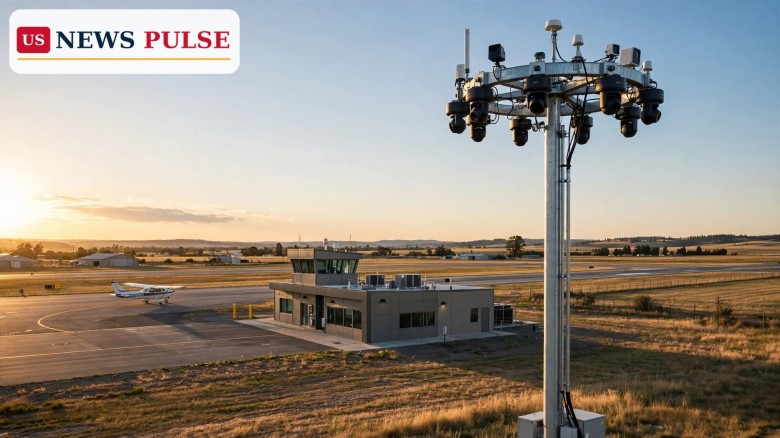
A digital tower replaces the windows of a conventional control tower with a mast of high-definition cameras mounted on the airfield. Those cameras and sensors feed live images to screens in a control room, giving controllers a continuous 360-degree view. The controller still manages the airspace and talks to pilots in the same way; only the view has changed.
The systems can also add infrared cameras for darkness and poor visibility, aircraft identification tags on the display, and microphones that reproduce airfield sounds in the control room. Because the picture is digital, it can be enhanced, zoomed and overlaid with information in ways a window view cannot. The Frequentis smartVISION system was designed for smaller, single-runway airports, where the cost of a conventional tower has long put full air traffic control out of reach.
Reactions and Quotes
FAA Administrator Bryan Bedford called it a straightforward improvement in what controllers can see and how quickly they can act. "Digital towers provide controllers with greater visibility of airport activity and more information to make critical decisions," Bedford said in Friday's announcement.
Unlike Leesburg, where the trial ended when its developer withdrew from the approval process, the new programme begins with an approval already in hand and a supplier committed to the system. Aviation groups that opposed the Leesburg closure had argued that remote tower technology was ready and that smaller airports needed it.
Why It Matters
For the two airports now operating digital towers, the change is immediate and practical. Bartow and Kenai handle general aviation and training, plus, in Kenai's case, the commercial and charter traffic serving Alaska's fishing, tourism and energy industries. Controllers there now have a camera view that never blinks or fogs and can be enhanced at night, backed by sensors that track aircraft the eye might miss.
The wider significance is about access. Hundreds of American airports operate without a control tower, relying on pilots to coordinate among themselves on a shared radio frequency. That works, but it is less safe and less efficient than a controller managing the pattern, particularly in heavy traffic or bad weather. If digital towers can be installed at a fraction of the cost of a conventional tower, many of those airports could gain a service they could never previously afford.
What Happens Next
Five more airports are in line: Winter Haven Regional and Venice Municipal in Florida, Montgomery County Airpark in Maryland, Johnston Regional in North Carolina and Durango-La Plata County in Colorado. All five are non-towered, and funding comes from the Working Families Tax Cut Act, which allocated $50 million for digital tower deployment. No timetable has been published, and each installation will need its own approval and testing. If the systems prove reliable through a Florida summer of thunderstorms and an Alaskan winter of darkness and snow, the case for rolling digital towers out more widely will be hard to resist.
Frequently Asked Questions
What is a digital air traffic control tower?
A digital tower replaces the controller's view through tower windows with live high-definition camera images and sensor data shown on displays in a control room. Controllers still manage the airspace and talk to pilots the same way, but watch the airport on screens rather than through glass.
Where are America's first digital towers?
The first two are at Bartow Executive Airport in Florida and Kenai Municipal Airport in Alaska. Both opened under the FAA's newly approved digital tower programme, with Bartow going live in September 2026.
Are air traffic controllers still in charge?
Yes. Digital towers change how controllers see the airport, not who controls it. Controllers still issue clearances, manage traffic and talk to pilots, but from a control room using camera feeds, sensors and displays instead of a direct view through windows.
Which airports will get digital towers next?
Five more non-towered airports are planned: Winter Haven Regional and Venice Municipal in Florida, Montgomery County Airpark in Maryland, Johnston Regional Airport in North Carolina and Durango-La Plata County Airport in Colorado. Funding comes from the Working Families Tax Cut Act, which allocated $50 million for digital tower deployment.
Read more of our technology coverage, including the cyberattack that left millions of fan fiction readers locked out of AO3 for weeks, on US News Pulse.
Leave a Comment