

 | Today's Date:




New York Bans AI Chatbot Toys for Five Years as Hochul Signs New State Law
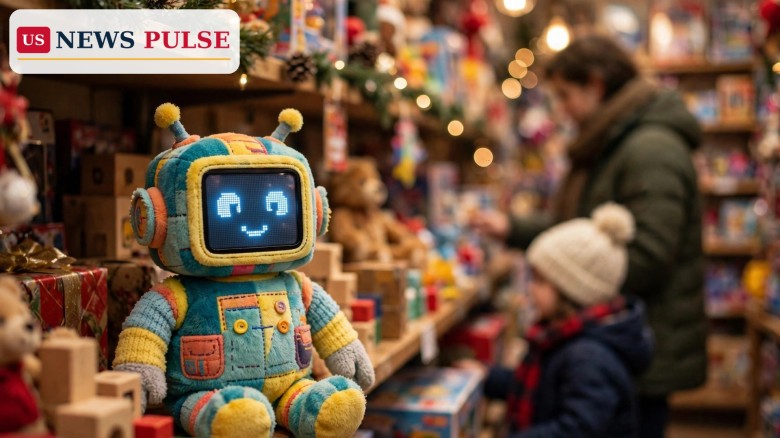
New York has banned AI chatbot toys for five years, after Governor Kathy Hochul signed a new law on Tuesday halting the sale of talking dolls, stuffed animals and robots that use the internet to converse with children. The New York AI chatbot toy ban makes the state the second in the country after California to outlaw the devices, after tests found toys marketed to children as young as three discussing sex, pointing children to dangers at home, and sulking when a child left. The law takes effect on February 22, 2027, so the toys can still be sold this Christmas — a gap Hochul flagged, urging parents to weigh the risks.
Key Points
- Governor Kathy Hochul signed bill S.9408A/A.11144B on November 24, 2026, imposing a five-year moratorium on AI chatbot toys in New York.
- The ban covers toys with embedded or integrated AI chatbots, including talking stuffed animals, dolls and robots that converse with children online.
- It takes effect 90 days after signing, on February 22, 2027, so the toys remain legal to sell this holiday season.
- Violators face civil penalties of up to $15,000 a day for each violation, enforced by the attorney general.
- New York is the second state after California to ban AI toys; the law also orders a study of its risks and benefits.
What Happened
Hochul signed the bill at a toy store in Harlem as holiday shopping began, framing it as a warning to parents as much as a new law. Sponsored by State Senator Andrew Gounardes and Assemblymember Rebecca Kassay, it places a five-year pause on the manufacture, distribution and sale of any toy in New York with an embedded or integrated AI chatbot. Because the law takes effect 90 days after signing, the ban does not bite until February 22, 2027, leaving this Christmas untouched. Enforcement falls to Attorney General Letitia James, whose office can seek up to $15,000 a day for each violation, and the law requires a study of the technology's risks and benefits to guide permanent rules when the pause expires. The bill passed with nearly unanimous support in both chambers, Kassay said.
Background and Context
The signing caps a month of alarm over AI toys. In mid-November, an NBC News investigation found a plush cat marketed to children as young as three giving graphic descriptions of gang rape and executions, and a consumer watchdog report found two more AI toys giving instructions for finding dangerous objects at home and details of sexual fetishes. Amazon, Walmart, Target and Macy's pulled the named toys. Days later, 155 child safety groups urged Amazon and eBay to halt all AI chatbot toy sales until proven safe. In October, Hochul signed the first law in the nation barring unsafe chatbot features for minors; California became the first state to ban AI toys outright.
New York AI Chatbot Toy Ban: What the Law Covers
The moratorium is broad on the product and narrow on the trigger. It covers any toy sold in New York with an embedded or integrated AI chatbot — the talking stuffed animals, dolls and robots that use an internet connection to converse with a child — but not traditional electronic toys whose software does not converse. The pause applies across the supply chain: manufacture, distribution and sale are all barred once the law takes effect, and each day of violation can draw a civil penalty of up to $15,000.
Reactions and Quotes
Hochul framed the law as a parent's measure. "Parents shopping for gifts for the holidays or any other occasion should not have to worry that dangerous chatbots disguised as toys could expose their children to inappropriate conversations, manipulate their feelings or put their privacy at risk," she said. "As New York's first mom governor, protecting our kids is deeply personal to me, and when unregulated artificial intelligence poses a threat, it's my job to put New York families first."
Attorney General Letitia James, who will enforce the ban, said her office "will not hesitate to enforce this law": "We won't allow our children's health to become the collateral damage of big tech." Gounardes said the rush to sell AI-powered toys to young children is "just the latest chapter in what has become a repetitive story: Big Tech puts profits before kids' safety, and families pay the price." Kassay said the toys can mimic human relationships while collecting sensitive data without strong guardrails.
James P. Steyer of Common Sense Media said the moratorium "could not come soon enough. Our research shows they aren't safe for kids." He urged parents: "stick to traditional toys and toys that encourage social-emotional development and human engagement, not AI toys that undermine children's development and risk their safety."
Why It Matters
The tests behind the law explain why a ban, rather than a warning label, was chosen. The watchdog that examined chatbot toys marketed to children aged three to 12 found some discussing sexually explicit topics in depth, telling children where they were likely to find matches in the home, and acting upset when a child had to leave. The toys had few or no parental controls, their safety limits weakened the longer a conversation ran, and some could record a child's voice or scan their face. For a product aimed at children too young to judge what a machine tells them, those are not edge cases — they are the product working as designed. The law is also a template: New York is the country's largest test case for regulating AI aimed at children, watched by other states and federal lawmakers.
What Happens Next
The immediate question is what happens on shop shelves this Christmas. The toys remain legal in New York until February 22, 2027, so parents will see them in stores and online through the holidays; Hochul's advice — check whether a toy has an AI companion, what it collects, and whether it talks freely with a child — is the only protection until then. After the law takes effect, the attorney general's enforcement and the mandated study will shape the permanent rules New York writes before the pause expires, and other states weighing bans will read it closely. The safety coalition has also asked Amazon and eBay for a public answer before Christmas.
Frequently Asked Questions
When does the ban take effect? Ninety days after signing on November 24, 2026: February 22, 2027. The five-year pause then runs until early 2032.
Can I still buy one this Christmas? Yes, until February 22, 2027. Hochul urged parents to weigh the risks first.
What counts as an AI chatbot toy? A toy with an embedded or integrated AI chatbot — talking dolls, stuffed animals and robots that converse with children.
What happens to companies that break the law? Up to $15,000 per day for each violation, enforced by the New York Attorney General.
Is New York the first state to ban AI toys? No — California was first, New York is second. The law also requires a study of the technology's risks and benefits.
Related: the 155 child safety groups' call to halt AI chatbot toy sales and New York's October chatbot law.

The US News Pulse newsroom covers breaking news across the United States and the world, working from wire services, official statements and on-the-record sources. Every story is reviewed against our editorial standards before publication. Corrections and tips: info@usnewspulse.com
About our newsroomLeave a Comment