

 | Today's Date:


Two Tankers Hit by Projectiles in Strait of Hormuz in New Saturday Attacks
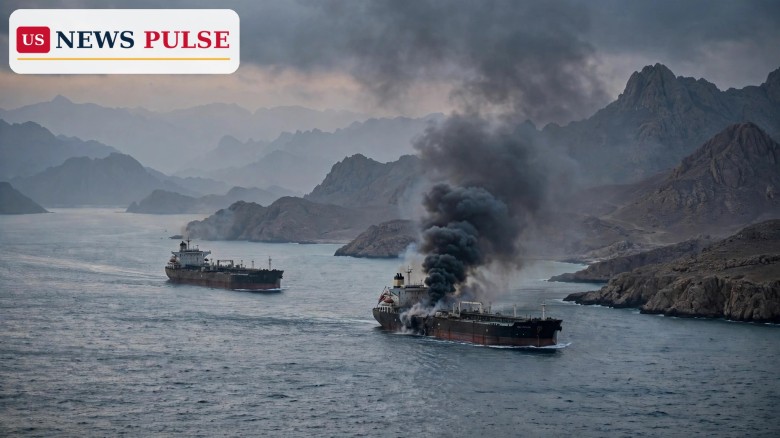
DUBAI — Two oil tankers were hit by unidentified projectiles in the Strait of Hormuz on Saturday, November 21, 2026, the United Kingdom Maritime Trade Operations agency said, in the latest attacks on shipping in the world's most important oil waterway. The strikes came about 50 minutes apart near the Omani port of Khasab, a day after another tanker was set ablaze nearby, as the US-Israel-Iran war entered its ninth month. No casualties were reported, and it was not immediately clear whether the two reports involved the same vessel.
Key Points
- UK Maritime Trade Operations reported two separate tanker incidents on Saturday, November 21, near Khasab, Oman, in the Strait of Hormuz.
- The first was hit on its stern about 11 nautical miles (20 km) north of Khasab; the second in its engine room about 17 nautical miles (31 km) east of Khasab.
- No casualties were reported in either incident, and the environmental impact remained unknown.
- Iran's navy said separately that an oil tanker caught fire after hitting a naval mine in a restricted area east of the strait — a claim not independently verified.
- The attacks follow Friday's strike in the same waters and come as hawks press President Trump to resume major strikes on Iran.
What Happened
The first report came from UKMTO, the British agency that monitors shipping security in the region. A tanker sailing outbound through the strait was struck on its stern by an unidentified projectile about 11 nautical miles north of Khasab, a small Omani port on the Musandam Peninsula at the strait's narrowest point.
About 50 minutes later, a second report reached UKMTO: another tanker — or possibly the same one — had been hit in its engine room by an unidentified projectile about 17 nautical miles east of Khasab. Neither report named the vessels or described the damage. Separately, Iran's navy said an oil tanker caught fire after hitting a naval mine in a restricted area east of the strait “before noon today.” The claim is unverified, and no group has claimed responsibility.
Strait of Hormuz Tanker Attacks: A Dangerous New Pattern
Saturday's attacks were the latest in a rapid run of strikes on shipping in the strait. On Friday, November 20, a tanker was hit on its port bow at about 3 p.m. UTC, roughly 8 nautical miles north of Khasab, and caught fire. Saturday brought two more within an hour.
Earlier in the week, the Panama-flagged LPG tanker Tara Gas was struck twice off Oman, forcing its 25 crew to abandon ship; one Indian seafarer is still missing. Days before that, at least four tankers were damaged when they struck mines, and Iran's Revolutionary Guard Corps said a supertanker and an LPG carrier had caught fire after hitting naval mines.
Seatrade Maritime had counted 17 confirmed incidents in the strait this month as of November 17, before Friday's attack and Saturday's two new strikes. The attacks have spread from mines to direct projectile strikes on moving ships.
Background: Nine Months of War in the Gulf
The attacks are taking place against the backdrop of the war between the United States, Israel and Iran, which began on February 28, 2026 and is now in its ninth month. The Strait of Hormuz, the narrow passage between Iran and Oman, sits at the centre of that war. Roughly a fifth of the world's seaborne oil passes through it, and any sustained threat there rattles energy markets and global trade.
Iran has threatened to close the waterway, laid mines, and warned shipping firms against trusting what it calls American lies. The United States has tightened a blockade of Iranian oil exports, targeting ship-to-ship transfers, while Israel has struck Iranian targets across the region, including Qeshm island at the mouth of the strait.
Reactions: Pressure Builds on Trump
Pressure on President Donald Trump is coming from two directions. Israel and administration hawks argue the steady drumbeat of attacks on shipping shows Iran is escalating and only a major strike will stop it. Others warn new strikes would widen a war already nine months old with no clear end.
Trump has sent mixed signals. On Friday he said Iran wants a deal “but they don't want to make a deal that's acceptable to me,” and repeated his pledge that “Iran will never have a nuclear weapon ever.” He has delayed any decision on new strikes until after the new year; the White House has not yet commented on Saturday's attacks.
Iran has neither confirmed nor denied involvement. Tehran has repeatedly denied targeting commercial shipping and has blamed the United States and Israel for the wider war.
Why It Matters
The strait is one of the world's great chokepoints. About a fifth of global seaborne oil moves through a channel barely 21 miles wide at its narrowest point, with no easy alternative route for most Gulf crude. Every new attack raises shipping costs — insurers raise war-risk premiums, owners reroute or delay sailings, and oil prices edge higher on the fear that one major incident could shut the strait.
The attacks also show the war widening, not winding down. What began as airstrikes and missile exchanges has become a grinding campaign against shipping, and each incident raises the risk of a miscalculation that turns a shipping attack into a wider confrontation.
What Happens Next
The first questions are practical: whether the two UKMTO reports involved one vessel or two, how badly the ships were damaged, and whether any oil leaked. UKMTO is expected to issue further updates as owners and insurers assess the damage. The bigger question is political: whether Saturday's attacks change the Trump administration's calculus on new strikes against Iran.
Frequently Asked Questions
What happened in the Strait of Hormuz on Saturday?
Two tankers were hit by unidentified projectiles near Khasab, Oman, according to UKMTO — the first on its stern about 11 nautical miles north of Khasab, the second in its engine room about 17 nautical miles east, roughly 50 minutes later.
Were there any casualties?
No casualties were reported in either incident, and the environmental impact remained unknown. It was not immediately clear whether the two reports involved the same vessel.
Who attacked the tankers?
No group has claimed responsibility, and UKMTO has blamed no government. Iran's navy said separately that a tanker hit a naval mine east of the strait, a claim not independently verified.
Is this part of a wider pattern?
Yes. A tanker was hit and set ablaze in the same waters on Friday, the LPG tanker Tara Gas was struck twice earlier in the week, and at least four tankers hit mines in mid-November. Seatrade Maritime counted 17 confirmed incidents this month as of November 17.
Why does the Strait of Hormuz matter?
Roughly a fifth of the world's seaborne oil passes through the narrow strait between Iran and Oman. Attacks there raise insurance costs, push up oil prices and risk a wider confrontation in the nine-month-old war.
Related: Tanker Struck and Set Ablaze in Strait of Hormuz as Missile Hits Iran's Qeshm Island • Second Strike on LPG Tanker Tara Gas Off Oman Forces Crew to Abandon Ship • Four Tankers Damaged in Strait of Hormuz as Mines Strike Ships

The US News Pulse newsroom covers breaking news across the United States and the world, working from wire services, official statements and on-the-record sources. Every story is reviewed against our editorial standards before publication. Corrections and tips: info@usnewspulse.com
About our newsroomLeave a Comment