

 | Today's Date:





Ukraine Strikes Savasleyka Airbase Deep in Russia, Damaging Five Warplanes
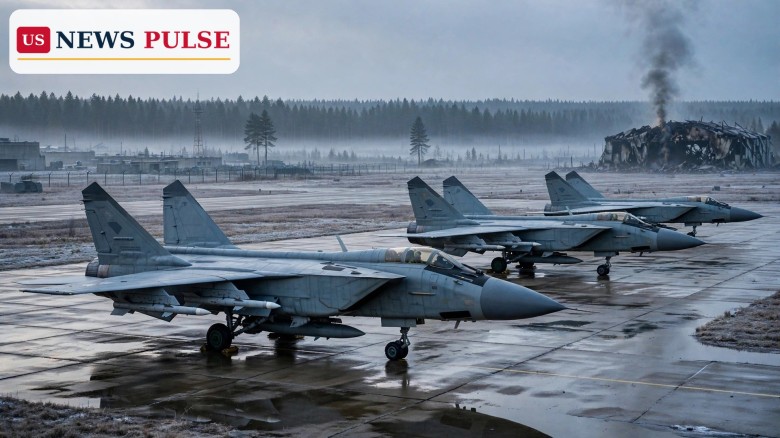
Ukraine struck the Savasleyka military air base deep inside Russia this week, damaging five warplanes including three MiG-31 jets that carry Kinzhal hypersonic missiles, Ukraine's General Staff said on Wednesday, November 25, 2026. The strike hit a base in the Nizhny Novgorod region, about 300 kilometres (190 miles) east of Moscow, in the latest long-range attack aimed at crippling Moscow's war effort. Two Su-34 fighter-bombers were also damaged in the operation, which took place on Tuesday and Wednesday, November 24 and 25. Russia did not immediately comment on the claim, and there was no independent confirmation of the damage.
Key Points
- Ukraine says it damaged three MiG-31 jets and two Su-34 fighter-bombers at Savasleyka air base in Russia's Nizhny Novgorod region.
- The base sits about 300 kilometres (190 miles) east of Moscow, far behind the front line.
- The strikes took place on Tuesday and Wednesday, November 24 and 25, 2026.
- Russia did not immediately comment, and the damage has not been independently confirmed.
- Kyiv also said it hit two oil refineries in Samara, plus a radar system and fuel and logistics depots in occupied territory.
What Happened
Ukraine's General Staff said on Wednesday, November 25, 2026, that Ukrainian forces had struck the Savasleyka military air base in the Nizhny Novgorod region. Three MiG-31 jets were damaged, along with two Su-34 fighter-bombers. The General Staff said all five aircraft were knocked out of operation "for some time", with the extent of the damage still being assessed.
The MiG-31 jets matter because they are the aircraft Russia uses to fire Kinzhal hypersonic missiles at Ukraine — among the fastest weapons in Russia's arsenal and among the hardest for Ukrainian air defences to intercept.
The strikes took place across Tuesday and Wednesday, November 24 and 25. Savasleyka lies about 300 kilometres east of Moscow, far from the front line, showing how far Ukraine's long-range campaign now reaches. Overnight, Kyiv also said it hit two oil refineries in Russia's Samara region, some 800 kilometres (500 miles) from the front line, and struck a radar system and fuel and logistics depots in occupied Ukrainian territory.
Background: Ukraine's Deep-Strike Campaign
The Savasleyka strike is the latest in a series of long-range Ukrainian attacks aimed at denting Moscow's military capacity and its oil-processing industry. Kyiv has steadily extended the reach of its drone and missile operations inside Russia, hitting airfields, refineries and fuel depots.
The timing matters. Ukraine is struggling under a renewed Russian campaign against its energy system, with waves of missiles and drones hitting power plants and grid infrastructure as winter sets in. At least 15 people were killed in Ukraine's Kyiv region in the intensified Russian attacks, according to Ukrainian officials.
Kyiv has said it will stop striking Russian energy targets only when Moscow does the same, framing its attacks on refineries as a response to the bombardment of its own power grid. The Savasleyka strike fits the same logic: hit the aircraft and weapons that launch attacks on Ukraine before they can fly again.
Ukraine Strikes Savasleyka Airbase: Why the MiG-31 Loss Matters
The three MiG-31 jets are the heart of this story. Only a limited number of the interceptors have been adapted to carry the Kinzhal hypersonic missile, so each one taken out of service, even temporarily, reduces the number of aircraft able to launch one of Russia's most feared weapons.
The Kinzhal travels at hypersonic speed and is launched from high altitude, giving air defences very little time to react. Ukraine has intercepted some Kinzhals with Western-supplied Patriot systems, but they remain among the most difficult Russian weapons to stop.
The two Su-34 fighter-bombers add to the toll. The Su-34 is the workhorse of Russia's bombing campaign, used to strike Ukrainian positions and towns. Losing five aircraft in one operation would be a heavy blow to a single base.
Reactions
Ukraine's General Staff announced the strike on Wednesday, November 25, saying the five aircraft had been damaged and knocked out of operation "for some time". It did not release images or further detail, and said the extent of the damage was still being assessed.
Russia did not immediately comment on the claim. Moscow rarely confirms Ukrainian strikes on military targets inside Russia promptly, and independent verification of damage at a closed military airfield is difficult. Satellite imagery and later official statements may confirm how badly the aircraft were hit.
The strike came as Kyiv pressed its case that its attacks on Russian energy and military targets are a direct answer to Russia's bombardment of Ukraine's power grid. Kyiv has said it will halt its strikes on Russian energy targets only when Moscow stops hitting Ukraine's energy system.
Why It Matters
The Savasleyka strike shows that Ukraine can reach high-value military targets hundreds of kilometres inside Russia. A base 300 kilometres east of Moscow is not a front-line target; hitting it requires long-range drones or missiles, careful planning and intelligence on where the aircraft are parked.
For Russia, the strike is a warning that its airfields are not safe, even far from the fighting. Every base that must be defended more heavily drains air-defence systems and personnel from elsewhere, and every MiG-31 grounded is one fewer Kinzhal carrier in the air.
For Ukraine, the operation is a morale boost and a practical blow at a moment when its energy grid is under severe strain. It also strengthens Kyiv's hand in talks, showing that it can impose costs on Moscow even as it defends its own cities.
What Happens Next
The first question is the damage assessment. Ukraine said the extent of the damage was still being assessed, and confirmation will likely come from satellite images or Russian statements in the coming days.
The second is whether Russia retaliates against Ukraine's energy grid, which is already under intense attack. Moscow has answered past deep strikes with heavy missile and drone barrages on Ukrainian power infrastructure.
Frequently Asked Questions
Where is the Savasleyka air base?
It is a Russian military air base in the Nizhny Novgorod region, about 300 kilometres (190 miles) east of Moscow.
What is a Kinzhal missile?
The Kinzhal is a hypersonic air-launched ballistic missile carried by adapted MiG-31 jets. Russia has used it repeatedly against targets in Ukraine.
How many aircraft were damaged?
Ukraine says five: three MiG-31 jets and two Su-34 fighter-bombers. The claim has not been independently confirmed.
Has Russia responded?
Russia did not immediately comment on the strike, and there was no independent confirmation of the damage when Ukraine announced it on November 25, 2026.
Why is Ukraine striking targets inside Russia?
Kyiv says its long-range strikes aim to dent Moscow's military capacity and oil-processing industry, and it will stop hitting Russian energy targets only when Moscow stops attacking Ukraine's energy system.
Related coverage: Trump and Rutte Urge Russia Not to Expand Ukraine War After Mar-a-Lago Talks | Kushner Says Putin Showed 'Restraint' on Nuclear Weapons in Ukraine War | Russia Hits Two Grain Ships Near Odesa as Black Sea Exports Grind to a Halt

The US News Pulse newsroom covers breaking news across the United States and the world, working from wire services, official statements and on-the-record sources. Every story is reviewed against our editorial standards before publication. Corrections and tips: info@usnewspulse.com
About our newsroomLeave a Comment