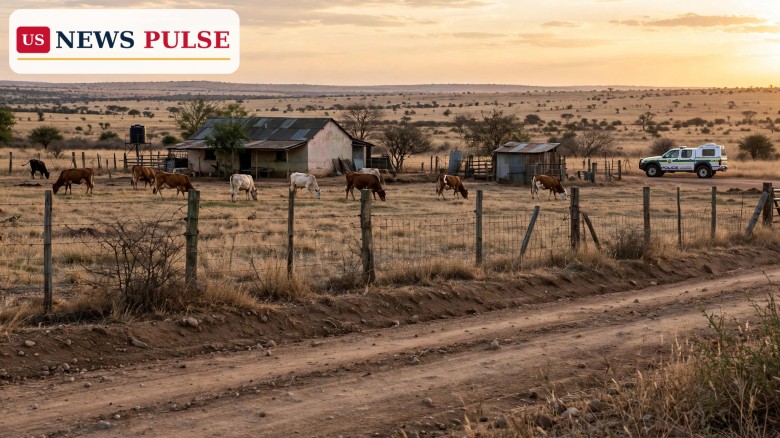
The United States State Department has accused South African politicians of endangering the lives of Afrikaners, after two violent attacks on white farmers in North West province, about 80 miles from Johannesburg. The Afrikaner lives endangered warning, delivered in exclusive comments to Fox News Digital on October 31, 2026, marks the latest escalation in an increasingly bitter dispute between Washington and Pretoria over rural crime, land policy and race-based employment rules.
In exclusive comments to Fox News Digital, a State Department spokesperson said: “The lives and property of Afrikaners have been endangered by politicians who incite race-based violence against them.” The department added that South African politicians “threaten to confiscate their farms without compensation and support a corrupt, race-based scoring system that discriminates against Afrikaners and other minorities in employment.”
The immediate trigger was the attack on Donovan Marx. South Africa's agriculture minister, Willie Aucamp, confirmed that Marx, 50, was brutally attacked and tortured on his farm between Potchefstroom and Ventersdorp on Wednesday, October 28, 2026, and remained in hospital. “I extend my heartfelt prayers and strength to Donovan, his family and the entire agricultural community for the trauma they have endured,” Aucamp said. “There is no place in our country for such senseless and barbaric acts and as government, we will continue to condemn rural crimes in the strongest possible terms.”
The second case cited by Washington involved Hannetjie van Zyl, 55, who was beaten to death during an attack on her property near Ottosdal earlier in October. Ian Cameron, chair of South Africa's Portfolio Committee on Police and a member of parliament with the main opposition Democratic Alliance, described both attacks as “appalling” and called the Marx attack one of “extraordinary cruelty.”
The State Department also repeated a demand first made publicly last year: that senior South African officials condemn incitement to race-based violence, “particularly the singing of ‘Kill the Farmer! Kill the Boer!’” The department said: “As directed by President Trump, we are prioritizing the resettlement of Afrikaners in South Africa escaping government-sponsored race-based discrimination.” Trump has separately demanded that South Africa formally designate rural crime as a priority crime and expand alternatives to the Broad-Based Black Economic Empowerment ownership requirements, such as equity-equivalent investment programmes.
The row burst into the open last year in a heated Oval Office exchange between President Donald Trump and South African President Cyril Ramaphosa, over a range of the country's policies — including safety concerns for the Afrikaner community, land reform and the chant associated with the song “Kill the Boer.” Since then Washington has moved to restrict visas for foreign nationals it deems responsible for or complicit in uncompensated land seizures, race-based discrimination and incitement of imminent violence against minority groups in South Africa.
Afrikaners are descendants of mainly Dutch settlers in South Africa, and the community has been at the centre of the Trump administration's refugee policy. The State Department says nearly 13,000 South African refugees, most of them Afrikaners, were flown to the United States in fiscal year 2026 under the resettlement priority. Critics of the policy, including the South African government, argue that it singles out one group in a country where violent crime affects all communities, and point to the national homicide rate of roughly 75 murders a day.
Rural crime is a long-running and politically charged issue in South Africa. Farming organisations and opposition politicians have for years demanded that farm attacks be treated as a priority crime, while the government and police say rural safety plans already exist and that farm attacks form part of a wider violent-crime problem. Minister Aucamp's statement underlined that argument from the government's side while condemning the Marx attack in the strongest terms, noting that the remote nature of rural areas leaves producers particularly vulnerable and calling for dedicated intelligence, specialised investigative teams, coordination with rural community policing forums, and increased police resources and visibility.
The dispute also sits inside a wider deterioration in US-South Africa relations, which has included disagreements over land expropriation law, South Africa's foreign policy positions and its participation in international forums. Washington's latest statement adds a direct accusation against named political behaviour — incitement — rather than a general complaint about crime levels, which is why Pretoria is likely to treat it as a diplomatic incident rather than a routine comment.
The State Department's statement contains three distinct demands. The first is rhetorical and political: that South African leaders publicly condemn incitement to race-based violence, including the “Kill the Boer” chant, which a South African court has previously ruled did not constitute hate speech — a ruling the US ambassador to South Africa, Brent Bozell III, has said Ramaphosa could override by banning the song. The second is administrative: that rural crime be formally designated a priority crime, with the policing resources that designation would imply. The third is structural: alternatives to Broad-Based Black Economic Empowerment ownership requirements, which Washington describes as a “corrupt, race-based scoring system.”
Each demand touches a live domestic debate in South Africa. The chant is defended by some as a liberation-era song and condemned by others as an incitement to murder; the courts have so far sided with the former reading. Rural crime designation is opposed by those who argue it would privilege one category of victim over others in a country with one of the world's highest murder rates. And Black Economic Empowerment, introduced after apartheid to redress racial inequality, remains a cornerstone of government policy that Pretoria will not easily dilute, even in an “equity-equivalent” form.
That is why the statement matters beyond the two attacks themselves. It converts a crime story into a policy confrontation: Washington is not only condemning violence, it is prescribing changes to South African law, policing and economic policy, and backing the prescription with visa restrictions and a refugee programme that has already moved nearly 13,000 people. For Pretoria, conceding any of the three demands would carry domestic political costs; refusing them risks further deterioration in relations with the world's largest economy.
The State Department spokesperson told Fox News Digital: “The lives and property of Afrikaners have been endangered by politicians who incite race-based violence against them.” The spokesperson added that the administration is acting on the president's direction: “As directed by President Trump, we are prioritizing the resettlement of Afrikaners in South Africa escaping government-sponsored race-based discrimination.”
Minister Willie Aucamp said of the Marx attack: “The extreme cruelty of the attack, during which the farmer was shot, stabbed and tortured, including having both his ears cut off, highlights the dangers faced by rural communities.” He added: “Farmers and farm workers are the backbone of South Africa's food security efforts and the endless risks to their personal safety directly place the country's food security at risk.”
Ian Cameron, the Democratic Alliance MP who chairs parliament's police committee, called this month's attacks “appalling” and detailed the Marx case as one of “extraordinary cruelty.” Corné Mulder, a politician cited in the reporting, argued that the attacks were fuelled by the president's refusal to stop performances of the song “Kill the Boer, Kill the Farmer,” writing: “As long as [President Ramaphosa] does not stop the incitement to attack farmers with the singing of the song ‘Kill the Boer,’ the attacks will continue.”
The South African government's broader response, repeated in official statements, is that attacks on farmers must be viewed against the country's overall crime rate, which includes roughly 75 homicides per day — a figure intended to rebut the claim that one community is being singled out for violence by design. South African police had not announced arrests in the Marx case as of the latest reports, and Marx remained in hospital.
For the United States, the statement is the latest step in a policy that treats Afrikaner resettlement as a flagship humanitarian priority, and it will be read by supporters as evidence that Washington is willing to confront Pretoria directly. For South Africa, it is an accusation from a major partner that its politicians are complicit in endangering citizens — language that goes well beyond disagreement over crime statistics and will be difficult to ignore diplomatically.
For the wider region, the row matters because it affects trade, investment and diplomatic cooperation. South Africa is the continent's most industrialised economy and a key US partner on health, security and minerals; a sustained diplomatic freeze would have costs on both sides. The visa restrictions already announced signal that Washington is prepared to use targeted tools rather than broad sanctions, which keeps the dispute contained but also keeps it open-ended.
For the farming communities themselves, the practical question is simpler: whether the attention translates into better rural policing. Minister Aucamp's call for dedicated intelligence, specialised teams and greater police visibility is the concrete ask from inside South Africa, and it is one on which both sides of the international argument could, in principle, agree — even while they disagree about why the attacks happen.
Watch for a formal South African government response to the State Department's accusation, and for whether Pretoria treats it as a matter for a diplomatic démarche or answers it publicly. Watch also for any update on the Marx investigation — an arrest would change the story's shape, while a continued absence of arrests will be cited by Washington as evidence of official indifference.
On the policy track, the questions are whether the US expands its visa restrictions, whether the Afrikaner resettlement programme continues at its fiscal-2026 pace, and whether South Africa moves on any of the three demands: condemning the chant, designating rural crime a priority, or offering equity-equivalent alternatives to empowerment ownership rules. None of those moves is expected quickly, which means the row is likely to run through the coming weeks rather than resolve with a single statement.
The human track is the most immediate: Donovan Marx remains in hospital after an attack of exceptional brutality, and the family of Hannetjie van Zyl is mourning a killing that has now become an international talking point. Whatever governments say next, those two cases will remain the facts at the centre of the argument.
What did the US State Department actually say? That “the lives and property of Afrikaners have been endangered by politicians who incite race-based violence against them,” and that those politicians threaten farm confiscation without compensation and back a race-based employment scoring system.
What were the two attacks? Donovan Marx, 50, was shot, stabbed and tortured on his farm between Potchefstroom and Ventersdorp on October 28, 2026, and remained in hospital. Hannetjie van Zyl, 55, was beaten to death at her property near Ottosdal earlier in October.
How many Afrikaners has the US resettled? Nearly 13,000 South African refugees, most of them Afrikaners, were flown to the US in fiscal year 2026 under the administration's resettlement priority, according to the State Department.
What does South Africa say? That farm attacks must be seen against the country's overall crime rate of roughly 75 homicides a day, and its agriculture minister condemned the Marx attack while calling for better rural policing.
What happens next? A formal Pretoria response, updates on the Marx investigation, and any movement on Washington's three demands: condemning the chant, prioritising rural crime, and changing empowerment ownership rules.
Read more: Trump says US in no hurry to end Iran war as Tehran wants talks | Quad ministers meet in Atlanta to ready Indo-Pacific leaders summit | White House Halloween: Trump and Melania host South Lawn trick-or-treat
Leave a Comment



 | Today's Date: