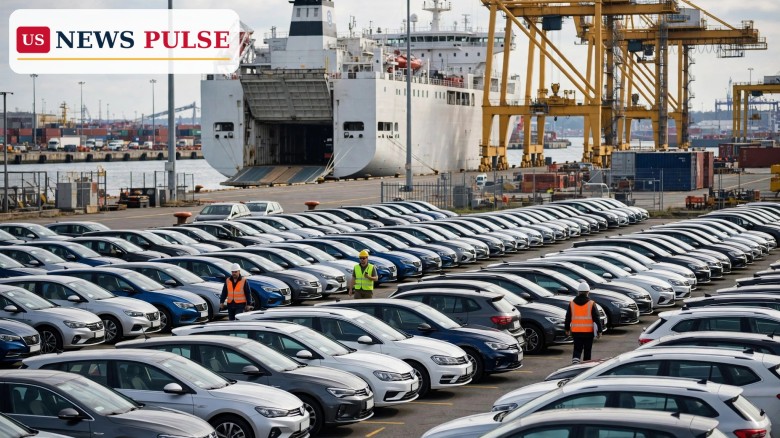
President Donald Trump will raise tariffs on cars and trucks imported from the European Union to 25% next week, accusing the bloc of failing to honour the trade deal struck last summer. The Trump EU car tariffs announcement, made on Friday, October 30, 2026, lands just four days before the November 3 midterm elections and reopens one of the sharpest transatlantic trade fights of his presidency. Vehicles built in American plants will escape the duty entirely, Trump said, in a move aimed at forcing more car production onto US soil.
The decision breaks the 15% ceiling on European cars agreed in the Turnberry framework deal and sets up a fresh clash with Brussels, Berlin and Europe's biggest carmakers. German manufacturers, which shipped around 409,000 new vehicles from Germany to the United States in 2025, face the heaviest exposure, and industry groups have already warned of serious strain on transatlantic economic relations.
Trump announced the increase in a Truth Social post on Friday, writing: "I am pleased to announce that, based on the fact the European Union is not complying with our fully agreed to Trade Deal, next week I will be increasing Tariffs charged to the European Union for Cars and Trucks coming into the United States. The Tariff will be increased to 25 per cent."
He added: "It is fully understood and agreed that, if they produce Cars and Trucks in U.S.A. Plants, there will be NO TARIFF. Many Automobile and Truck Plants are currently under construction, with over 100 billion dollars being invested, a record in the history of car and truck manufacturing."
Speaking at a Florida event later on Friday, Trump said Washington had informed Germany of the threat because "they and other European nations have not adhered to our trade deal." The announcement came a day after his renewed criticism of German Chancellor Friedrich Merz, and it was reported by AFP, the Times of Oman and other outlets on Saturday, October 31.
The White House defended the decision by saying the EU has not made significant progress on commitments under the trade agreement. Administration officials have pointed to Section 232, the national-security tariff power, as the legal basis for existing duties on vehicles and auto parts imported from several countries, including the EU. Those sector-specific duties were not touched by the Supreme Court ruling earlier this year that struck down a swath of Trump's broader global levies.
The dispute goes back to the trade framework Trump and European Commission President Ursula von der Leyen announced in July 2025 and fleshed out in August 2025. Under that deal, tariffs on most European goods entering the United States were capped at 15%, lower than the 30% Trump had previously threatened, and the cap covered European cars, light trucks and car parts. In return, the EU agreed to erase levies on US industrial goods and committed to purchasing $750 billion worth of American energy. EU officials said at the time that the deal would save European automakers about 500 to 600 million euros ($587 million to $704 million) a month.
Implementation, however, has dragged. In late March 2026, EU lawmakers gave their green light to the bloc's tariff deal with Trump, but with conditions attached. In May, US Ambassador to the EU Andrew Puzder warned that Washington would implement 25% tariffs on cars and trucks from the EU "relatively soon" if the bloc did not swiftly ratify the long-delayed agreement, telling Bloomberg Television: "Unless we see some substantial progress, I think you probably should expect those relatively soon." EU trade chief Maros Sefcovic told US Trade Representative Jamieson Greer that the bloc wanted the main parts of the agreement in place by July, but a final agreement was still not in place months later.
The legal backdrop shifted in February 2026, when the US Supreme Court held that the 1977 International Emergency Economic Powers Act (IEEPA) does not grant the president authority to levy broad tariffs. That ruling lowered the ceiling on EU tariffs to 10% for duties imposed under the emergency law and set in motion an estimated $166 billion in refunds to companies that directly paid the duties. But sector-specific auto tariffs imposed under Section 232 were left standing, which is why the White House can raise the car duty without relying on the emergency powers the court rejected.
Trump has also kept other tariff tools in reserve. US officials have completed investigations required to impose new "overcapacity" tariffs on China, Japan and more than a dozen other economies, but have held off unveiling them as the midterms approach, according to Nikkei Asia reporting on October 30. China alone was set to face a 7.5% tariff over excess capacity. The administration's caution reflects the political calendar: with voters heading to the polls on Tuesday, November 3, a fresh tariff shock could feed into prices and the campaign debate.
For European carmakers, the arithmetic is stark. Under the Turnberry framework, cars, light trucks and car parts imported from the EU faced a 15% tariff cap, while medium and heavy trucks were generally already subject to a 25% duty. Raising the car and light-truck rate to 25% adds ten percentage points to the cost of every European-built vehicle shipped to the United States, unless the manufacturer builds it in an American plant.
Germany is the most exposed. According to estimates from the Center Automotive Research (CAR) in Bochum, German automakers exported approximately 409,000 new vehicles from Germany to the US in 2025, at an average value of 60,000 euros per unit. Mercedes-Benz, BMW and Volkswagen all rely heavily on imports for their US sales, even though each also operates American plants. The new rate will test how much of that production they can shift, and how quickly, before the higher duty feeds into showroom prices.
For American buyers, the effect will depend on how much of the duty carmakers absorb and how much they pass on. The EU had calculated that the Turnberry deal would save its automakers hundreds of millions of euros a month; reversing the cap wipes out that saving and hands it back as a cost. US-built vehicles escape the duty, which is precisely the incentive Trump wants: his post pointed to more than $100 billion in car and truck plant investment already under way in the United States.
Trump's own words set the tone. "Based on the fact the European Union is not complying with our fully agreed to Trade Deal, next week I will be increasing Tariffs charged to the European Union for Cars and Trucks coming into the United States," he wrote on Truth Social. "The Tariff will be increased to 25%."
At his Florida event later on Friday, he added that Washington had told Germany directly: "they and other European nations have not adhered to our trade deal." The White House, defending the move, said the EU has not made significant progress on its commitments under the agreement.
European industry groups reacted with alarm when the same threat surfaced earlier this year. The German Association of the Automotive Industry (VDA) and the Federation of German Industries (BDI) have described the higher tariffs as a serious strain on transatlantic economic relations, and the European Commission has said it remains committed to honouring the deal while warning of broader consequences if the dispute escalates. The EU had previously warned it was ready to retaliate but would prefer to de-escalate and preserve the existing pact. No detailed EU response to Friday's specific announcement had been reported at the time of publication.
US Ambassador to the EU Andrew Puzder had previewed the logic in May, telling Bloomberg Television that the president's message was: "Look, this has gone on long enough. You've done nothing for nine months." The ambassador said the 25% car tariff would breach the 15% ceiling in the original deal, a point European negotiators have also made.
The announcement matters for three reasons. First, it shows that the Turnberry deal, once presented as the settlement of the transatlantic tariff war, is not holding. If the 15% cap can be lifted unilaterally days before an election, European governments and companies must plan around the risk that any future cap is equally fragile.
Second, it puts the auto industry at the centre of the midterm endgame. Cars are one of the biggest-ticket purchases households make, and tariff-driven price rises are visible in a way that abstract trade disputes are not. By exempting US-built vehicles, Trump is also drawing a sharp line for voters in auto-manufacturing states: build here, pay nothing; build in Europe, pay 25%.
Third, it tests the post-Supreme Court tariff playbook. After the court struck down the IEEPA-based global tariffs in February, the administration shifted to sector-specific powers such as Section 232 and to new investigations such as the overcapacity probes. The EU car tariff is the most prominent use of that playbook so far, and how Brussels responds — retaliation, negotiation or legal challenge — will shape how far the administration pushes the same approach with other partners.
The higher rate is due to take effect next week, though the administration has not yet published the precise start date or the formal legal notice. Watch for three things in the coming days: the formal Federal Register notice, which will confirm the scope, including whether car parts are included alongside finished cars and trucks; the European Commission's response, including whether it revives retaliation threats or seeks an emergency negotiation; and statements from Mercedes-Benz, BMW and Volkswagen on pricing and production shifts.
The midterm calendar adds urgency. With voting on Tuesday, November 3, both sides have an incentive to frame the dispute in their favour: Trump as defending American manufacturing, Brussels as defending a signed deal. After the election, the overcapacity tariffs that Nikkei reports are ready but on hold could follow, widening the tariff fight beyond Europe to China, Japan and more than a dozen other economies.
Longer term, the dispute will feed into the ratification fight in Europe. EU lawmakers attached conditions to the deal in March, and the Commission must now decide whether to accelerate ratification to defuse Trump's complaint or to stand firm and risk a tit-for-tat escalation. Either way, the era of a stable 15% cap looks over.
Trump announced that tariffs on cars and trucks imported from the European Union will rise to 25% starting next week, up from the 15% cap agreed in the Turnberry framework deal.
Trump said the increase will take effect next week. The precise start date will be confirmed in the formal legal notice, which had not been published at the time of publication.
No. Trump said cars and trucks produced in US plants will face no tariff, and he pointed to more than $100 billion in car and truck plant investment under way in the United States.
Trump accused the EU of "not complying with our fully agreed to Trade Deal" and said Washington had told Germany that it and other European nations "have not adhered to our trade deal." The White House said the EU has not made significant progress on its commitments.
European-built cars will cost importers 10 percentage points more than under the 15% cap. How much reaches showroom prices depends on how much carmakers absorb, but German brands that rely heavily on imports, including Mercedes-Benz, BMW and Volkswagen, face the biggest pressure.
Related coverage: US warns EU over Airbus loan in aircraft trade truce fight, Overcapacity tariffs on hold as Trump weighs prices before midterms, Trump-Xi trade deal cuts China tariffs after Busan breakthrough.
Leave a Comment



 | Today's Date: