

 | Today's Date:
US and Qatar Sign Critical Minerals Framework at Eighth Strategic Dialogue
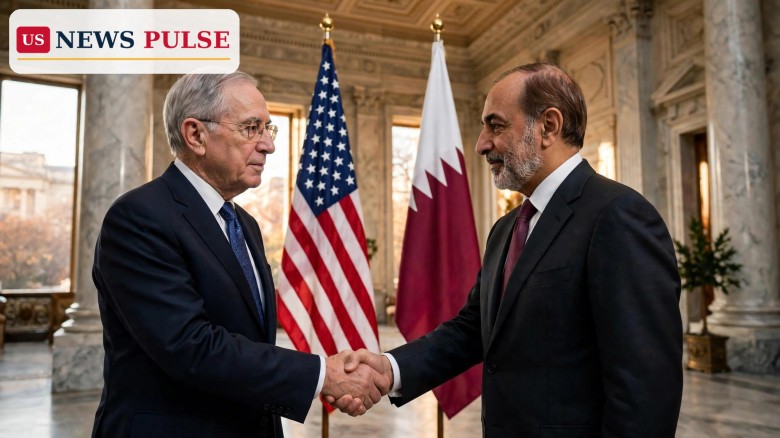
Washington — The United States and Qatar signed a Critical Minerals Framework on Monday, November 23, 2026, at the eighth US-Qatar Strategic Dialogue in Washington, D.C., deepening a partnership that now spans energy, defence, technology and mediation across the Middle East. The US Qatar critical minerals framework aligns the two countries' strategies for diversifying critical mineral supply chains, and both sides reaffirmed their commitment to keeping the Strait of Hormuz open to shipping at a moment of acute tension with Iran.
Key Points
- The United States and Qatar signed a Critical Minerals Framework at the eighth US-Qatar Strategic Dialogue on Monday, November 23, 2026, in Washington, D.C.
- The framework aligns both countries' strategies for diversifying critical mineral supply chains, building on the Pax Silica initiative.
- Both sides reaffirmed freedom of navigation through the Strait of Hormuz, calling safe passage essential to regional security and energy supplies.
- The dialogue reviewed progress under the $38 billion US-Qatar Statement of Intent on defence cooperation.
- The partnership builds on more than $240 billion in deals announced during President Trump's May 2025 visit to Qatar.
What Happened
Secretary of State Marco Rubio and Qatari Prime Minister and Foreign Minister Sheikh Mohammed bin Abdulrahman Al Thani convened the eighth US-Qatar Strategic Dialogue on Monday, with senior officials from both governments taking part. The joint statement described the meeting as a reaffirmation of the enduring US-Qatar strategic partnership, under the leadership of President Donald J. Trump and the Amir of Qatar, Sheikh Tamim bin Hamad Al Thani.
The centrepiece was the signing of the Critical Minerals Framework, designed to deepen collaboration and align the two countries' national strategies for diversifying critical mineral supply chains and strengthening global supply-chain resilience. The statement named no specific project, funding commitment or published framework text. Qatar also signed the Pax Silica Declaration, the US-led initiative to secure supply chains for artificial intelligence, semiconductors and rare earths.
Background: A Partnership Built on Energy, Defence and Mediation
The United States and Qatar are preparing to celebrate 55 years of diplomatic relations, and the dialogue underscored a partnership that has grown far beyond its original energy ties. Qatar hosts Al Udeid Air Base, the largest US military installation in the Middle East, and the two countries' defence relationship is governed by a $38 billion Statement of Intent on defence cooperation.
The economic relationship has expanded rapidly. The partnership builds on more than $240 billion in deals announced during President Trump's May 2025 visit to Qatar, and Qatar's sovereign wealth fund holds stakes in critical-minerals firms, including $180 million in TechMet and $500 million in Ivanhoe Mines. Qatar has also become Washington's most important Arab mediator, between the United States and Iran and in Gaza ceasefire talks.
US Qatar Critical Minerals Framework: What the Deal Covers
Critical minerals — the rare earths, lithium, cobalt, nickel and other materials essential to batteries, semiconductors, defence systems and clean-energy technology — have become a central front in the contest between the United States and China. Beijing dominates processing of many of them, and Washington has spent two years building alternative supply chains with allies.
The framework signed on Monday fits into that wider effort. It follows the Pax Silica initiative and sits alongside the San Francisco Declaration signed earlier in November by the United States and eight partners, including Qatar, to shield AI supply chains from China. The Qatar framework is bilateral rather than multilateral, and its value lies in aligning two national strategies that were already moving in the same direction. For Qatar, it offers a route into the industrial policy at the heart of the US technology strategy; for the United States, it brings a wealthy Gulf partner into a supply-chain effort led so far mainly by the Quad partners and other Asian allies.
Reactions and Quotes
The joint statement was the two governments' shared account of the meeting, and its Hormuz language was the clearest signal of the day. "Both sides reaffirmed their commitment to upholding freedom of navigation through the Strait of Hormuz," it said. "They stressed that safe and unimpeded passage through this vital waterway is essential to regional security, reliable energy supplies, and global economic stability."
On the partnership itself, the statement said Secretary Rubio "affirmed the U.S.-Qatar partnership as a model of peace through strength and a force for stability amid regional and global challenges." Prime Minister Al Thani "commended President Trump's leadership" in pursuing agreements to resolve regional conflicts, it added. He also congratulated the United States on its successful co-hosting of the FIFA World Cup 2026.
Why It Matters
The framework matters for three reasons. First, it widens the coalition behind the US effort to reduce dependence on China for critical minerals, bringing in a Gulf state with deep pockets and a growing mining portfolio. Second, it ties that economic agenda to the security of the Strait of Hormuz, through which a large share of the world's oil and liquefied natural gas passes, amid Washington's confrontation with Tehran over Iran's nuclear programme and attacks on shipping.
Third, it confirms Qatar's place as the United States' most versatile partner in the Gulf. Few countries combine a major US military base, hundreds of billions of dollars in investment capacity, and a mediation channel to Iran. Qatar also pledged $30 million to the United Nations Trust Fund for the Gang Suppression Force in Haiti.
What Happens Next
Discussions will continue into early 2027 on defence, security cooperation, counterterrorism, law enforcement and cultural ties. On defence, the two sides will build on the September 2026 US-Qatar Military Consultative Commission, with talks on enhancing Qatar's air and missile defence and potential investments in munitions and platforms supporting interoperability between the two forces.
On the minerals side, the test will be whether the framework produces concrete projects, funding or offtake agreements. The statement named none, and the next sign of progress will be any announcement of joint investment or a published framework text. The Golden Pass LNG project, the joint US-Qatari gas venture in Texas, was also discussed.
Frequently Asked Questions
What is the US-Qatar Critical Minerals Framework?
An agreement signed on November 23, 2026, to deepen US-Qatari collaboration and align both countries' strategies for diversifying critical mineral supply chains.
What are critical minerals?
Materials such as rare earths, lithium, cobalt and nickel, essential for batteries, semiconductors and defence systems, whose supply chains are dominated by China.
What did the two sides say about the Strait of Hormuz?
Both reaffirmed freedom of navigation through the strait, stressing that safe and unimpeded passage is essential to regional security, reliable energy supplies and global economic stability.
What is the Pax Silica Declaration?
A US-led initiative to secure supply chains for artificial intelligence, semiconductors and rare earths. Qatar signed the declaration, and the framework builds on it.
How big is the US-Qatar economic partnership?
More than $240 billion in deals from President Trump's May 2025 visit to Qatar, plus a $38 billion Statement of Intent on defence cooperation.
Read more: Quad Summit in Manila Ends With Critical-Minerals Deals; Nine Nations Sign San Francisco Declaration on AI Supply Chains; Witkoff and Kushner Meet Qatari Mediators in Berlin.

The US News Pulse newsroom covers breaking news across the United States and the world, working from wire services, official statements and on-the-record sources. Every story is reviewed against our editorial standards before publication. Corrections and tips: info@usnewspulse.com
About our newsroomLeave a Comment