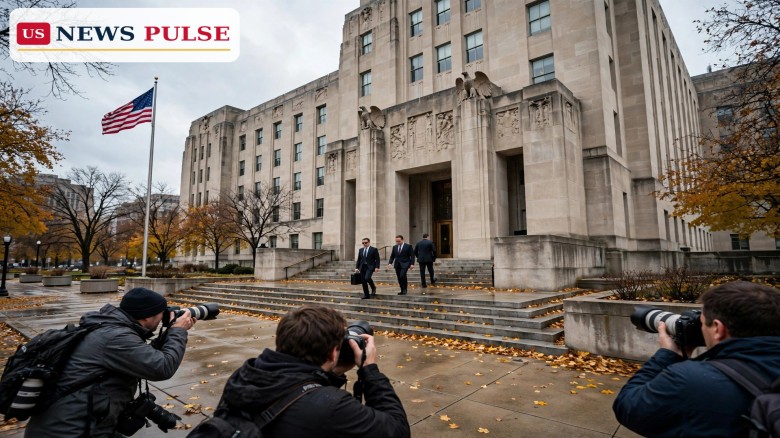
A Michigan man has been arrested and charged with threatening to kill FBI Director Kash Patel, federal prosecutors announced on October 30, 2026, in a case built on a series of Facebook messages, emails and voicemails that investigators say escalated even after agents interviewed him at his home. The Kash Patel threat case is the latest federal prosecution over threats aimed at senior officials, and it arrives with a detention hearing set for Monday, November 2, 2026.
Anthony Daniel Palazzolo, 42, of Chesterfield Township, Michigan, was arrested on October 30 and charged with one count of transmitting threatening communications in interstate commerce, a felony that carries a maximum sentence of five years in federal prison. He appeared in federal court in Detroit the same day, did not enter a plea, and was temporarily detained pending the November 2 hearing.
The case was announced by Jerome F. Gorgon Jr., the United States Attorney for the Eastern District of Michigan, together with Jennifer Runyan, the special agent in charge of the FBI in Detroit. The criminal complaint, filed by FBI Special Agent Brian Koczenasz, traces the alleged threats to a single Facebook message sent on October 8, 2026.
According to prosecutors, Palazzolo used his own Facebook account to contact a person identified only as Victim-1, an associate of Patel whose identity has not been disclosed. In that message, Palazzolo referred to himself as "Baby Bird" and told the associate he had "put a hit" on him, before adding a profane insult aimed at Patel himself, calling the FBI director a dead man. Federal investigators then used Palazzolo's Facebook and TikTok accounts to trace him to a home in Chesterfield Township, about 30 miles north of Detroit.
Agents went to that home on October 9 to interview him. According to the complaint, Palazzolo admitted sending the messages, apologised, and told agents he had no intent to harm anyone. Prosecutors say the conduct did not stop there. On October 12, Palazzolo emailed the investigating officer, as well as a district court in Texas, the Secret Service and the Supreme Court, with threats of sexual violence against a government official. The next day, he called the officer and left two voicemails threatening to come to the FBI office and "use deadly force against every single one of you government officials", naming the FBI and the Secret Service.
Palazzolo was arrested on October 30. He appeared in federal court in Detroit that afternoon before Magistrate Judge David R. Grand, who ordered him temporarily detained. He did not enter a plea. The case is being prosecuted by Assistant United States Attorney Eaton Brown, and the FBI is leading the investigation.
Chesterfield Township sits in Macomb County, in the northern suburbs of Detroit, a region that has repeatedly appeared in federal threat cases because of its proximity to the FBI's Detroit field office and the federal courthouse in the city. Palazzolo, prosecutors say, has an extensive criminal history spanning Michigan, Texas and Florida, including a 2018 charge for making a bomb threat and filing a false report of a terrorist attack. That history is part of the prosecution's account, not a conviction in this case, and it is likely to feature in arguments at the November 2 detention hearing, where prosecutors can ask a judge to keep a defendant in custody.
The charge itself, transmitting threatening communications in interstate commerce under 18 U.S.C. 875(c), is the federal statute most commonly used when a threat travels across state lines by phone or online message. Prosecutors do not have to prove that the defendant intended or was able to carry out the threat; they must prove that the communication itself was a genuine threat, judged in context. The maximum penalty is five years in prison, along with a possible fine and a period of supervised release.
The case also fits a wider pattern that researchers have been tracking. A January report by researchers at the University of Nebraska at Omaha counted 824 federal criminal cases involving threats against public officials since 2013, a figure cited in coverage of the Palazzolo complaint. Federal officials have repeatedly warned that threats against judges, prosecutors, election workers and law enforcement leaders have risen sharply in recent years, and the FBI director's own office has been the target of at least one earlier case this year.
At the centre of the complaint is the contrast between the October 8 message and what prosecutors say happened afterwards. The first message was personal and direct: a named associate, a claimed "hit", and a crude insult aimed at Patel. The later messages were broader, aimed at institutions rather than one person: a Detroit FBI agent, the Secret Service, a Texas court and the Supreme Court, all named as recipients of emails or voicemails in the complaint.
That escalation matters legally as well as narratively. A single angry message, later retracted with an apology, can still support a charge, but a pattern of repeated threats after a face-to-face warning from agents is the kind of evidence prosecutors use to argue that a defendant should remain in custody while a case proceeds. It is also why the complaint lingers on the October 13 voicemails, in which Palazzolo allegedly urged an agent to warn President Donald Trump that he planned to storm the Detroit office.
Prosecutors have been careful to stress the limits of the document. "A criminal complaint is only a charging document and is not evidence of guilt," the United States Attorney's office said in its announcement. "A defendant is entitled to a fair trial in which it will be the government's burden to prove guilt beyond a reasonable doubt." Palazzolo's court-appointed lawyer, Todd Shanker, did not immediately respond to requests for comment in initial coverage of the case.
The Justice Department's announcement was factual and brief, as is typical for a complaint-stage case: the arrest, the charge, the timeline, and the detention hearing date. The FBI's Detroit office, through Special Agent in Charge Runyan, joined the announcement, signalling that the bureau itself treated the messages as a threat to its director and its personnel rather than as an ordinary online dispute.
Coverage of the case has drawn attention to one earlier, parallel prosecution. In March 2026, a Massachusetts man, Alden Welch Ruml, was arrested and charged with sending a threatening email to Patel's fiancee, Alexis Wilkins, the previous month. Ruml faces the same charge of interstate communications involving threats, has pleaded not guilty, and has a jury trial set for February. The two cases are separate, but together they illustrate how often threats against the FBI's leadership now reach a courtroom.
Neither Patel nor the FBI has issued a personal public statement about the Palazzolo arrest in the material released so far, and the White House has not commented on the case. That restraint is normal at this stage: with a detention hearing days away and a prosecution to build, investigators and prosecutors generally let the complaint speak for itself.
Threat cases against federal officials are rarely about a single message. They test how the justice system draws the line between angry, even abusive, speech and a genuine threat, and they test whether the system can act quickly enough to prevent harm without overreaching. Palazzolo's case will be watched on both counts: the messages are explicit, the timeline is short, and the alleged escalation after an FBI interview gives prosecutors a strong factual narrative for detention.
The case also lands in a politically charged moment. With the November 3 midterm elections days away and the FBI itself at the centre of several election-related investigations, any threat against its director carries a symbolic weight beyond the courtroom. Federal officials have argued for years that threats against public servants, whatever their target's politics, corrode the institutions those servants run. A conviction here would reinforce that message; an acquittal or a dismissed complaint would show the high bar prosecutors still face.
For residents of Chesterfield Township and the wider Detroit area, the case is a reminder that online threats are investigated locally as well as nationally. The complaint was built by Detroit-based agents, filed in Detroit federal court, and will be argued before a Detroit magistrate judge, even though the alleged target sits in Washington.
The immediate next step is the detention hearing on Monday, November 2, 2026, when a judge will decide whether Palazzolo remains in custody while the case proceeds or is released under conditions. Prosecutors may also seek a grand jury indictment, which would replace the complaint with formal charges and set the case on a path towards trial or a plea agreement.
If the case proceeds to trial, prosecutors will have to prove beyond a reasonable doubt that Palazzolo sent the messages and that they amounted to genuine threats, not protected speech. The defence, in turn, is likely to test the context of the messages, including Palazzolo's apology and his stated lack of intent to harm anyone, as well as his mental state at the time. No trial date has been set, and no plea has been entered.
Whatever happens on November 2, the case is unlikely to be the last of its kind. As long as senior officials remain targets of online abuse, the FBI and federal prosecutors will keep bringing these complaints, and each one will add to the running total that researchers are now counting in the hundreds.
Anthony Daniel Palazzolo is a 42-year-old man from Chesterfield Township, Michigan, about 30 miles north of Detroit. Federal prosecutors say he has a criminal history spanning Michigan, Texas and Florida, including a 2018 charge involving a bomb threat and a false report of a terrorist attack.
He is charged with one count of transmitting threatening communications in interstate commerce, a federal felony under 18 U.S.C. 875(c). The charge carries a maximum sentence of five years in federal prison.
Prosecutors say he sent an October 8 Facebook message telling a Patel associate he had "put a hit" on him and insulting FBI Director Kash Patel, then sent emails and voicemails threatening deadly force against federal officials, including at the FBI's Detroit office.
No. He appeared in federal court in Detroit on October 30, 2026, did not enter a plea, and was temporarily detained. A criminal complaint is an accusation only, and prosecutors must prove guilt beyond a reasonable doubt at trial.
A detention hearing is set for Monday, November 2, 2026, when a judge will decide whether Palazzolo stays in custody while the case proceeds.
Related coverage: Daytona Trump threat arrest: woman, 21, held after threatening rally post; Minnesota fraud charges: 4 charged in $41 million healthcare scheme; FBI blames North Korea for $6.3 billion Binance hack.
Leave a Comment



 | Today's Date: