

 | Today's Date:





Event Horizon Telescope Maps Black Hole Jet Bending Toward Earth in Record Detail
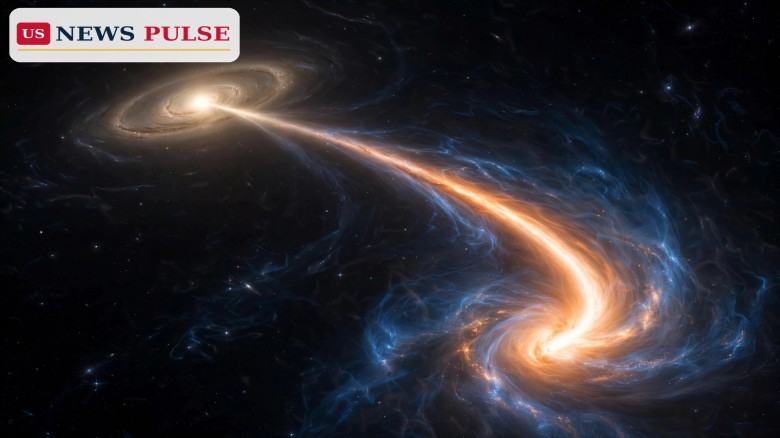
The Event Horizon Telescope has produced the sharpest view yet of a black hole jet, mapping the inner outflow of the blazar 3C 279 in unprecedented detail. The new images, published in a 2026 paper in Astronomy & Astrophysics and reported on November 25, show a jet of plasma curving away from a supermassive black hole about 538 million light-years from Earth — and bending so that part of it points almost directly at us. The result explains why the jet shines brightest away from its base, and shows the flow already moving at more than 99.5 percent of the speed of light.
Key Points
- The Event Horizon Telescope imaged the inner jet of blazar 3C 279, powered by a black hole of about 800 million solar masses, 538 million light-years away.
- The sharpest images yet came from the largest EHT array ever published, adding Kitt Peak in Arizona and NOEMA in the French Alps.
- The jet bends so a downstream section points more directly toward Earth, explaining why its brightest region sits at the bend, not the base.
- Plasma near the base already moves at 99.5 percent of light speed, so the flow turns relativistic very close to the black hole.
- A tightly coiled helical magnetic field steers the jet, while wobbles and brightness changes reveal turbulence and shock fronts.
What Happened
The images come from a 2021 observing campaign, now published in Astronomy & Astrophysics. The campaign used the largest array configuration the collaboration has published to date, with two decisive additions: the 12-metre telescope at Kitt Peak in Arizona and the NOEMA interferometer in the French Alps. Together they supplied intermediate-length baselines that sharpened the view of the jet’s inner regions.
Rather than streaming straight out, the jet of 3C 279 bends. A section further downstream swings around until it points more directly toward Earth than the jet’s base does, and because light from material moving toward us is boosted, that bend is exactly where the jet shines brightest. Close to the base, the plasma is already travelling at no less than 99.5 percent of the speed of light, so the outflow reaches relativistic velocity almost immediately, within a tiny distance of the black hole.
Background: How the Event Horizon Telescope Works
3C 279 is a blazar, a galaxy whose central black hole fires a jet almost directly along our line of sight. That alignment makes blazars among the brightest objects in the sky at radio and gamma-ray wavelengths, and natural laboratories for studying how black holes launch jets. The black hole at the heart of 3C 279 weighs roughly 800 million times as much as the Sun, and its light has travelled about 538 million years to reach us.
The Event Horizon Telescope is a planet-wide network of radio observatories linked to act as one Earth-sized telescope. It made history in 2019 with the first image of a black hole’s shadow, in the galaxy M87, and in 2022 with an image of Sagittarius A*, the black hole at the centre of our Milky Way. The new work pushes the technique further, from imaging the shadow itself to dissecting the jet the black hole launches — one of the most powerful phenomena in the universe, fed by gas falling toward the black hole.
The Black Hole Jet’s Bend Explains Its Brightest Spot
The new images give the magnetic picture of jets its sharpest support yet. The data show a tightly coiled helical magnetic field wrapping around the outflow and steering it. The jet is not a smooth beam: faint wobbles in its direction and fluctuations in its brightness betray turbulence and shock fronts rippling through the flow, where fast material catches up with slower material ahead of it.
The geometry also matters for the violent flares blazars are famous for. When a shock passes through a section pointed at us, the flare we see can be far brighter than the same event would be from another angle — which is why mapping the jet’s true shape, rather than assuming it, changes how astronomers read every flare 3C 279 produces.
Reactions: What the Scientists Say
Lead author Hendrik Muller of the US National Radio Astronomy Observatory said the 2021 campaign is “just the beginning”, with multi-frequency data from several years of Event Horizon Telescope observations still under analysis. The same telescopes are now gathering data at more than one frequency, which will let astronomers separate the jet’s structure from its spectrum and track how it changes over time.
The finding lands in a field that has waited years for this kind of detail. Models of jet launching have had to work from images that blurred the innermost regions, where acceleration happens. A direct view of the flow at 99.5 percent of light speed near the base, together with the shape of the magnetic field, gives those models something concrete to match.
Why It Matters
Black hole jets shape galaxies. The energy they carry can heat intergalactic gas, switch off star formation and redistribute matter on scales far larger than the black hole itself, so understanding how jets are launched and accelerated is part of understanding why galaxies look the way they do. The 3C 279 result also shows the Event Horizon Telescope has grown beyond its original mission: built to image black hole shadows, it now resolves the engines around them in motion. The same approach will now be applied to other jets, testing whether 3C 279’s bending, coiled jet is typical or exceptional.
What Happens Next
The collaboration is analysing multi-frequency data collected over several years, which should show whether the bend in 3C 279’s jet is stable or shifts over time, and how the magnetic coil evolves. New telescopes joining the array will sharpen the view further, and coordinated observations with space-based gamma-ray and X-ray observatories will link the jet’s shape to its flares. Continued monitoring will test whether the brightest region stays locked to the bend — the cleanest check of the new explanation.
More from US News Pulse: Voyager 1 went silent for two days; ULA Vulcan anomaly ends Amazon Leo launch; Western New York fireball lit up the sky.
Frequently Asked Questions
What is 3C 279? A blazar about 538 million light-years away, whose central black hole — about 800 million times the Sun’s mass — fires a jet almost directly toward Earth.
How fast does the jet move? Near its base, the plasma already travels at no less than 99.5 percent of the speed of light.
Why is the brightest part not at the base? The jet bends so a downstream section points more directly toward Earth, and light from material moving toward us is boosted.
What is the Event Horizon Telescope? A planet-wide network of radio observatories working as a single Earth-sized telescope. It produced the first black hole images in 2019 and 2022.
What happens next? The collaboration is analysing multi-frequency data from several years of observations to see whether the jet’s bend is stable and how its magnetic field evolves.

The US News Pulse newsroom covers breaking news across the United States and the world, working from wire services, official statements and on-the-record sources. Every story is reviewed against our editorial standards before publication. Corrections and tips: info@usnewspulse.com
About our newsroomLeave a Comment