

 | Today's Date:




NASA's ESCAPADE Probes Photograph Earth From 38,500 Miles Away on the Way to Mars
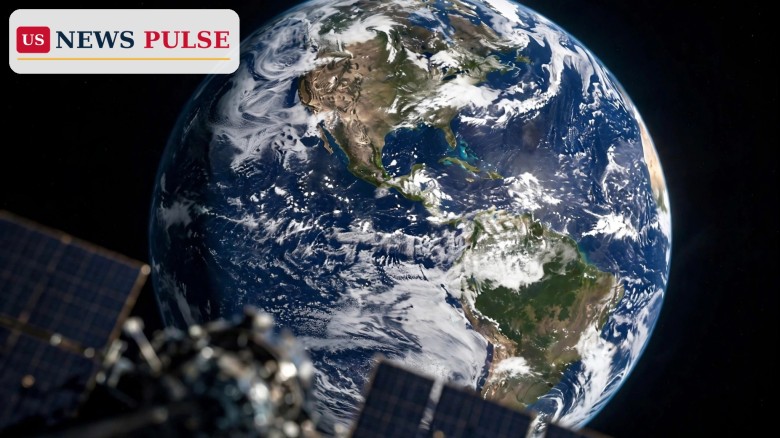
NASA released striking photographs of Earth on Wednesday, November 26, 2026, taken by its twin ESCAPADE spacecraft during a powered flyby on November 9, on their way to Mars. The visible-light image, captured by ESCAPADE Gold about three hours after its closest approach, shows the Western Hemisphere from 61,950 kilometres (38,500 miles) away, with one of the probe's solar panels framing the scene. It is a farewell portrait with a purpose: the two refrigerator-sized craft are now bound for the Red Planet, due in Mars orbit in September 2027, to study how the solar wind stripped away the planet's atmosphere.
Key Points
- NASA released Earth photographs from its twin ESCAPADE probes on November 26, 2026.
- Gold took the visible-light shot three hours after closest approach, from 38,500 miles away.
- The image shows the Western Hemisphere, with one of Gold's solar panels framing the scene.
- Blue and Gold performed the first Oberth manoeuvre ever by Martian probes around Earth.
- Both craft reach Mars orbit in September 2027; science operations start in April 2028.
What Happened
The photographs were taken as Gold, the second of the two craft, carried out its pioneering Earth flyby on November 9. Gold captured the visible-light image at about 9 a.m. EST (2 p.m. GMT), roughly three hours after its closest approach, from 61,950 kilometres away. The shot was taken with the Visible and Infrared Observation System camera, a modest 5-megapixel instrument from Northern Arizona University, and one of Gold's solar panels is visible at the frame's edge.
Gold also captured Earth in infrared shortly afterwards. NASA released the infrared image unprocessed — warmer areas brighter, cooler areas darker — and in two colourised versions, where warm areas show up in white, orange and yellow and cool areas in blue and purple.
Blue completed its manoeuvre on November 7, and Gold followed on November 9. NASA also published imagery of the two craft from the commercial Vantor Worldview Legion satellite.
Background: ESCAPADE's Long Road to Mars
ESCAPADE stands for Escape and Plasma Acceleration and Dynamics Explorers. The mission is two identical craft, Blue and Gold, each about the size of a refrigerator. Once they arrive, they will share one orbit for six months, then shift onto two different orbits for five more months.
Their target is the Martian magnetosphere: how it interacts with the solar wind and how the wind stripped away Mars's atmosphere over many millennia. Mars once had a thicker atmosphere and liquid water; what happened to it bears on whether the planet could ever have supported life.
The pair launched on November 13, 2025, from Cape Canaveral, when Mars and Earth were on opposite sides of the Sun. With no direct route, they spent a year waiting at the Earth-Sun Lagrange point L2. When the transfer window opened a few weeks ago, they came hurtling back towards Earth for a gravity-assist flyby.
This was no ordinary gravity assist, but an Oberth manoeuvre: the spacecraft fired their engines to boost velocity while using the standard gravity-slingshot effect. It is a common technique in spaceflight, but ESCAPADE's craft are the first Martian probes ever to carry it out around Earth.
NASA ESCAPADE Earth Photo: What the Images Show
The headline image is the visible-light shot: the whole Western Hemisphere, North and South America wrapped in swirling cloud, seen from 38,500 miles away. One of Gold's solar panels intrudes at the frame's edge — a reminder of the modest 5-megapixel camera that took it, far smaller than flagship cameras, yet enough to capture a portrait of home.
The infrared images tell a different story. In the unprocessed version, brightness maps to temperature: warmer land and ocean show up bright, cooler regions dark. The colourised versions turn warm areas white, orange and yellow and cool ones blue and purple — a calibration test as much as a keepsake, proving the cameras work before the long cruise.
Reactions
The flyby drew a small audience on the ground. Mission scientist Christophe Mandy captured the two craft in flight over Los Angeles, in a composite of five-second exposures taken over two days. The trajectories appear as faint streaks, enhanced and colourised in processing: the blue streak is ESCAPADE Blue, the gold one ESCAPADE Gold.
The images were credited to NASA, the University of California, Berkeley, and Northern Arizona University, the partners behind the mission's science and cameras. For a mission that spent a year parked at L2, the portraits are the first close look at the craft in flight — proof both craft survived the wait intact.
The probes are now officially on their way to Mars, more than a year after they launched, opening a ten-month cruise: the twin design promises simultaneous measurements from two places at once, something no single Mars orbiter can offer.
Why It Matters
Mars is the great "what if" of the solar system. Long ago it had rivers, lakes and a thick atmosphere; today it is a cold desert with an atmosphere less than one percent as dense as Earth's. The solar wind is the prime suspect, and ESCAPADE is the first mission designed to watch that theft in progress with two spacecraft at once.
Two probes matter because the solar wind changes minute by minute. A single spacecraft cannot tell whether a change it measures came from the wind or from the planet. Two craft, in formation and then on separate orbits, can separate the two — one watching the incoming wind, the other its effect on the magnetosphere.
The Oberth manoeuvre is a milestone of its own. If it works reliably for small, low-cost probes, it opens a cheaper route to Mars — a slingshot that does not need a heavy launch vehicle to do all the work.
What Happens Next
ESCAPADE will now continue to the Red Planet and should enter Mars orbit in September 2027. The two craft will orbit together for six months, then shift to two different orbits for five more months, with science operations beginning in April 2028. Because their orbits are wide, they will also image the whole of Mars in a single frame — something probes on tighter orbits cannot do. The first full-disc portraits of Mars are almost a year away, but the Earth photographs are the mission's calling card: two small spacecraft, on their way, with cameras already working.
Frequently Asked Questions
What is NASA's ESCAPADE mission?
Two identical probes, Blue and Gold, studying Mars's magnetosphere and how the solar wind stripped away its atmosphere.
How far away was Earth when the photo was taken?
61,950 kilometres, about three hours after Gold's closest approach on November 9, 2026.
What is an Oberth manoeuvre?
Firing a spacecraft's engines at closest approach while using a planet's gravity as a slingshot, to gain extra speed.
When will ESCAPADE reach Mars?
September 2027, with science operations beginning in April 2028.
Why send two spacecraft instead of one?
Two craft can measure the solar wind and its effect on Mars simultaneously, from two places at once.
Related coverage: Voyager 1 Went Silent for Two Days, Then Answered on Its Own, ULA Vulcan Rocket Anomaly Ends Amazon Leo Launch, NASA Seeks Bids to Build Lunar Reactor 1.

The US News Pulse newsroom covers breaking news across the United States and the world, working from wire services, official statements and on-the-record sources. Every story is reviewed against our editorial standards before publication. Corrections and tips: info@usnewspulse.com
About our newsroomLeave a Comment