


 | Today's Date:
Wildfire Drinking Water Contamination Can Linger for a Decade, Studies Find
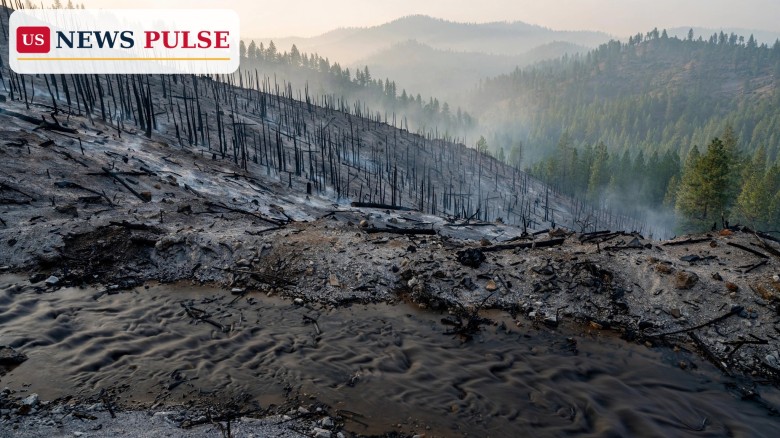
Wildfire drinking water contamination can linger for more than a decade after the flames go out, new research finds. A report published on Thursday, November 13, 2026, warns that bigger, more frequent wildfires are poisoning the streams and rivers supplying drinking water to much of America.
So far in 2026, 68,179 wildfires have burned more than 14,062 square miles — about 9.5 million acres. Forested watersheds supply water to nearly two-thirds of American municipalities, so when those forests burn, the danger reaches beyond the fire line.
Key Points
- New studies show wildfire drinking water contamination can last up to a decade, with some pollutants elevated for 15 years.
- In 2026, 68,179 wildfires have burned 14,062 square miles (9.5 million acres) across the United States.
- Forested watersheds supply drinking water to nearly two-thirds of U.S. municipalities.
- Las Vegas, New Mexico, went without reliable water for months after the 2022 Hermit’s Peak/Calf Canyon fire.
- Treatment plants are not built for the spikes in metals and organic matter that follow a fire.
What Happened
The Associated Press report, published on November 13, 2026, gathers new research on how long wildfire damage lingers in water supplies. A University of Colorado Boulder study led by Carli Brucker, comparing hundreds of burned basins with unburned ones, found impacts can last up to eight years. A U.S. Forest Service paper found nitrogen and dissolved organic carbon stayed elevated for 15 years after a high-severity fire.
After a fire, rain carries ash and organic matter into streams feeding treatment plants. The trees and soil that acted as a natural filter are gone, so sediment and chemicals flow straight into the water. Plants built to treat high-quality water face spikes in heavy metals and dissolved organic matter they cannot handle, Brucker said, and may have to shut off their intake. Chlorine can then react with the organic matter to form disinfection byproducts, regulated by the EPA because they can cause illnesses, including cancer.
Background: How a Burned Forest Reaches Your Tap
Wildfires are natural, but rising severity has made watersheds vulnerable, said Amanda Hohner, a Montana State University assistant professor specialising in wildfires and water quality. A healthy forest floor slows rain, traps sediment and filters pollutants. A severe fire burns that layer away and can make soil repel water, so the first heavy rain sends ash and debris racing downhill.
Reservoirs can make it worse. They act as a sedimentation basin where particles settle, said Kyle Shimabuku, an associate professor of civil engineering at Gonzaga University. But sediment from burned vegetation is rich in nitrogen and phosphorus, feeding algal blooms that can make people sick and kill fish. Utilities are extremely concerned, said Garrett McKay of Texas A&M University, and are seeking help finding other water sources and treating the organic matter reaching their plants.
Wildfire Drinking Water Contamination: What the Studies Found
Colorado shows how fast a town can be pushed to the edge. When a 2020 wildfire burned around No Name and Grizzly creeks, the main water sources for Glenwood Springs, the Colorado Water Conservation Board authorised an $8 million emergency loan within two months. Fort Collins faced the same threat when ash from the Cameron Peak fire forced it to close its river intake and draw from the Horsetooth Reservoir, safe because it is fed by a different watershed.
Las Vegas, New Mexico, shows the other side. The city went without water for months after the Hermit’s Peak/Calf Canyon fire contaminated the Gallinas River in 2022. Four years on, residents still rely on bottled and trucked-in water. A 2024 flood carried more debris into the town’s two reservoirs, leaving only days of safe water; trucks brought 2.2 million gallons from Santa Fe and Santa Rosa. In February 2025, debris, bad weather and equipment failure caused a monthlong boil-water advisory.
Reactions
Karen Pettine, who has owned the Hillcrest Restaurant in Las Vegas, New Mexico, for 50 years, said the crisis forced closures, sometimes for a week at a time. “It’s hard to run a restaurant without good water,” she said. “We used some paper plates at times. They brought in semi-truckloads of bottled water.”
Mayor David Romero said climate change has made what used to be reliable less predictable. “It’s a scary situation that we’re all going to encounter,” he said. On the river his city depends on, he added: “The Gallinas River is something we can’t depend on forever.” Researchers say Las Vegas is a warning, not an exception.
Why It Matters
The threat grows with the fires. With 68,179 blazes recorded in 2026, more watersheds will carry fire damage into the next decade. Every burned basin sits upstream of someone’s drinking water. A fire in the news for a week can shape a town’s water quality for ten to fifteen years.
The costs fall hardest on communities least able to pay. Glenwood Springs secured an $8 million loan in two months; Fort Collins switched reservoirs. Las Vegas, New Mexico, spent four years trucking in water before governments allocated $148 million to rebuild its treatment plant and fund wells and water reuse. Not every fire-hit town will get that rescue.
What Happens Next
In Las Vegas, groundbreaking on the first phase of the new treatment plant is set for November 18, 2026. Elsewhere, utilities are mapping burned watersheds, testing for the pollutants that linger longest, and lining up backup sources before the next storm. Researchers want better detection and treatment tools and clearer guidance on when a reservoir is safe to draw from. The 2026 fire season is not over, and every new fire adds another watershed where drinking water may be affected for years.
Frequently Asked Questions
How long can wildfire contamination affect drinking water?
Up to eight years, per a University of Colorado Boulder study of hundreds of burned basins, and up to 15 years for nitrogen and dissolved organic carbon after a severe fire, per the U.S. Forest Service.
How does a wildfire contaminate drinking water?
Fire destroys the trees and soil that filter water. Rain washes ash, sediment, heavy metals and organic matter into streams and reservoirs, where chlorine can react with it to form disinfection byproducts regulated by the EPA.
How many wildfires have burned in the U.S. in 2026?
So far in 2026, 68,179 wildfires have burned more than 14,062 square miles, about 9.5 million acres, per the Associated Press report of November 13, 2026.
Is tap water safe to drink after a wildfire?
It depends on the area and the timing. Officials may issue boil-water advisories or shut off intakes when contamination spikes. Residents should follow local advisories after a fire or heavy rain in a burned area.
What is being done to fix the problem?
Towns are building new treatment plants, drilling wells, finding alternative sources and reusing water. Las Vegas, New Mexico, received $148 million in state and federal funding for a new plant, with groundbreaking set for November 18, 2026.
Related coverage: the Claremont Fire burned 11,310 acres near Quincy, California, closing Highway 70 for days, and flooding in the Southwest turned deadly as two died in Flagstaff and Arizona declared an emergency.
Leave a Comment