


 | Today's Date:





FAA Nationwide Ground Stop Halts All US Flights for Four Hours in Rare Outage
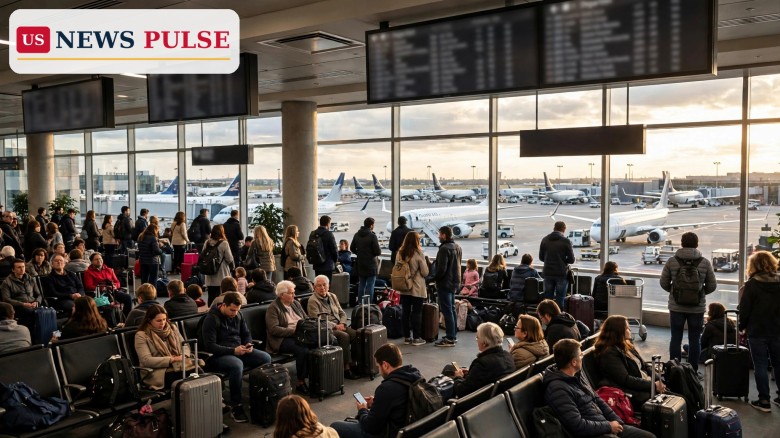
The FAA nationwide ground stop that froze every departing flight in the United States on Friday, November 13, 2026, lasted about four hours before the Federal Aviation Administration lifted it on Friday evening. The order, issued at 3:54 p.m. Eastern Time, kept all departing aircraft on the ground at every airport in the country after a communications failure struck the air traffic control centres that guide high-altitude flights. More than 10,000 flights were delayed and more than 5,000 cancelled before the skies reopened, and airlines warned the disruption would ripple through the weekend.
Key Points
- The FAA issued a nationwide ground stop at 3:54 p.m. Eastern Time on Friday, November 13, 2026, citing "extraordinary circumstances and for reasons of safety", and lifted it at about 8:15 p.m., roughly four hours later.
- The cause was a communications outage affecting all Air Route Traffic Control Centers. Earlier on Friday, departures to Chicago O'Hare and Midway were halted, with reports pointing to the Kansas City centre.
- Flights already in the air were not ordered to land and continued to their destinations, while international departures were handled case by case.
- FlightAware reported that by 8 p.m. Eastern Time, more than 10,000 flights had been delayed and more than 5,000 cancelled across the United States.
- Homeland Security Secretary Markwayne Mullin said there was no indication of a cyberattack. It was only the third nationwide ground stop in US history, after September 11, 2001, and the January 11, 2023, NOTAM failure.
What Happened
The trouble began on Friday afternoon, when the FAA first halted departures bound for Chicago O'Hare and Midway airports over air traffic control communications issues. Within hours the problem had spread across the National Airspace System, and at 3:54 p.m. Eastern Time the FAA Command Center issued the nationwide order. Its advisory read: "Due to extraordinary circumstances and for reasons of safety. Attention all aircraft operators, by order of the FAA Command Center, all airports are ground stopped. All departing traffic should remain ground stopped until further notice. Inbound international flights will be handled on a case by case basis."
Some flights were allowed to move as the afternoon wore on. An Etihad Airways flight from Boston to Abu Dhabi took off at about 4:45 p.m.,. Two hours after the advisory, Pacific-bound flights from San Francisco, including services to Hawaii and Asia, were cleared to depart, and some trans-Atlantic flights from the East Coast were also allowed to go. Even so, most of the system stayed frozen until the FAA announced just before 8:30 p.m. that the stop had been lifted.
Background: How a Nationwide Ground Stop Works
A ground stop is one of the most powerful tools in the FAA's hands. It orders aircraft that have not yet taken off to stay on the ground, and it can be applied to a single airport, a region, or, as on Friday, the entire country. Local ground stops are routine, but a nationwide stop is almost unheard of. Before Friday, it had happened only twice: on September 11, 2001, and on January 11, 2023, when a failure of the NOTAM system grounded departures for about 90 minutes.
The failure hit the Air Route Traffic Control Centers, the regional centres that manage aircraft flying at cruising altitude between airports. Controllers rely on radio frequencies and telecommunications links to speak to pilots and hand aircraft from one sector to another. When those links fail, controllers cannot safely manage the traffic, and the only safe option is to stop departures until communications are restored.
FAA Nationwide Ground Stop: The Communications Failure Behind the Halt
What made Friday's outage so disruptive was its reach. The problem was not a single airport or centre, but a communications failure touching every Air Route Traffic Control Center in the country, according to Transportation Secretary Sean Duffy. Reports earlier in the day pointed to the Kansas City centre and a rolling frequency outage, in which radio frequencies drop out one after another. The FAA described the fault as a temporary telecommunications outage and said its technicians were investigating.
Reactions and Official Statements
Transportation Secretary Sean Duffy confirmed the stop on social media at 4:16 p.m. on Friday, writing: "The @FAAnews issued a nationwide ground stop for all U.S. airports following a communication issue impacting all Air Route Traffic Control Centers. FAA technicians are investigating the issue." The FAA said the flights were halted "out of an abundance of caution", adding: "Every flight has been accounted for and international flights will be handled on a case by case basis." Homeland Security Secretary Markwayne Mullin told reporters there was no indication the outage was a cyberattack, saying "there should be no fear to the public", while cautioning that a resolution would "take some time".
Aviation analysts warned the damage would outlast the stop itself. Robert W. Mann Jr., a former airline executive and president of the consultancy R.W. Mann and Co., said: "The longer the ground stop, the longer the recovery time." He added: "At this point, the day is effectively done. Airlines should be focusing on resetting their resources and systems for the weekend."
Why It Matters
Friday's halt showed how much of American aviation depends on a small number of shared systems. A single communications failure, touching every high-altitude control centre at once, was enough to stop departures at every airport in the country for four hours, delaying more than 10,000 flights and cancelling more than 5,000. It was only the third ever.
What Happens Next
Airlines are now working through the backlog, repositioning aircraft and crews and rebooking stranded passengers, with cancellations expected to stretch into the weekend. Travellers should check their flight status with their airline before heading to the airport. The FAA is investigating the failure and is expected to explain what went wrong once the cause is confirmed.
Frequently Asked Questions
How long did the nationwide ground stop last?
About four hours. The FAA issued the order at 3:54 p.m. Eastern Time on Friday, November 13, 2026, and lifted it at about 8:15 p.m. Eastern Time the same evening.
What caused the ground stop?
A communications outage affecting all Air Route Traffic Control Centers. The FAA called it a temporary telecommunications outage
Were flights already in the air forced to land?
No. Aircraft already airborne were allowed to continue to their destinations and land normally. Only departures were halted, and international flights were handled case by case.
How many flights were affected?
By 8 p.m. Eastern Time on Friday, FlightAware reported more than 10,000 flights delayed and more than 5,000 cancelled across the United States
Has a nationwide ground stop happened before?
Only twice: September 11, 2001, and January 11, 2023, when a NOTAM system failure grounded departures. Friday's stop was the third in US history.
Related coverage: Flight cancellations soar past 1,530 on Saturday as shutdown chaos deepens; FAA orders fuel-tank sealant checks on 60 Boeing 787s and 31 747s over lightning risk; Nor'easter tornado warning at JFK Airport as tornadoes strike Delaware and New Jersey.
Leave a Comment