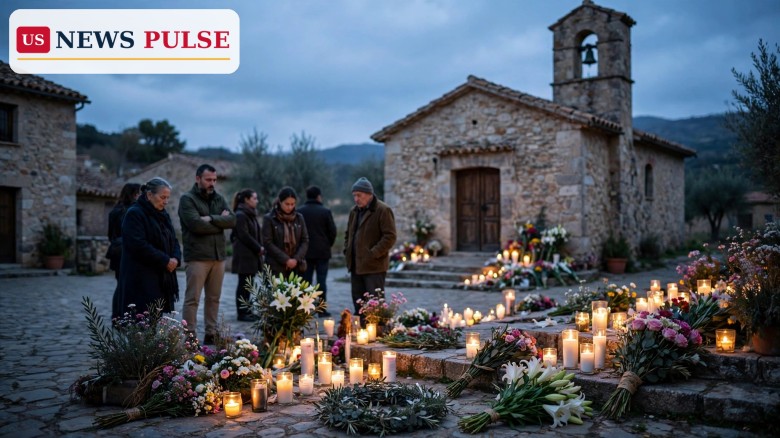
Spain marked a third day of national mourning on Saturday, October 31, 2026, with a memorial Mass in the village of Urda for the victims of one of Europe's deadliest rail disasters this century, as the confirmed death toll from Wednesday's high-speed train collision reached 69 and train drivers demanded urgent safety reforms. Inside the village's San Juan Bautista church, pews were packed and dozens more gathered outside to listen to the service, some wiping away tears, as the country paused to honour the dead.
The memorial came as Transport Minister Óscar Puente, speaking on Friday, ruled out resigning and announced new measures aimed at reducing technical risks and restoring public confidence in the high-speed network, without yet specifying what those measures would be. The train drivers' union Semaf, meanwhile, called two fresh strikes at state operator Renfe for November 10 and 12, demanding structural safety measures.
The collision happened on Wednesday morning on the Madrid-Seville high-speed line between Los Yébenes and Urda, about 130 kilometres south of Madrid. Renfe AVE service 02080, the 8:00 a.m. Madrid Atocha to Seville Santa Justa train carrying 397 passengers, struck the rear of the stationary Iryo service 6076, which had left at 7:54 a.m. carrying 147 people. Several carriages derailed, some falling down an embankment. At least 180 people were injured, and Castilla-La Mancha authorities reported that 58 injured people required hospital treatment.
On Saturday, residents and local officials gathered in Urda for the memorial Mass honouring the victims. Prime Minister Pedro Sánchez said Spain was working tirelessly to complete the identification process, as families continued to wait for news. The legal authorities handling the process said 67 reports for missing people remained active, including 14 for foreign nationals. Toledo's morgue received 52 bodies, far more than its capacity of 30, and search teams used sniffer dogs and thermal drones at the crash site as the toll climbed from 68 to 69 during the week. Former labour minister Fátima Báñez was among those confirmed dead.
The mourning was nationwide. Town halls across Spain held a minute of silence at 8:00 p.m. during the week, around 1,500 people gathered outside Spain's Ministry of Transport to demand accountability, about 400 gathered outside Toledo city hall, and about 1,000 assembled in Zaragoza's Plaza del Pilar, where some held signs calling for Puente's resignation. Flags flew at half-mast, and the government cancelled or scaled back official ceremonies and public events.
Puente said a computer malfunction stopped the LZB train-protection system, which covered a stretch of about 63 to 69 kilometres, at about 8:30 a.m. on Wednesday. The failure automatically halted trains on the section. According to the minister's account, a central control centre later authorised the AVE to resume without speed restrictions, although a stop signal reportedly remained active. Reports put the authorisation at 8:36 a.m., and the Renfe train then travelled about 25 kilometres before colliding with the stationary Iryo service.
Puente said the train could have been travelling at up to 200 kilometres per hour on that stretch; its speed at the moment of impact remained under investigation. The Civil Guard opened an investigation and questioned an Adif controller, examining communications between the control room and the train drivers. Preliminary information from the Independent Authority for the Technical Investigation of Accidents and Incidents, known as AITAT, confirmed that the LZB system stopped functioning at 8:31 a.m. on Wednesday, shortly before the crash, although it remains unclear whether that failure directly caused the accident.
Puente described the control centre's decision to resume traffic as taking place in circumstances that, in his words, were inexplicable, and said the centre had more than enough time to verify the error and did not fix it. Opposition leader Alberto Núñez Feijóo accused Puente of frivolity for blaming one control centre operator. The minister has rejected calls to resign.
Wednesday's collision was Spain's second fatal rail accident of 2026, following the Adamuz crash in Córdoba in January, in which 46 people died. Together, the two disasters have shaken confidence in a high-speed network long regarded as one of the safest and most modern in the world, and have put intense pressure on Sánchez's government ahead of a general election on November 29.
King Felipe VI visited injured passengers in Toledo and called for measures to ensure this does not happen again. Sánchez visited the crash site. In Santiago de Compostela, a vigil recalled the 2013 Angrois crash, another of Spain's darkest rail days. A school in Urda was converted into a centre where relatives could seek information, with Red Cross workers providing psychological support to families arriving in tears.
The drivers' union says its concerns are not new. Semaf reported in January 2026 that hundreds of train drivers had long been reporting incidents on the railway network without response or corrective measures. Renfe drivers had already been on a strike called before the accident, and the union maintained a stoppage on Thursday. The newly announced November 10 and 12 strikes escalate that dispute into a direct demand for structural change.
Urda's mayor, Manuel Galán, thanked those who worked at the scene, praised cooperation between administrations, offered condolences to victims' families and wished the injured a quick recovery. Regional president Emiliano García-Page attended the Toledo tribute alongside ministers Milagros Tolón and Isabel Rodríguez.
Sánchez said on Friday that trust in the high-speed network had been shaken, and that the government was working tirelessly to expedite identifications. Puente, dismissing calls for his resignation, announced plans for new measures to mitigate technical risks and restore public confidence, though specific details are yet to be disclosed.
Semaf's demand is specific: a thorough review of the regulations governing how trains should operate when automatic protection systems fail, so that trains are never again resumed at normal speed when there is a risk that two trains could end up on the same section of track.
The Urda disaster matters first for the families still waiting for certainty. With 67 missing-person reports still active days after the crash, identification — not blame — remains the most urgent task, and the strain on Toledo's morgue underlines how unprepared the system was for a disaster of this scale.
It matters second for rail safety across Europe. Spain's AVE network carries millions of passengers a year and is often held up as a model. If a protection-system failure, followed by a manual authorisation to resume at speed, can produce a 69-death collision, regulators in every country with similar systems will be asking how their own fallback procedures work when automation fails.
It matters third politically. Two fatal rail disasters in one year, a looming general election, street protests demanding accountability and a drivers' strike threat all converge on a single question: whether the government can show, quickly and concretely, that the network is safe. Puente's unspecified new measures will be judged against that test, and the November strikes give the dispute a hard deadline.
The investigation continues on two tracks: the Civil Guard's inquiry into the control-room decisions and communications, and AITAT's technical investigation into the LZB failure and whether it directly caused the collision. Both will shape any criminal or disciplinary consequences, and any redesign of operating rules.
Puente's promised measures are expected to be detailed in the coming days, and will be scrutinised against Semaf's demand for structural change. If the union judges them insufficient, the November 10 and 12 Renfe strikes will go ahead, disrupting services on the very network whose safety is in question.
For Urda itself, the coming days will be quieter and harder: funerals, identifications, and the slow work of a village of a few thousand people absorbing a disaster that the whole country watched. The memorial Mass on Saturday was, for many residents, only the beginning of that mourning.
What happened at Urda? On Wednesday morning, a Renfe AVE train struck the rear of a stationary Iryo train on the Madrid-Seville high-speed line near Urda, Toledo, killing 69 people and injuring at least 180.
What caused the crash? The LZB train-protection system malfunctioned at 8:31 a.m., halting trains; the control centre then authorised the AVE to resume, reportedly without speed restrictions, and it travelled about 25 kilometres before the collision. The full cause remains under investigation.
What happened on Saturday? Spain observed a third day of national mourning, with a memorial Mass at San Juan Bautista church in Urda, packed pews and mourners gathered outside.
Has the transport minister resigned? No. Óscar Puente ruled out resigning on Friday and promised new safety measures, details unspecified.
What happens next? The Civil Guard and AITAT investigations continue, Puente's measures are awaited, and train drivers plan Renfe strikes on November 10 and 12.
Related coverage: Spain train crash kills 68 as high-speed trains collide near Toledo; Spain train crash cause: Renfe train cleared past red signal, minister says; Spain train crash kills at least 64 in high-speed collision near Toledo.
Leave a Comment



 | Today's Date: