On Tuesday night, newsrooms across the United States will call winners in one of the country's most closely contested midterm election cycles in recent years — long before all the votes are counted. A Reuters explainer published on November 1, 2026 sets out exactly how those calls are made, who makes them, and why they can occasionally go wrong. For voters watching the results roll in, it is a guide to what a "call" really means, and what it does not.
Most television networks and digital outlets rely on two providers for vote counts: the Associated Press or the election-data firm Decision Desk HQ. Some outlets, such as the Wall Street Journal and MS NOW, will rely solely on the AP's calls. Others, including Fox News and CBS News, will make their own projections based on the AP vote count, exit polls, early-vote totals and their own statistical modelling. The first calls will start soon after polls begin to close, first in Indiana and Kentucky at 6 p.m. Eastern Time.
Nov 1 (Reuters) — on Tuesday night, newsrooms across the US will call winners in one of the country's most closely contested midterm election cycles in recent years, long before all the votes are counted, Reuters reported in an explainer by Jaspreet Singh. The piece, published two days before polling day, walks readers through a process that is often misunderstood: a race call is a statistical judgment that the trailing candidate cannot catch up, not a certification of the result.
Most television networks and digital outlets rely on two providers for vote counts: the Associated Press or election-data firm Decision Desk HQ. Some news outlets such as the Wall Street Journal and MS NOW will rely solely on the AP for race calls, while others like Fox News and CBS News will make their own projections based on the AP vote count, exit polls, early-vote totals and their own statistical modelling.
The first calls will start soon after polls begin to close in the United States, first with Indiana and Kentucky at 6 p.m. ET (2300 GMT), and shortly after in Georgia, South Carolina, Vermont and Virginia at 7 p.m. (0000 GMT on November 4). In certain races there may be an instant call if much of the voting has already taken place — for example, where early voting and mail ballots already account for most of the expected turnout.
Low public trust complicates race calls for news outlets. While more than 60 percent of Americans have some confidence in news organisations to report accurate election results, only 32 percent have high confidence, with Democrats more trusting than Republicans, according to an October poll for the Medill Local News Initiative and the Alliance for Trust in Media cited by Reuters.
The Associated Press is a nonprofit newsroom supported by member newspapers, and it has counted votes in every US election since 1848. It works with a national network of reporters and election officials to verify results, and for the 2026 midterms it said it would deploy more than 4,000 reporters at county election offices and local polling locations, gathering and providing data to the decision desks at ABC News, CBS News, Fox, CNN and NBC News.
ABC, CBS, CNN and NBC also rely on research firm SSRS, which acquired exit-polling company Edison Research in 2025. Exit polls — interviews with voters as they leave polling places, combined with early-vote and mail-ballot data — help decision desks understand who is voting and how the remaining vote is likely to break.
When making calls, the AP uses vote totals and estimates how many votes remain uncounted based on past voting patterns and early-vote data. It calls a race only when the trailing candidate cannot catch up. That is a deliberately conservative standard: the AP would rather wait than call a race that later flips, because a wrong call damages trust in the whole process.
While most major TV networks all use the same AP vote count tabulation to make their calls, the ones who decide to call winners use a proprietary mix of their own data analysis, historical models, exit poll interviews and expert judgment to call races when they determine that they have become a statistical certainty.
Decision Desk HQ, the main alternative to the AP, collects vote counts from official state sources, usually secretaries of state or state election departments. The firm uses statistical analysis, modelling and expert review to project election winners. Its clients include NewsNation, the Hill and Newsmax, and it recently signed up X, the social network owned by Elon Musk.
DDHQ uses automated software to repeatedly check official election websites and collect newly posted vote totals, in addition to using reporters on the ground. The firm says roughly 80 percent of all votes are processed by pulling data directly from official election sites, or by manually monitoring election sites. The remaining counts are collected by reporters.
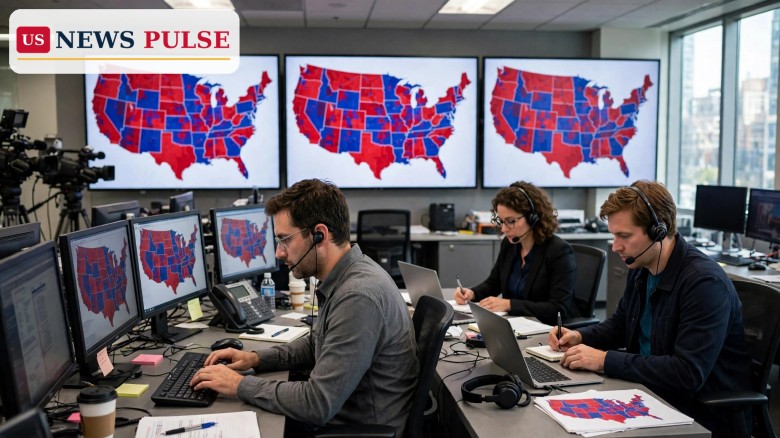
It calculates the percentage of ballots counted by dividing the votes reported by election officials by its estimated total turnout for a race. It determines remaining votes by subtracting reported votes from this overall turnout estimate, which is refined on election night using actual data. Final projections require unanimous team agreement and a sign-off from the head of data science, Scott Tranter. "We're preparing to have several thousand people working on election night to gather data," Tranter told Reuters.
The two systems therefore differ in emphasis: the AP leans on its vast reporter network and a long institutional history, while DDHQ leans on automated collection from official sites plus modelling. Both, however, face the same fundamental problem on election night — estimating how many votes are still out there, and how they will break, before they have all been counted.
Reuters' explainer quotes the people who run the process rather than politicians, and their language is strikingly cautious. Tranter's emphasis on "several thousand people working on election night" is a reminder that race calling is still, at its core, a human operation: software collects the numbers, but people make the judgment.
The networks' own arrangements show the same caution in different forms. Fox's decision desk will be making its own calls in all statewide races as well as the calls for control of the House and control of the Senate, using the AP vote count and applying its own analysis. MS NOW, covering its first midterms since separating from NBCUniversal's cable portfolio, will rely on the AP's race calls. The New York Times relies on AP calls for most contests but independently reviews competitive races using precinct-level data and its Needle model, and may make a call before or after the AP.
Bloomberg does not make its own race calls, Reuters notes. For election results, it uses established third-party sources, and Reuters itself will be citing the race calls from other news organisations. The Washington Post did not respond to requests for comment on how it will call races.
The trust figures in the Medill poll frame the whole exercise. With only 32 percent of Americans expressing high confidence in news organisations to report accurate election results, every call on Tuesday night will be watched not just for its political meaning but for its accuracy. A fast call that proves right builds credibility; a fast call that proves wrong is remembered for years.
The explainer matters because race calls shape the story of election night itself. When a network calls control of the House or Senate, it changes what candidates say, what markets do and what voters believe has happened — hours or days before the official count is certified. Understanding that a call is a projection, made to a statistical standard, helps readers separate the signal of election night from the noise.
It also matters because the 2026 midterms are unusually close. Polls favour Democrats to win the House, while the Senate remains too close to call, and the margins in several battleground states are narrow enough that a small error in estimating the remaining vote could flip a call. That is precisely the environment in which decision desks are most careful, and in which viewers may have to wait longest for the biggest calls.
Finally, the explainer is a reminder of the infrastructure behind democracy's most-watched night. More than 4,000 AP reporters, several thousand DDHQ staff, exit pollsters, data scientists and decision-desk analysts will all be working from the same incomplete numbers, applying different models, and — usually — reaching the same answer. When they disagree, the disagreement itself is news.
Polls close first in Indiana and Kentucky at 6 p.m. ET on Tuesday, November 3, 2026, with Georgia, South Carolina, Vermont and Virginia following at 7 p.m. ET. Calls will follow through the evening as the vote count builds, with the biggest prizes — control of the House and Senate — likely to be called only when decision desks are confident the trailing party cannot catch up.
Viewers should expect some races to remain uncalled on election night, particularly close contests with large numbers of mail ballots still to be counted. An uncalled race is not a disputed race: it simply means the remaining vote is large enough, and uncertain enough, that no responsible projection can yet be made.
Official results will follow over the coming days and weeks as states canvass and certify their counts. The race calls of Tuesday night will be checked against those certified results — and, as Reuters' history of retractions shows, the rare call that proves wrong will be corrected in public.
What is a race call? A race call is a news organisation's projection that a candidate has won, made when its analysts judge that the trailing candidate cannot catch up given the votes counted and the votes estimated to remain. It is not an official certification of the result.
Who counts the votes? Most US outlets rely on the Associated Press or Decision Desk HQ. The AP deploys more than 4,000 reporters for the 2026 midterms; DDHQ collects about 80 percent of its votes from official state websites, with the rest gathered by reporters.
When will the first calls come? Soon after polls close in Indiana and Kentucky at 6 p.m. ET on November 3, 2026, followed by Georgia, South Carolina, Vermont and Virginia at 7 p.m. ET. Some races may be called instantly if most voting has already taken place.
Can race calls be wrong? Yes, rarely. In 2025 DDHQ withdrew a projection in the Seattle mayor's race, and earlier in 2026 it withdrew a call in the Democratic primary for a special election in New Jersey's 11th Congressional District. In 2018 the AP retracted a call in California's 21st Congressional District after Democrat T.J. Cox took the lead.
Why do different networks call races at different times? Because each decision desk applies its own models, exit-poll data and expert judgment to the same underlying vote count. The New York Times, for example, may call a competitive race before or after the AP depending on its own precinct-level analysis.
Related coverage: CNN Senate polls: Democrats lead in four battlegrounds before 2026 midterms, Dark money: $1 billion in secret cash floods US races as vote nears, AI chatbots spread election errors before midterms, study finds.
Leave a Comment



 | Today's Date: