North Korea has tested a cluster warhead designed for tactical ballistic missiles and vowed to put four types of cluster warheads into service before the end of 2026, its state media reported on Sunday, November 1. The North Korea cluster warhead test, carried out on Saturday, October 31, is Pyongyang's latest public step in refining a weapon built to hit many targets across a wide area with a single missile, and it comes at a moment when Washington, Seoul and Tokyo are publicly pressing for the complete denuclearisation of the Korean Peninsula.
KCNA reported on November 1 that the Missile Administration had conducted a test to assess the combat applicability and power of a scattering warhead — the North's term for a cluster warhead — for a tactical ballistic missile. The test was overseen by Kim Jong-sik, first vice department director of the Central Committee of the Workers' Party of Korea, according to reports based on the KCNA dispatch.
Research institutes under the Missile Administration were quoted as saying the Standard Type 2 scattering warhead can devastate a target area of 12 to 13 jongbo, or about 11.9 to 12.9 hectares, with ultra-high density. Seoul Economic Daily, citing Yonhap, put the same claim in plainer terms: an area equivalent to about 18 soccer fields. KCNA published photographs showing submunitions exploding across a broad area, according to the coverage.
The general director of the Missile Administration was quoted as saying the warheads are classified into four categories, for special purposes and standard purposes, without giving technical details of each type. "Within this year we will enable units to select and use all those types according to operational aims and specific features of targets," the director said, in the KCNA account carried by the Korea Times and Reuters.
South Korea's military did not issue its usual immediate announcement of a ballistic missile launch. On Sunday, the Joint Chiefs of Staff said South Korea and the United States had been tracking related movements before the launch under close information sharing and had maintained a readiness posture. The military said the missile was fired toward the Yellow Sea — the West Sea — from an area around Chongju, in North Pyongan province in the northwest of the country.
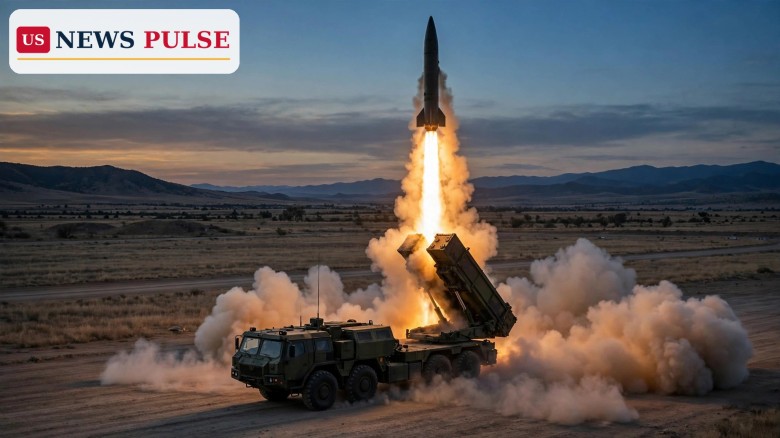
Analysts cited in South Korean coverage differed on the exact missile, but agreed on its family. Shin Jong-woo, secretary-general of the Seoul-based Korea Defense and Security Forum, said the missile appeared to be the Hwasong-11 Ra, while other photo analysis identified it as the Hwasong-11Na, also known as the KN-24 — described as North Korea's version of the American ATACMS tactical missile, with a range of about 400 kilometres. The type was not disclosed by KCNA itself, and the precise identification remains an analyst assessment rather than an official confirmation.
A cluster munition is a weapon that carries dozens to hundreds of smaller submunitions in a single warhead and disperses them in the air, so that one strike can hit multiple targets spread over a wide area. That design is also why the weapons are controversial: submunitions that fail to explode on impact can remain dangerous long after a conflict, and the wide footprint makes it harder to limit effects to a single military target.
This is not North Korea's first public cluster-warhead test. In April 2026, Pyongyang said it had test-fired a Hwasongpho-11Ra missile fitted with a cluster warhead, a launch overseen by leader Kim Jong-un and his daughter Ju-ae, striking an island target 136 kilometres away. The October 31 test therefore reads less as a first experiment than as a continuation — moving from demonstrating that a cluster warhead can be fitted to a tactical missile toward declaring that a family of warheads is ready for units to choose from.
The timing matters. The test came on the same day that the foreign ministers of South Korea, the United States and Japan held trilateral talks in Atlanta, reaffirming what they called their unwavering commitment to the complete denuclearisation of the Korean Peninsula. It also followed, by days, a separate reported launch: Reuters noted that North Korea test-fired around 10 ballistic missiles from its east coast toward the sea on Thursday, when German Chancellor Friedrich Merz visited South Korea for a summit.
North Korea's short-range tactical missile programme has long been aimed, in the assessment of Seoul and Washington, at targets in South Korea — airfields, command posts, artillery positions and other military facilities within a few hundred kilometres of the border. A cluster warhead fits that mission: instead of one warhead striking one point, submunitions spread across a base, a runway or a dispersed battery. The claimed 12 to 13 hectare footprint, if accurate, would cover a substantial military installation in a single strike.
The North Korea cluster warhead test carries a message that goes beyond the hardware. By announcing four categories of warheads and a year-end deployment goal, Pyongyang is telling its neighbours — and the United States — that it is not merely experimenting with cluster munitions but organising them into a usable arsenal, with variants matched to different targets.
The announcement also tests the diplomatic track. US Secretary of State Marco Rubio said on Saturday that President Donald Trump remains open to talks with North Korean leader Kim Jong-un if Pyongyang is willing to discuss issues of concern to Washington and its allies, though no meeting has been scheduled. The test, disclosed hours later, is a reminder of how Pyongyang has historically paired weapons demonstrations with diplomatic openings: building leverage while keeping the door to talks visibly ajar.
For Seoul, the practical question is detection and defence. South Korea's decision not to announce the launch immediately — unusual for a ballistic missile test — and its later statement that the launch had been tracked in advance, suggest a deliberate choice to avoid amplifying the test while signalling that surveillance held. The Joint Chiefs' emphasis on information sharing with the United States points to the same message: the launch was seen, even if it was not immediately publicised.
There is also a limit to what the KCNA report proves. North Korea's claims about warhead performance are unverified by independent testing, and the photographs released by state media are selected by Pyongyang. The 12 to 13 hectare figure, the four-category claim and the year-end timeline are assertions from the Missile Administration, not measurements published by an outside observer. What is independently confirmed is narrower: a missile was launched from the northwest toward the Yellow Sea on October 31, South Korea and the United States tracked it, and North Korea publicly claimed a cluster-warhead success the next day.
KCNA's own account, as carried by Yonhap, the Korea Times and Reuters, is the fullest statement so far. The Missile Administration's research institutes said the Standard Type 2 warhead can turn a target area of 12 to 13 hectares into ashes "with its highest-density power." The Missile Administration's general director added: "Within this year we will enable units to select and use all those types according to operational aims and specific features of targets."
South Korea's Joint Chiefs of Staff said: "Under close information sharing between South Korea and the United States, (we) tracked relevant activities before North Korea's missile launch and maintained a readiness posture." That statement, issued on Sunday, was Seoul's main public response at the time of reporting.
On the diplomatic side, Rubio's Saturday remarks framed the American position: Trump remains open to talks with Kim if Pyongyang is willing to discuss issues of concern to Washington and its allies. No meeting has been scheduled, and Rubio did not link any talks to the cluster-warhead test, which had not yet been publicly disclosed when he spoke.
Independent analysts focused on identification rather than rhetoric. Shin Jong-woo of the Korea Defense and Security Forum identified the missile as appearing to be the Hwasong-11 Ra, while other analysts, working from the released photographs, pointed to the Hwasong-11Na (KN-24), citing the wheeled transporter-erector-launcher, the blunt body, large fins and box-type launch canisters on a four-axle, eight-wheel truck. The arched-roof target building in the photographs was assessed by one analyst as simulating a South Korean military facility — an interpretation, not a KCNA statement.
The test matters for three reasons. First, it expands the threat picture for South Korea and for American forces on the peninsula. A tactical missile that can spread submunitions across a dozen hectares changes how bases, airfields and dispersed units must be protected; hardening a single point is less useful against a weapon designed to cover an area.
Second, it complicates arms-control and diplomatic conversations. Cluster munitions are already a sensitive subject internationally, and a declared plan to field four types by year-end gives negotiators one more capability to account for in any future talks about North Korea's arsenal — talks that, for now, remain hypothetical, with no meeting scheduled.
Third, the test is a reminder that North Korea's weapons programme continues to advance even while the world's attention is fixed elsewhere — on the war in Ukraine, the renewed confrontation over Iran, and the American midterm elections three days away. A launch that Seoul chose not to announce immediately still landed in the news cycle within a day, because Pyongyang chose to publicise it.
For American readers, the direct connection is the alliance: US forces in South Korea train and operate alongside South Korean units that would be in range of exactly this class of weapon, and the US-South Korea information-sharing arrangement that tracked this launch is part of the deterrence architecture for the peninsula. A cluster warhead does not change the nuclear equation, but it changes the conventional one — and conventional deterrence is what keeps a crisis from escalating.
Watch for three developments. The first is whether North Korea follows the announcement with further tests of the other three warhead categories, or with a launch that KCNA explicitly links to a specific missile type. A second test would suggest the programme is moving from announcement to validation.
The second is the South Korean and American response: whether Seoul publishes its own assessment of the missile type and trajectory, and whether Washington issues a statement beyond Rubio's standing openness to talks. A formal condemnation, a sanctions designation, or a joint military exercise would each signal a different level of concern.
The third is the diplomatic calendar. The Atlanta trilateral talks produced a renewed denuclearisation commitment, but no new meeting with Pyongyang. If the cluster-warhead announcement hardens positions in Seoul, Tokyo or Washington, the space for the talks Rubio described could narrow — even as Pyongyang's own message, that it is building a more flexible arsenal, makes the case for engagement harder to dismiss.
What did North Korea test on October 31, 2026? According to KCNA, a cluster-bomb warhead for a tactical ballistic missile, tested by the Missile Administration to assess its combat applicability and power.
How large an area does North Korea claim the warhead can devastate? KCNA said the Standard Type 2 warhead can devastate 12 to 13 hectares — about 18 soccer fields — at its highest density.
When does North Korea say the warheads will be in service? The Missile Administration said units will be able to select and use all four categories of cluster warheads within this year, meaning before the end of 2026.
How did South Korea respond? The Joint Chiefs of Staff said South Korea and the United States tracked related activity before the launch, which was fired from around Chongju toward the Yellow Sea, and maintained a readiness posture.
Is this North Korea's first cluster-warhead test? No. In April 2026, Pyongyang said it tested cluster bombs mounted on a Hwasong-11Ra tactical ballistic missile, overseen by Kim Jong-un.
Related coverage: North Korea missiles fired toward East Sea as border tensions surge, US, South Korea and Japan unite in Atlanta on North Korea denuclearisation, FBI blames North Korea for $6.3 billion Binance hack in record crypto heist.
Leave a Comment



 | Today's Date: