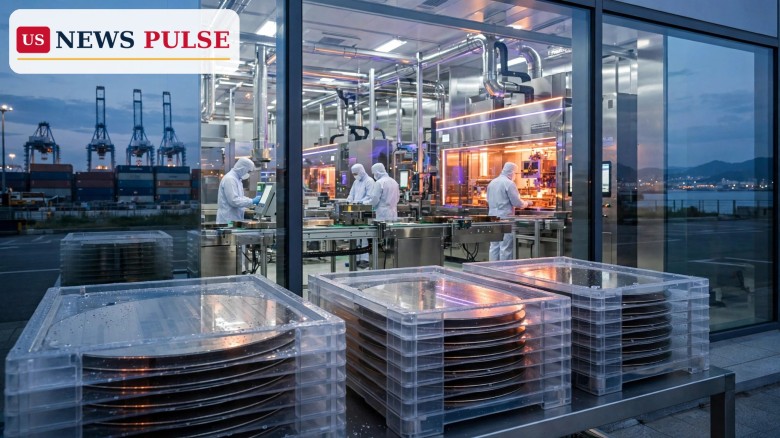
South Korea exports surged 93.7% in October 2026 to $115.28 billion, the second-highest monthly total on record and the strongest annual growth rate since January 1974, as the global artificial intelligence build-out sent demand for the country's semiconductors soaring. Chip shipments alone jumped 259.4% from a year earlier to $56.44 billion, nearly half of everything the country sold abroad in the month.
The figures, released by South Korea's Ministry of Trade, Industry and Resources on Sunday, November 1, beat the median forecast of a 93.2% rise in a Reuters poll of economists and followed September's 83.7% gain. They confirm South Korea, Asia's fourth-largest economy and a bellwether for world trade, as the clearest winner so far from the AI infrastructure boom — even as a sharp sell-off in technology shares on Friday raised fresh questions about how long the boom can last.
South Korea's trade ministry said strong global demand for semiconductors, combined with continued investment by major technology companies in AI infrastructure, drove the record month. Semiconductor shipments of $56.44 billion were the standout, with prices and volumes both staying high as global big tech firms keep spending on new facilities in the race for AI leadership.
Computer exports spiked 496.6% as demand for servers to run AI services surged. Shipments to the United States jumped 185.8% to $24.9 billion, supported by robust demand for semiconductors, computers and electrical equipment used in AI infrastructure. Petroleum products rose 80% and automobiles gained 18%, while imports climbed 36%, leaving a trade surplus of $42.5 billion for the month.
On a working-day adjusted basis, exports climbed 76.1% — a figure economists watch closely because the calendar flattered the headline number. The Chuseok holidays fell in September this year but in October last year, giving October 2026 more working days than the same month a year earlier. Even after that adjustment, the underlying momentum remained exceptionally strong, and the October value followed September's record $121.1 billion.
"With exports continuing solid growth of more than $110 billion in October, it is becoming certain that annual exports of $1 trillion will be reached within November," Trade, Industry and Resources Minister Kim Jung-kwan said. Cumulative exports for January to October totalled $930 billion, already past $900 billion for the first time. If the $1 trillion mark is reached, South Korea would become only the fourth country ever to do so, after the United States, China and Germany.
South Korea's export machine has always run on memory. Samsung Electronics and SK Hynix dominate the global market for DRAM and NAND flash memory, and both are central suppliers of high-bandwidth memory, or HBM — the fast, stacked memory that lets AI processors access vast amounts of data at very high speeds. As AI models grow larger and more demanding, demand for that memory has outstripped supply, pushing prices and volumes sharply higher.
The third quarter already showed the shift. South Korea's economy grew faster than expected on strong semiconductor exports and investment, with Samsung and SK Hynix reporting surging profits. SK Hynix reported a sevenfold surge in quarterly profit, while Samsung outlined plans to raise capital spending by more than 60% this year as demand for advanced chips continues to outstrip supply.
The boom is not confined to chips. The ministry's data show the AI build-out rippling through the whole export basket: servers, computers, electrical equipment and the components that fill data centres. For American readers, the link is direct — the chips and servers are being bought, in large part, to power AI services built by United States technology firms, and shipments to the United States nearly tripled in October.
The United States is both customer and competitor in this story. American hyperscalers — the giant cloud and AI companies — are the buyers driving Korean chip prices higher, while Washington has spent years trying to secure semiconductor supply chains closer to home. October's data show that, for now, the world's AI build-out still runs heavily through South Korea.
That dependence cuts both ways. South Korea's export surge arrived in the same week that United States tech earnings rattled markets: Amazon, which has committed $220 billion to spending this year, disclosed it had spent more cash than it earned, and Alphabet fell sharply after revealing that AI summaries were hurting its core advertising revenue. The Nasdaq 100 has entered its third correction of 2026 as investors question nearly $1 trillion in AI spending. Friday's sell-off spilled into Asia, with South Korea's Kospi falling 3.5%, SK Hynix sliding 7% and Samsung dropping 3%.
For the United States, the Korean numbers are therefore a double signal: real, physical demand for AI hardware remains enormous, but financial markets are no longer willing to take the AI trade on faith. The chips are shipping; whether the profits follow at the pace investors assumed is the open question.
Minister Kim Jung-kwan's assessment was unambiguous: annual exports of $1 trillion will be reached within November if the current trend continues. Bank of Korea Governor Shin Hyun-song echoed that view, saying the export boom is putting South Korea on course to exceed $1 trillion in annual shipments for the first time this year.
The Bank of Korea also faces a policy dilemma created by the boom. It stood pat in October to assess the impact of consecutive rate increases in July and August, and the continued strength of exports adds to the case for a rate rise this month. Inflation data due on Tuesday will provide another key input before the bank's November 26 decision. The bank already expects growth this year and next to substantially exceed its August projections of 3.3% and 2.9%.
Market analysts struck a more cautious note. The robust figures came, as Bloomberg's reporting put it, "in the wake of a sharp global sell-off in technology stocks, fuelled by disappointing earnings and outlooks from major US companies, including Amazon.com and Intel, that have reignited concerns over the sustainability of the AI investment boom." A Bloomberg gauge of regional chipmakers fell as much as 4.8% on Friday.
South Korea is the world's trade canary. Its exports — chips, ships, cars and steel — are an early read on global demand, and a 93.7% jump is not a number that appears in normal times. The last time growth was this strong, in January 1974, the world was in the grip of the oil shock. This time the shock is technological: a race to build AI capacity that is consuming memory, servers and power at a pace manufacturers can barely match.
For American consumers and businesses, the Korean data help explain two things at once: why AI services keep getting more powerful, and why the companies building them keep spending at a scale that alarms their own shareholders. The hardware bill for the AI era is being paid, in large part, to South Korea — and October's $56.44 billion chip tally is the receipt.
There is also a strategic dimension. As Washington debates tariffs, export controls and supply-chain security, October's figures underline how intertwined the United States and South Korean technology economies remain. Shipments to the United States alone were worth $24.9 billion in a single month.
Three dates matter now. First, South Korea's inflation data, due Tuesday, will feed directly into the Bank of Korea's November 26 rate decision — a rise would be a bet that the export boom is generating domestic heat, not just foreign sales. Second, the $1 trillion annual export milestone, which the trade ministry expects within November, will be a symbolic moment for Asia's fourth-largest economy. Third, the next round of United States big tech earnings will test whether the AI spending that drives Korean exports survives the market's new scepticism.
If chip prices stay high and server demand holds, November could deliver both the $1 trillion milestone and another blockbuster month. If the tech sell-off deepens and hyperscalers trim capital plans, South Korea's export miracle could cool as fast as it ignited. Either way, October 2026 will stand as the month the AI boom showed up, in full, in a national trade ledger.
How much did South Korea's exports rise in October 2026? Exports rose 93.7% from a year earlier to $115.28 billion, the strongest growth since January 1974 and the second-highest monthly total on record.
How much of that was semiconductors? Chip exports jumped 259.4% to $56.44 billion, or 48.9% of all exports in the month, driven by AI infrastructure demand.
Why did exports rise so fast? A mix of surging AI-related demand, high chip prices and volumes, more working days than October 2025 because of the Chuseok holiday shift, and strong shipments to the United States.
Will South Korea reach $1 trillion in annual exports? The trade ministry and the Bank of Korea both expect it within November: January-October exports already total $930 billion.
Does the tech stock sell-off threaten the boom? Not yet in the trade data, but markets are watching: South Korea's Kospi fell 3.5% on Friday as investors questioned whether AI spending will generate sufficient returns.
Related coverage: Meta's $95 billion AI raise leads a $198 billion day of AI spending, Big Tech earnings test: Alphabet, Amazon and Apple face AI spending verdict, and US, South Korea and Japan vow complete North Korea denuclearisation at Atlanta talks.
Leave a Comment



 | Today's Date: