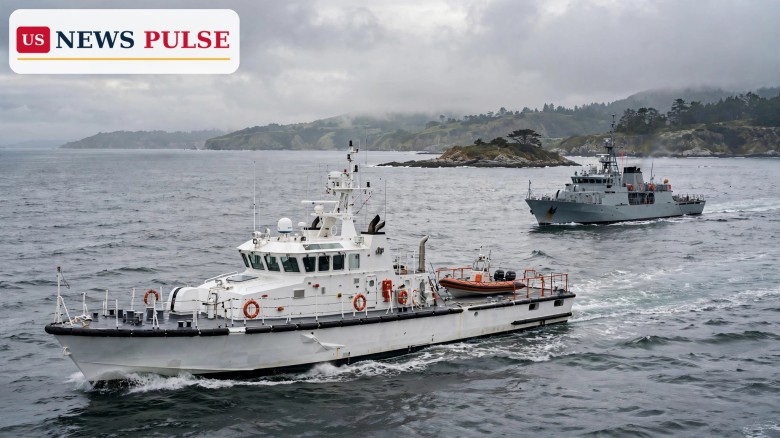
Taiwan accused China of harassing shipping on Saturday, October 31, 2026, after a China Taiwan coast guard patrol operated off Taiwan's east coast and a separate Chinese coast guard ship moved close to the Taiwan-controlled Pratas Islands. Taipei said it sent its own ships to keep watch, and it described radio messages from the Chinese vessels as an attempt to assert a jurisdiction that, in its view, does not exist. Beijing has described the activity as lawful law enforcement in waters it considers its own, a disagreement that sits at the heart of a widening contest over who controls the seas around Taiwan.
Responding late on Saturday to China's announcement of its latest east-coast patrol, Taiwan's Coast Guard said two Chinese ships were involved and that it had sent its own forces to monitor the operation. Chinese state media showed video of one of its ships broadcasting a radio message saying it was carrying out law enforcement and offering help should any be needed. The broadcast did not say who the message was addressed to, and the footage showed an unidentified fishing trawler.
Taiwan's Coast Guard rejected that framing in blunt terms. It said China's "attempts to harass ships at sea through radio communications are a clear expansion of power that violate international law, undermine regional peace and stability, and deviate from reality." It added: "Our country holds sovereign rights and jurisdiction over the exclusive economic zone east of Taiwan, and China has absolutely no jurisdiction over any of Taiwan's waters."
The Pratas encounter, described separately by Taiwan's Coast Guard Administration, began before dawn on Saturday. Vessel 3102 approached Pratas without transmitting identification data, Taipei said, and entered what Taipei calls restricted waters west of the island at about 4 a.m. Taiwan sent the patrol ship Hsun Hu No. 7 to intercept it. The two ships sailed alongside each other during radio exchanges, with the Taiwanese crew ordering the Chinese ship to leave. At one point, the Chinese vessel closed to within one nautical mile of the Taiwanese patrol ship. Chinese personnel said they were conducting a law-enforcement patrol in waters under Beijing's jurisdiction, according to the Taiwanese account.
At the same time, Taiwan's military said it detected 32 People's Liberation Army aircraft, seven naval vessels and two other official ships around the island during the 24 hours ending Sunday morning. Twenty-six of the aircraft crossed the Taiwan Strait's median line and entered sectors of Taiwan's air-defence identification zone, Taipei said. That tally is Taipei's operational account and has not been independently verified, a caution that matters when a single day's numbers are read as a trend.
China views Taiwan as its own territory. Taiwan rejects Beijing's sovereignty claims. That basic disagreement shapes almost every incident at sea: the same patrol is, in Beijing's telling, routine enforcement, and in Taipei's telling, a step toward manufacturing authority through repetition.
China has stepped up activity off Taiwan's east coast since June, with regular coast guard patrols. In a July statement, Beijing said its coast guard had maintained patrols east of Taiwan since June and would keep strengthening enforcement in waters it considers Chinese jurisdiction. Officials in Taiwan say they believe China is practising for a potential maritime blockade using overlapping military, paramilitary and civilian assets. Taipei regards the area off its east coast as critical to wartime supply routes from allies in the event of a blockade or conflict, because the Pacific side of the island, unlike the narrow strait to the west, is the direction from which outside help would most plausibly arrive.
For decades, most attention focused on the Taiwan Strait west of the island. The east coast faces the open Pacific and is central to Taiwan's plans for receiving supplies or outside assistance if western ports and airfields were disrupted. Regular Chinese patrols there therefore challenge an assumption that Taiwan's eastern approaches would remain comparatively accessible during a crisis. In June, Britain, France and Germany raised concern about new Chinese activity east of Taiwan, while Beijing said its operations promoted maritime order.
Pratas, also known as Dongsha, sits more than 400 kilometres southwest of Taiwan, roughly between southern Taiwan and Hong Kong, at the top of the South China Sea. It has no permanent civilian population. Security experts see the islands as vulnerable to Chinese attack because of their distance from Taiwan, which makes reinforcement and resupply more difficult than for positions close to Taiwan's main island. Taiwan said it has so far this year "expelled" Chinese coast guard vessels from Pratas waters 13 times, involving 16 ship movements.
Independent vessel data provide a longer baseline. The Asia Maritime Transparency Initiative found 24 unique Chinese coast guard or maritime-safety vessels operating around Pratas on 94 days from 2021 through 2025. Activity rose from none observed in 2021 to 25 patrol days in 2024 and 60 in 2025, according to its analysis of automatic identification system data, supplemented by Taiwanese government releases. That method has limits: ships can deactivate or manipulate tracking signals, as Taiwan alleges vessel 3102 did on Saturday, so counts based on transmissions may miss activity. Government statements from both Beijing and Taipei also serve competing sovereignty claims, so the strongest conclusion is about direction rather than a precise total: documented Chinese law-enforcement activity near Pratas and east of Taiwan has become more frequent and more routine.
The east-coast patrol matters precisely because it is not presented as a military exercise. Coast guard vessels occupy a deliberate space between civilian policing and naval force. Their presence can be persistent and coercive while giving leaders more room to manage escalation than a deployment led by combat ships. In a blockade scenario, law-enforcement vessels could inspect, divert or warn commercial traffic while naval and air forces remain farther away as deterrent support.
That possibility does not mean the latest patrol was the start of a blockade. No evidence released by either side shows commercial shipping was stopped or physically diverted, and the immediate events produced no reported exchange of fire or collision. Their significance lies instead in the combination: coast guard, naval and air activity near routes Taiwan would need to keep open during a crisis, on widely separated approaches, without a declared blockade or a conventional military exercise.
Radio tactics are part of that pattern. Taiwan said Chinese crews used radio messages that it viewed as harassment; Chinese state media portrayed the broadcast as law enforcement and an offer of assistance. The available record supports a finding of sustained pressure, not a conclusion that conflict is imminent. How commercial mariners respond to radio instructions from Chinese ships will matter: compliance would help Beijing turn patrol claims into practical authority, while routine rejection would limit that effect.
Taiwan's Coast Guard said China's "attempts to harass ships at sea through radio communications are a clear expansion of power that violate international law, undermine regional peace and stability, and deviate from reality." It added: "Our country holds sovereign rights and jurisdiction over the exclusive economic zone east of Taiwan, and China has absolutely no jurisdiction over any of Taiwan's waters."
Chinese state media, by contrast, showed one of its ships broadcasting a radio message that it was carrying out law enforcement and offering help should any be needed. Beijing has previously said its coast guard patrols east of Taiwan, maintained since June, promote maritime order and protect navigation, fishing and Chinese maritime rights. Taiwan rejects Beijing's sovereignty claim and says the patrols are an attempt to manufacture authority by repeatedly performing official functions at sea.
Outside the two governments, the June exchange showed how an operation presented domestically as law enforcement can carry military implications for several countries with interests in the western Pacific. Britain, France and Germany raised concern about new Chinese activity east of Taiwan in June, while Beijing said its operations promoted maritime order and answered Japan-Philippines boundary discussions.
The incident matters for three reasons. First, it tests Taiwan's eastern lifeline. If the Pacific side of the island becomes as contested as the strait, Taiwan's planning for resupply and outside assistance in a crisis becomes far harder, and its forces must spread patrol ships, aircraft and surveillance assets over a much wider area. The cost is cumulative even when each encounter ends without violence.
Second, it tests the line between policing and coercion. Coast guard patrols that never fire a shot can still change behaviour at sea if mariners, insurers or port authorities begin to treat Chinese instructions as rules to be obeyed. Each uneventful encounter that ends with a Chinese vessel having operated where Taipei says it has no jurisdiction adds a precedent that Beijing can cite later.
Third, it tests the region's response. The United States and its allies have a deep interest in open sea lanes around Taiwan, and European governments have already weighed in on the east-coast patrols. A pattern of simultaneous pressure around Pratas, Taiwan's east coast and the surrounding airspace would force those governments to decide, repeatedly and publicly, whether routine patrols deserve a routine response or a firmer one.
The next test is whether China sustains simultaneous pressure around Pratas, Taiwan's east coast and the airspace surrounding the main island. Repeated operations across those areas would force Taiwan to spread its patrol assets thinner and would make each new patrol harder to dismiss as an isolated event. Watch also for the next Taiwanese tally of aircraft crossings and vessel movements, and for whether Taipei reports further close approaches near Pratas.
Equally important will be how commercial mariners respond to radio instructions from Chinese ships, and whether any shipowner, flag state or insurer publicly reports being diverted, delayed or warned. For now, Saturday's encounters show a strategy built around repetition and ambiguity: each operation remains below the threshold of war, while the combined pattern narrows the space Taiwan expects to use in an emergency.
What happened off Taiwan's east coast? Taiwan said two Chinese coast guard ships took part in a patrol off its east coast on Saturday, October 31, 2026, and that it sent its own forces to monitor them. Taipei called Chinese radio messages harassment; Beijing described the activity as law enforcement.
What happened near Pratas Island? Taiwan said Chinese coast guard vessel 3102 entered restricted waters west of Pratas before dawn on Saturday, without transmitting identification data, and closed to within one nautical mile of the Taiwanese patrol ship Hsun Hu No. 7, which ordered it to leave.
Where is Pratas Island? Pratas, also known as Dongsha, is a Taiwan-controlled island group at the top of the South China Sea, more than 400 kilometres southwest of Taiwan and roughly between southern Taiwan and Hong Kong. It has no permanent civilian population.
Was anyone hurt or was shipping stopped? No exchange of fire, collision or confirmed stoppage of commercial shipping was reported in the incidents described by Taipei. The significance, analysts say, lies in the pattern of pressure rather than in a single violent clash.
What should readers watch next? Whether China repeats simultaneous operations around Pratas, the east coast and nearby airspace, what Taiwan's next military tally shows, and how commercial mariners respond to radio instructions from Chinese vessels.
Related coverage on US News Pulse: North Korea tests cluster warhead for tactical missiles, South Korea exports surge 93.7% as AI chip boom delivers record October, and Trump-Xi trade deal cuts China tariffs to 47% after Busan breakthrough.
Leave a Comment



 | Today's Date: